

History
The Rossiysky Kupol Volna Kupol Garant is a Russian ground-based electronic-warfare system developed to interfere with Starlink satellite communications. Instead of primarily jamming user terminals on the ground, the system tracks passing Starlink spacecraft and directs high-power interference toward their uplink receivers in the 14.0-14.5 GHz Ku-band.
Open-source reporting indicates that the system was first observed in Russian service near the Kharkiv sector in 2024. Wider deployment was reported in 2026 as Russian forces sought additional protection for logistics routes, military infrastructure, and other sites exposed to Ukrainian long-range drone operations that relied on satellite communications.
The system became publicly known largely through battlefield losses. Ukrainian units reported several strikes on Volna Kupol Garant deployments during 2026, including attacks in southern occupied territory and a reported destruction at Gelendzhik in Russia's Krasnodar Krai.
Development and emergence
Rossiysky Kupol LLC, also rendered in English-language reporting as Russkiy Kupol or Russian Dome, is identified as the developer and manufacturer. The company is based in Simferopol. The available sources do not provide a prototype date, formal acceptance date, or production-start date, but Kyiv Post and KeepTrack report that the system was already observed near Kharkiv in 2024. That makes 2024 the earliest supported year in which the exact equipment is known to have been physically deployed.
The design responds to the heavy wartime use of Starlink for Ukrainian communications and drone operations. A Militarnyi report described the system as tracking a satellite and transmitting a powerful signal toward it so that the spacecraft has greater difficulty receiving signals from terminals below. A technical overview published by Conflits likewise describes the concept as uplink-side jamming directed at the satellite rather than conventional local interference aimed only at the terminal.
Reporting on the system's price is inconsistent. Militarnyi cited a manufacturer price of about 150 million rubles, while other 2026 reporting cited approximately 100 million rubles or about US$1.5 million. These figures should therefore be treated as open-source estimates rather than a confirmed procurement price.
Combat deployment in 2026
On 15 June 2026, Ukraine's 422nd Regiment of Unmanned Systems and the Security Service of Ukraine's Special Operations Center A reported a strike on a Volna Kupol Garant deployment in the southern theater. Published footage showed six deployed modules or vehicles being attacked by strike drones while reconnaissance drones observed the target. Open-source reporting later described another system as having been destroyed near Kerch in occupied Crimea during late June 2026.
On 7 August 2026, Ukrainian and open-source monitoring reports said another Volna Kupol Garant system was struck at military unit 2156 in Gelendzhik, Krasnodar Krai. The location is associated with the Novorossiysk Border Detachment of Russia's FSB Border Service. Satellite imagery was reported to show the destroyed system. Kyiv Post described this as at least the third reported loss of the type in recent months. Images from the Gelendzhik area on 8 August showed smoke near the same military site, suggesting a possible follow-on strike, but the available material does not establish that a second Volna Kupol Garant system was destroyed there.
Design
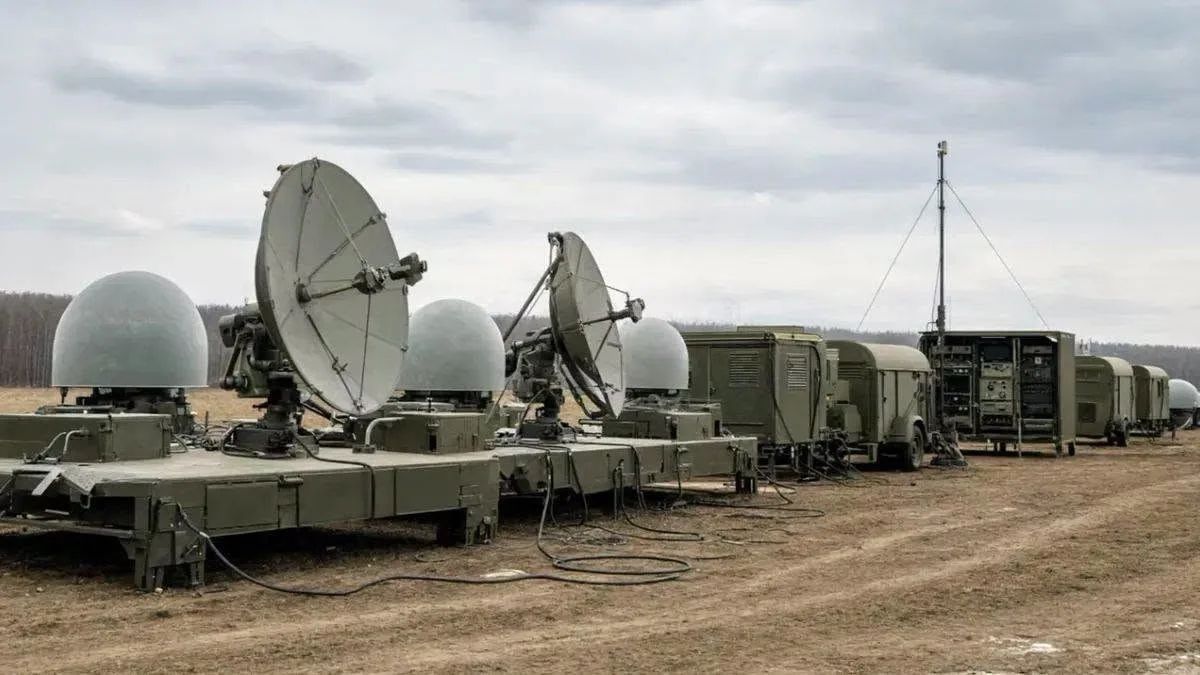
Volna Kupol Garant is a modular, trailer-based electronic-warfare complex built around steerable satellite antennas. Open-source imagery and reporting describe individual trailer modules carrying two dish antennas beneath radio-transparent radomes. One documented deployment consisted of six such modules. A Vietnam.vn overview also describes a multi-trailer arrangement with paired rotating antennas, although public reports differ on the total number of antennas attributed to a complete system.
Jamming method
The system is intended to interfere with the Starlink uplink, the radio path from a user terminal on the ground to a satellite. It operates in the 14.0-14.5 GHz band. Multiple reports describe coverage of eight Starlink uplink channels within this frequency range. The jammer tracks a passing spacecraft and directs concentrated interference toward the satellite receiver so that legitimate terminal transmissions within the protected ground area are harder to receive.
Published descriptions state that one system can disrupt stable Starlink communications over an area of up to about 20 square kilometres. Militarnyi cites a communications-blocking range of up to 16 km, while other reporting characterizes the practical protected area as only several kilometres across. These figures describe different measures and should not be treated as interchangeable: the 16 km value is reported as a maximum jamming range, whereas the 20 km² figure describes an affected ground area.
The system's operating geometry creates limitations. Starlink satellites move rapidly across the sky, so the antennas must continuously track a target and later acquire another spacecraft. KeepTrack reports that a Volna Kupol Garant deployment can engage one satellite at a time. Because many Starlink satellites can be visible from the same area, single-satellite jamming does not by itself deny the entire constellation.
Control and deployment
Militarnyi reports that the system can be operated by one person and supports remote control. Published characteristics also give 360-degree azimuth coverage and an angular coverage of 110 degrees. A reported mass figure of 120 kg appears in several summaries, but the available source material does not clearly define whether this refers to a jammer component, antenna assembly, or another subsystem; it should not be interpreted as the mass of the full six-module deployment.
The powerful emissions required to reach low-Earth-orbit satellites also make the system detectable. Ukrainian reporting states that SpaceX can detect interference in Starlink communication channels and that signals-intelligence assets can locate strong transmissions. The large physical footprint of a multi-trailer deployment further complicates concealment. These characteristics were repeatedly cited in 2026 reporting as factors contributing to the system's vulnerability to drone strikes.
Operational history
Volna Kupol Garant has been reported in Russian use during the Russia-Ukraine War. The earliest supported field observation in the available sources dates to 2024 near the Kharkiv sector. Broader deployment was reported in 2026, particularly in areas where Russia sought to protect logistics and infrastructure from Ukrainian drone attacks supported by satellite communications.
Several Ukrainian units have reported destroying or damaging the system. The 15 June 2026 strike involved the 422nd Regiment of Unmanned Systems and the SBU's Special Operations Center A. Later open-source reporting documented another loss in occupied Crimea and the August 2026 strike at Gelendzhik. Because most public information comes from wartime reporting, precise production totals, the number in service, and the extent of surviving inventory remain unknown.
Operators
- Russia: Reported in operational use by Russian military and security forces during the Russia-Ukraine War. A system destroyed at Gelendzhik in August 2026 was located at military unit 2156, associated with the FSB Border Service's Novorossiysk Border Detachment.
Specifications (Volna Kupol Garant)
General characteristics
- Manufacturer: Rossiysky Kupol LLC, Simferopol
- Type: Ground-based satellite-communications electronic-warfare jammer
- Configuration: Modular trailer deployment with steerable satellite antennas; one documented deployment used six modules with two antennas on each module
- Crew: One operator reported
- Control: Remote-control capability reported
Electronic-warfare characteristics
- Target: Starlink satellite uplink communications
- Operating frequency: 14.0-14.5 GHz Ku-band
- Channel coverage: Eight Starlink uplink channels reported
- Simultaneous satellite targets: One reported
- Affected area: Up to about 20 km² reported
- Maximum communications-blocking range: Up to 16 km reported
- Azimuth coverage: 360 degrees reported
- Angular coverage: 110 degrees reported
Related equipment
- Volna 3M: Another Rossiysky Kupol electronic-warfare system reported to suppress satellite navigation used by unmanned aircraft. Russian forces have fitted the system to Mi-8AMTSh helicopters.
 Argentina
 Armenia
 Australia
 Austria
 Austria-Hungary
 Belgium
 Brazil
 United Kingdom
 United States
 Brunei
 Bulgaria
 Canada
 Chile
Chile China
China Colonial America
 Colombia
 Confederate States
 Croatia
 Czech
Czech Denmark
 Egypt
Egypt Finland
 France
 Georgia
 Germany
 German Imperial
 Greece
 Holland
 Hungary
 India
India Indonesia
 Iran
Iran Iraq
Iraq Ireland
 Israel
 Italy
Italy Japan
Japan Japan (1940)
 Jordan
 Kingdom of Italy
 Malaysia
 Mexico
 Myanmar
 Nazi Germany
 Netherlands
 New Zealand
 North Korea
 Norway
 Pakistan
 Peru
Peru Philippines
 Poland
 Portugal
 Prussia
 Romania
 Saudi Arabia
 Serbia
 Singapore
 Slovakia
 Slovenia
 South Africa
 South Korea
 Soviet Union
 Spain
Spain Sweden
 Switzerland
 Syria
Syria Taiwan
 Thailand
 Turkey
 UAE
UAE Ukraine
 Vietnam
 Yugoslavia