
History
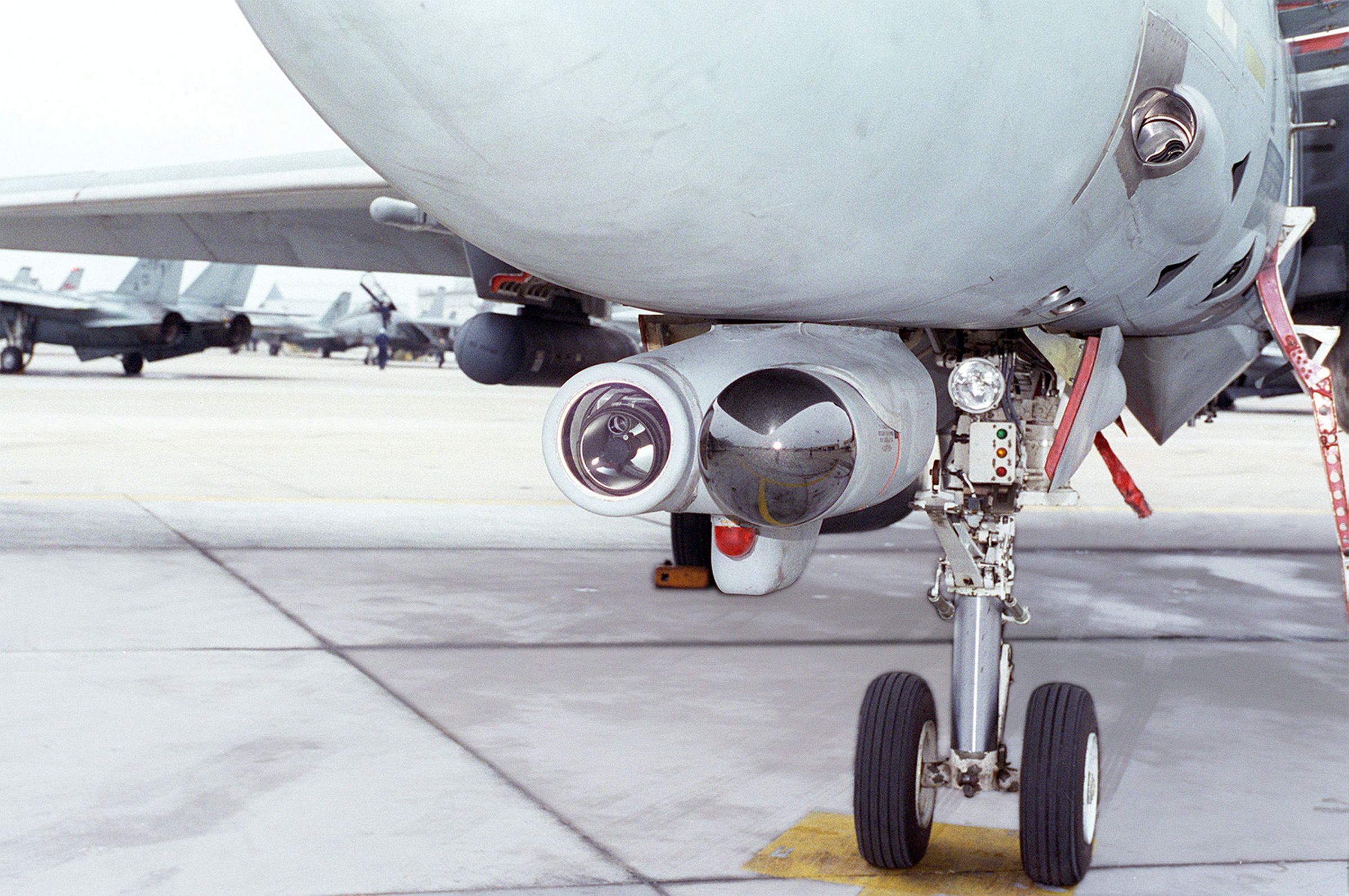
Lockheed Martin IRST21 is a passive long-wave infrared search-and-track sensor developed for long-range detection and tracking of airborne targets. It is the central sensor in the U.S. Navy's F/A-18E/F Infrared Search and Track Block II system.
Unlike radar, IRST21 does not transmit radio-frequency energy for its basic search and tracking function. This allows it to provide target information when radar emissions are undesirable or when electronic attack reduces radar effectiveness. The sensor can operate autonomously or complement other aircraft sensors.
On the F/A-18E/F Super Hornet, IRST21 is installed in the nose section of a modified centerline fuel tank. The Block II configuration incorporates upgraded optics, processing hardware, and software algorithms intended to improve detection, tracking, and targeting performance.
In 2018, Boeing awarded Lockheed Martin a contract for Phase II of the U.S. Navy's F/A-18E/F Super Hornet Block II IRST program. The work covered development, platform integration, flight testing, and qualification of the IRST21 sensor technology for the aircraft.
The U.S. Navy declared IRST Block II initially operational on the F/A-18E/F in February 2025. Later in 2025, Lockheed Martin received a $233 million firm-fixed-price contract to deliver full-rate-production IRST21 Block II systems and initial spares to the U.S. Navy and Air National Guard. Lockheed Martin has stated that it plans to provide 170 IRST21 systems to the U.S. Navy.
In 2026, the U.S. Navy awarded Lockheed Martin a $244.96 million contract modification for Full Rate Production 2 hardware. The order includes 48 infrared receivers, of which 45 are for the U.S. Navy and three for the Royal Australian Air Force, as well as 74 processors and 27 inertial measurement units for the Navy. It also includes test-equipment maintenance and material for future production. Completion is scheduled for February 2031. Pasted text
Design
Sensor and processing
IRST21 is a long-wave infrared search-and-track system that detects heat sources within a large field of regard and develops tracks on airborne targets. Its passive operating principle allows the aircraft to search for and track targets without transmitting the radio-frequency signals associated with radar operation.
The system is intended to provide long-range detection and weapon-quality tracking data. Block II uses advanced optics, processors, and software algorithms to extend detection capability and improve the quality and speed of target information. The resulting tracking and targeting data are intended to support beyond-visual-range air-to-air missile engagements.
Production hardware for the F/A-18E/F IRST Block II configuration includes infrared receivers, processors, and inertial measurement units. The receivers collect infrared data, while the processors support target detection and tracking. The inertial measurement units provide motion-reference information as the carrying aircraft maneuvers.
F/A-18E/F integration
On the F/A-18E/F Super Hornet, IRST21 is mounted in the nose section of a modified centerline fuel tank. The installation preserves an external-tank configuration while providing the aircraft with a passive infrared fire-control sensor. The modified tank carries about 1,290 liters (340 US gal) of fuel, compared with about 1,820 liters (480 US gal) for the centerline tank it replaces.
IRST21 complements the Super Hornet's AN/APG-79 active electronically scanned array fire-control radar. The infrared system can operate independently or alongside other sensors, providing an alternative means of maintaining target tracks in congested or contested electromagnetic environments. The U.S. Navy identifies IRST Block II as a primary out-of-band fire-control capability for passive air-to-air engagement chains.
Podded integration
IRST21's compact design permits alternative installations. Lockheed Martin has also developed the sensor for externally mounted pod configurations. A podded IRST21 system has been associated with the Legion Pod and with integration on aircraft including the F-15 and F-16. Lockheed Martin describes additional podded integration as a development path intended to make the sensor transportable across multiple aircraft platforms.
Operational history
The F/A-18E/F IRST Block II configuration reached U.S. Navy initial operational capability in February 2025 and subsequently entered full-rate production. The sensor gives Super Hornet crews a passive means of detecting and tracking airborne targets when radar use is constrained, including environments affected by electronic attack.
Production expanded through successive orders in 2025 and 2026. The 2025 full-rate-production contract covered systems for the U.S. Navy and Air National Guard, while the 2026 Full Rate Production 2 modification included infrared receivers for both the U.S. Navy and Royal Australian Air Force. The supplied evidence does not establish operational-service status for the Air National Guard or Royal Australian Air Force installations.
Operators
- United States Navy - IRST Block II reached initial operational capability on the F/A-18E/F Super Hornet in February 2025 and entered full-rate production.
Specifications (IRST21 Block II)
General characteristics
- Type: Passive infrared search-and-track sensor system
- Spectral region: Long-wave infrared
- Primary target set: Airborne targets
- Primary functions: Long-range search, detection, tracking, and generation of targeting data
- Operating principle: Passive detection without radio-frequency transmission for basic search and tracking
- F/A-18E/F installation: Nose section of a modified centerline fuel tank
- Modified centerline tank fuel capacity: About 1,290 liters (340 US gal)
- Standard tank capacity replaced: About 1,820 liters (480 US gal)
Capabilities
- Tracking: Autonomous tracking of airborne targets with weapon-quality accuracy
- Fire-control role: Provides tracking and targeting data intended to support beyond-visual-range missile engagements
- Sensor cooperation: Can operate autonomously or in combination with other aircraft sensors
- Radar complement: Designed to complement the F/A-18E/F AN/APG-79 fire-control radar
- Block II improvements: Upgraded optics, processing hardware, and software algorithms for improved detection and tracking performance
 Argentina
 Armenia
 Australia
 Austria
 Austria-Hungary
 Belgium
 Brazil
 United Kingdom
 Brunei
 Bulgaria
 Canada
 Chile
Chile China
China Colonial America
 Colombia
 Confederate States
 Croatia
 Czech
Czech Denmark
 Egypt
Egypt Finland
 France
 Georgia
 Germany
 German Imperial
 Greece
 Holland
 Hungary
 India
India Indonesia
 Iran
Iran Iraq
Iraq Ireland
 Israel
 Italy
Italy Japan
Japan Japan (1940)
 Jordan
 Kingdom of Italy
 Malaysia
 Mexico
 Myanmar
 Nazi Germany
 Netherlands
 New Zealand
 North Korea
 Norway
 Pakistan
 Peru
Peru Philippines
 Poland
 Portugal
 Prussia
 Romania
 Russia
 Saudi Arabia
 Serbia
 Singapore
 Slovakia
 Slovenia
 South Africa
 South Korea
 Soviet Union
 Spain
Spain Sweden
 Switzerland
 Syria
Syria Taiwan
 Thailand
 Turkey
 UAE
UAE Ukraine
 Vietnam
 Yugoslavia