
History
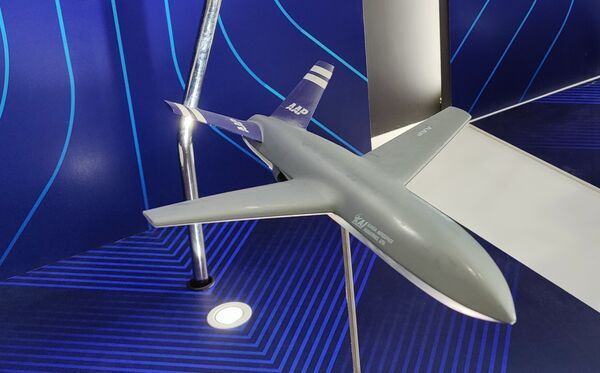
Korea Aerospace Industries (KAI) began developing the Adaptable Aerial Platform (AAP) through company-funded investment in 2024. The jet-powered unmanned aircraft completed its maiden flight in October 2025. KAI subsequently displayed the AAP test bed at Seoul ADEX 2025 and flight-tested it with its internally developed KAiLOT artificial-intelligence pilot system, demonstrating threat avoidance and target engagement capabilities.
On 8 October 2026, KAI conducted the first joint formation flight between the AAP and an FA-50 light attack aircraft over waters south of Goheung in South Jeolla Province. The two aircraft flew for approximately 20 minutes at an altitude of about 7,000 feet (2.1 km), maintaining a separation of 9 to 30 meters while travelling at 360 km/h. KAI announced the achievement on 12 October 2026, describing it as the first time in South Korea that actual flight tests had verified the operational feasibility of manned-unmanned teaming (MUM-T) systems. The demonstration did not yet constitute an operational loyal-wingman capability involving autonomous targeting or weapons employment, but it established a step in the development sequence toward that level.
KAI plans to use the collected data to develop AI-enabled multi-aircraft formation technology and to demonstrate mission control of the AAP directly from the FA-50. The company intends to transfer these technologies into its future unmanned combat aircraft (MUCCA) and a broader collaborative combat-air architecture linking the FA-50, KF-21, and autonomous platforms.
Specifications
The AAP is a 150-kilogram-class high-speed unmanned aircraft powered by a turbojet engine. The platform measures approximately 3.1 meters in length and 2.2 meters in wingspan, with a maximum stated speed of 790 km/h. It incorporates KAI's KAiLOT artificial-intelligence pilot system for autonomous flight, including threat avoidance and target engagement. The platform is intended to operate alongside crewed fighters and other unmanned systems for missions including reconnaissance, electronic jamming, deception, and strike.
 Argentina
 Armenia
 Australia
 Austria
 Austria-Hungary
 Belgium
 Brazil
 United Kingdom
 United States
 Brunei
 Bulgaria
 Canada
 Chile
 China
 Colonial America
 Colombia
 Confederate States
 Croatia
 Czech
 Denmark
 Egypt
 Finland
 France
 Georgia
 Germany
 German Imperial
 Greece
 Holland
 Hungary
 India
 Indonesia
 Iran
 Iraq
 Ireland
 Israel
 Italy
 Japan
 Japan (1940)
 Jordan
 Kingdom of Italy
 Malaysia
 Mexico
 Myanmar
 Nazi Germany
 Netherlands
 New Zealand
 North Korea
 Norway
 Pakistan
 Peru
 Philippines
 Poland
 Portugal
 Prussia
 Romania

 Russia
 Saudi Arabia
 Serbia
 Singapore
 Slovakia
 Slovenia
 South Africa
 Soviet Union
 Spain
 Sweden
 Switzerland
 Syria
 Taiwan
 Thailand
 Turkey
 UAE
 Ukraine
 Vietnam
 Yugoslavia