
History
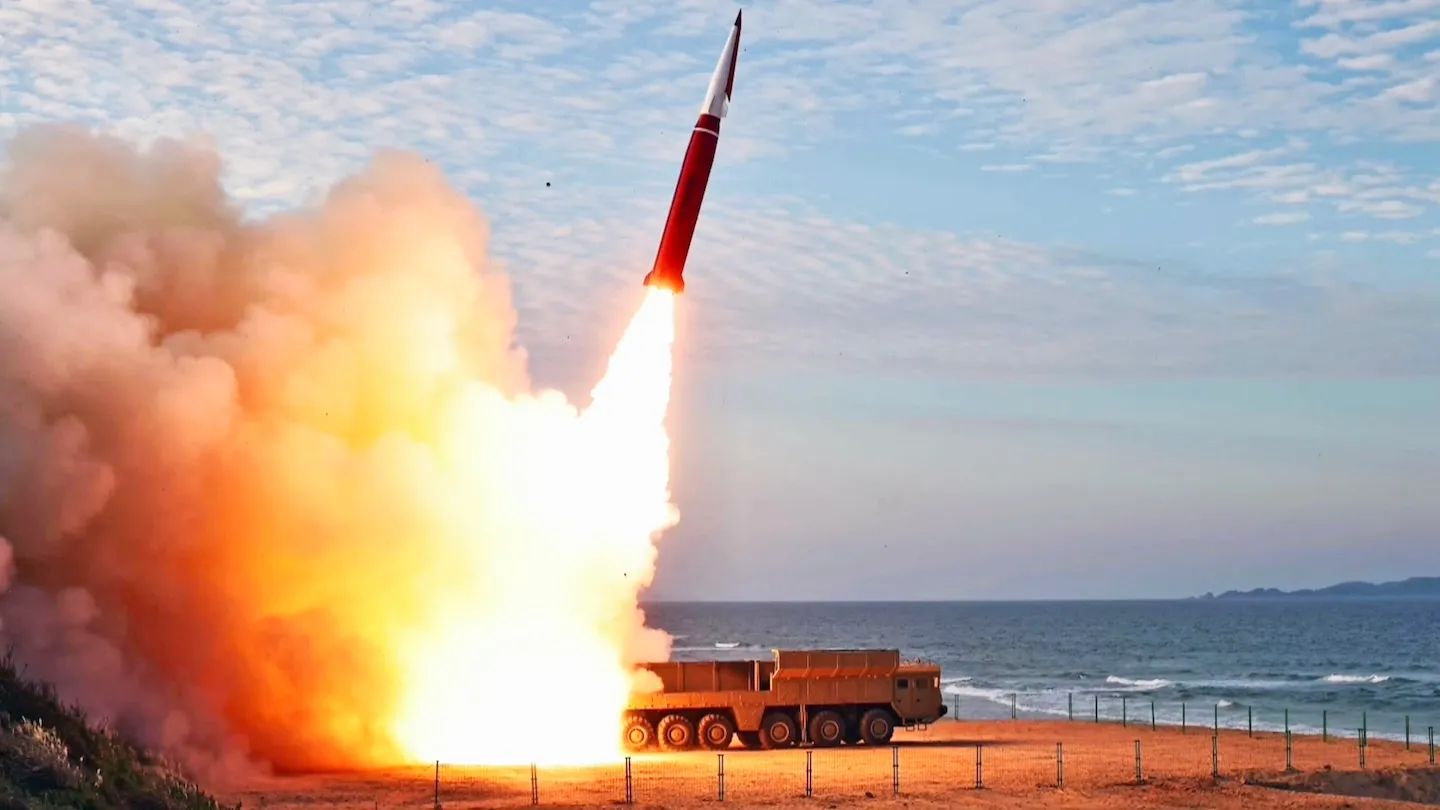
The Hwasong-11Ma is a North Korean road-mobile hypersonic missile design derived from the solid-fuel Hwasong-11 short-range ballistic missile family, which is also known as the KN-23 family. It replaces the conventional warhead arrangement with a wedge-shaped hypersonic glide vehicle intended to maneuver after the boost phase.
The Hwasong-11Ma first appeared publicly as a mock-up at the Defense Development-2025 exhibition in Pyongyang in October 2025. An updated configuration identified as Hwasongpho-11Ma-1, also rendered as Hwasong-11Ma-1 or Hwasong-11E-1, was flight-tested on September 20, 2026.
The program represents an effort to combine a relatively compact solid-fuel short-range missile booster with a maneuvering hypersonic glide vehicle. The September 2026 imagery indicates continued development, but the available evidence does not independently establish the missile's actual range, maneuverability, accuracy, reliability, or operational status.
Development
North Korea had already tested wedge-shaped hypersonic glide vehicle concepts before the Hwasong-11Ma appeared. A wedge-shaped vehicle was associated with the liquid-fuel Hwasong-8 in 2021 and a similar configuration with the solid-fuel Hwasong-16B intermediate-range ballistic missile in 2024. The Hwasong-11Ma applied the concept to the smaller Hwasong-11 short-range missile architecture.
The original Hwasong-11Ma displayed in 2025 was carried on a five-axle transporter-erector-launcher. It was subsequently shown during a military parade. North Korea also announced another hypersonic missile test in 2025, but the available material did not clearly establish that the weapon involved was the Hwasong-11Ma.
On September 20, 2026, South Korean and Japanese authorities detected two missile launches from the Wonsan area on North Korea's east coast. Material released after the event showed a missile designated Hwasongpho-11Ma-1 and a flight-monitoring display bearing the same designation. The first launch occurred at approximately 15:00 local time and the second at approximately 17:50.
The updated missile was shown with a new six-axle transporter-erector-launcher carrying two missiles. The vehicle differed from the five-axle launcher associated with the original Hwasong-11Ma and incorporated modified covers around the missiles. It remains unclear whether this launcher represents the intended standardized field configuration or a vehicle used specifically for development testing.
Design
The Hwasong-11Ma uses the basic architecture of the Hwasong-11 solid-fuel short-range ballistic missile family but substitutes a hypersonic glide vehicle for the conventional payload arrangement. The solid-fuel booster provides the initial acceleration and altitude before the glide vehicle separates or transitions into its unpowered atmospheric flight phase.
Hypersonic glide vehicle
The glide vehicle has a distinctive wedge-shaped aerodynamic form. Material from the September 2026 test showed an initial ballistic climb followed by descent and an apparent pull-up maneuver in which the vehicle regained altitude before continuing toward the target area. Such a profile is consistent with the intended operation of a boost-glide weapon, in which the glide vehicle travels through the atmosphere at hypersonic speed and can alter its trajectory instead of following a purely ballistic path.
The Hwasong-11Ma-1 appears to incorporate changes to the glide vehicle's aerodynamic surfaces compared with the original displayed Hwasong-11Ma. These changes may be associated with efforts to improve gliding or maneuvering performance, although the degree of controlled maneuverability demonstrated during the test has not been independently established.
Launcher
The original Hwasong-11Ma was displayed on a five-axle wheeled transporter-erector-launcher. The Hwasong-11Ma-1 test used a six-axle vehicle carrying two missiles. The later launcher also incorporates modified protective structures around the missiles. Road mobility allows the system to be moved between launch positions and reduces dependence on fixed launch infrastructure.
Flight profile
A monitoring display shown during the September 2026 test depicted a relatively low-altitude trajectory with a descent followed by a pull-up maneuver. This type of flight profile is intended to make the missile's path less predictable than that of a conventional ballistic missile. Sustained controlled flight, navigation accuracy, and terminal maneuvering remain among the most important unresolved aspects of the system's demonstrated performance.
Program status
The September 2026 flight test shows that development progressed beyond the mock-up displayed in 2025. The introduction of the Hwasong-11Ma-1 designation, changes to the glide vehicle, and the appearance of a six-axle launcher indicate an iterative development process.
North Korean imagery presented detailed flight data, but external tracking produced substantially different range and altitude estimates. The discrepancy prevents the displayed figures from being treated as confirmed performance specifications. The available evidence also does not establish that the Hwasong-11Ma or Hwasong-11Ma-1 has entered operational service.
Variants
- Hwasong-11Ma — Original configuration publicly displayed as a mock-up in October 2025. It combines a Hwasong-11-family solid-fuel booster with a wedge-shaped hypersonic glide vehicle and was shown on a five-axle transporter-erector-launcher.
- Hwasong-11Ma-1 — Updated configuration flight-tested on September 20, 2026. It is also identified as Hwasongpho-11Ma-1 and Hwasong-11E-1. The configuration was shown with revised glide-vehicle features and a six-axle launcher carrying two missiles.
Specifications (Hwasong-11Ma-1)
General characteristics
- Type: Road-mobile solid-fuel short-range missile with a hypersonic glide vehicle
- Booster: Solid-fuel booster derived from the Hwasong-11 missile family
- Launcher: Six-axle transporter-erector-launcher carrying two missiles in the September 2026 test configuration
Performance
- Displayed flight distance: Approximately 908-909 km; the figure shown in North Korean test imagery has not been independently verified
- Externally tracked test distances: Approximately 440-450 km for the first September 20 launch and approximately 590-600 km for the second
- Displayed altitude: Approximately 35.8 km; externally reported maximum altitudes for the two launches were approximately 60 km and 70 km
- Displayed velocity: Approximately 2,145 m/s
- Displayed flight time: Approximately 445 seconds
Related equipment
- Hwasong-11 family — Solid-fuel short-range ballistic missile family forming the basis of the Hwasong-11Ma booster architecture.
- Hwasong-8 — Earlier North Korean liquid-fuel missile associated with a wedge-shaped hypersonic glide vehicle tested in 2021.
- Hwasong-16B — Solid-fuel intermediate-range ballistic missile paired with a similar hypersonic glide vehicle configuration in 2024.
 Argentina
 Armenia
 Australia
 Austria
 Austria-Hungary
 Belgium
 Brazil
 United Kingdom
 United States
 Brunei
 Bulgaria
 Canada
 Chile
Chile China
China Colonial America
 Colombia
 Confederate States
 Croatia
 Czech
Czech Denmark
 Egypt
Egypt Finland
 France
 Georgia
 Germany
 German Imperial
 Greece
 Holland
 Hungary
 India
India Indonesia
 Iran
Iran Iraq
Iraq Ireland
 Israel
 Italy
Italy Japan
Japan Japan (1940)
 Jordan
 Kingdom of Italy
 Malaysia
 Mexico
 Myanmar
 Nazi Germany
 Netherlands
 New Zealand
 Norway
 Pakistan
 Peru
Peru Philippines
 Poland
 Portugal
 Prussia
 Romania
 Russia
 Saudi Arabia
 Serbia
 Singapore
 Slovakia
 Slovenia
 South Africa
 South Korea
 Soviet Union
 Spain
Spain Sweden
 Switzerland
 Syria
Syria Taiwan
 Thailand
 Turkey
 UAE
UAE Ukraine
 Vietnam
 Yugoslavia