
History
The Hwaseongpho-11 HGV-equipped variant is a North Korean road-mobile missile configuration combining a Hwaseong-11-family booster with an apparent hypersonic glide vehicle. The system was publicly test-fired on 20 September 2026 and is associated with the designation Hwaseongpho-11Ma-1 visible on test telemetry.
The missile belongs to the broader Hwaseong-11, or KN-23, family of short-range ballistic missiles. Unlike a conventional ballistic payload, the tested configuration appears to use a boost-glide arrangement in which the rocket accelerates a glide vehicle that subsequently follows a comparatively shallow atmospheric trajectory.
The September 2026 test demonstrated a physical Hwaseong-11-family missile carrying the apparent glide vehicle, but publicly available information does not establish that the system has entered operational service. Its exact official designation, production status and operational performance remain unconfirmed.
Development
North Korea had pursued hypersonic glide vehicles before the appearance of the Hwaseongpho-11 configuration. Earlier tests in 2021 and January 2022 involved different glide-vehicle designs, including systems associated with the Hwasong-8 program. Those earlier vehicles should not be treated as the same missile as the Hwaseongpho-11 HGV-equipped variant.
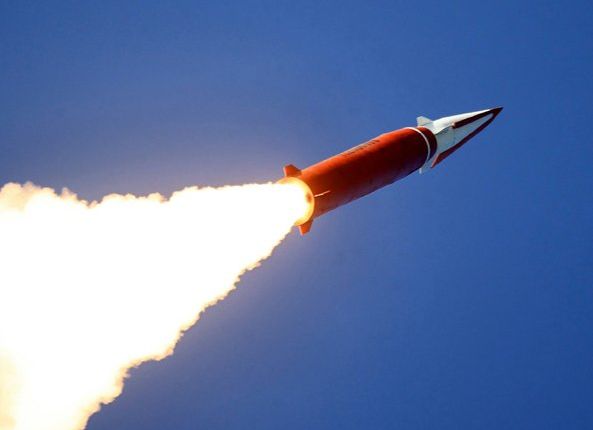
A related Hwaseong-11Ma configuration was publicly displayed in October 2025. Its visible shape differed from a conventional pointed ballistic warhead and incorporated a faceted body with small control surfaces consistent with a lift-generating, maneuvering payload. The later Hwaseongpho-11Ma-1 designation visible during the September 2026 test suggests a subsequent iteration, although the exact changes between the displayed and tested configurations have not been officially specified.
September 2026 test
North Korea's Missile Administration conducted the test on 20 September 2026. Two missile launches detected that day were assessed by South Korea as short-range ballistic missile launches. Imagery from the North Korean test showed a missile launched from a six-axle road-mobile transporter-erector-launcher carrying a single round.
Telemetry visible during the test displayed the designation Hwaseongpho-11Ma-1 and showed the glide vehicle at 2,146 m/s and an altitude of 35.8 km after 446.1 seconds of flight, with a displayed distance of 908.2 km. The trajectory shown on the display was comparatively depressed and consistent with a glide profile rather than a conventional high ballistic arc.
Publicly available flight figures are not fully consistent. South Korean and Japanese tracking information placed the two launches at approximately 440 to 600 km with peak altitudes of about 60 to 70 km, while the North Korean telemetry display showed 908.2 km and 35.8 km at the recorded point in flight. The available data do not establish whether these figures describe the same measurement basis, the complete flight path, or different portions of the test.
Design
The Hwaseongpho-11 HGV-equipped variant appears to use a rocket booster derived from the solid-fuel Hwaseong-11 short-range ballistic missile family. The upper portion carries an aerodynamic glide body rather than a conventional ballistic re-entry vehicle.
Hypersonic glide vehicle
In a boost-glide arrangement, the rocket booster provides the initial acceleration before the glide vehicle travels through the atmosphere using aerodynamic lift. A controllable glide vehicle can potentially change altitude or heading during flight, producing a less predictable trajectory than a conventional ballistic warhead. The September 2026 imagery and displayed flight profile are consistent with this configuration, but the available evidence does not independently establish the vehicle's full maneuvering envelope, accuracy or sustained performance.
Launcher
The missile was launched from a six-axle road-mobile vehicle configured as a single-round transporter-erector-launcher. Road mobility allows the missile and launcher to be moved before launch rather than operating from a fixed firing position.
Dimensions
Measurements inferred from launch imagery place the missile at approximately 9.6 m in length and 1.1 m in diameter, with an estimated mass of about 9.8 tonnes. These values are image-based estimates rather than officially released specifications.
Program status
The Hwaseongpho-11 HGV-equipped variant had reached flight-testing status by September 2026. The available material confirms a physical test vehicle and a launch demonstration but does not establish serial production, deployment, combat use or formal entry into service.
The designation Hwaseongpho-11Ma-1 is visible in test telemetry and is therefore associated with the tested missile, but the exact official naming structure has not been fully disclosed. The relationship between the Hwaseong-11Ma displayed in 2025 and the Hwaseongpho-11Ma-1 tested in 2026 remains only partially defined.
Specifications (Hwaseongpho-11 HGV-equipped variant)
General characteristics
- Type: Road-mobile missile with apparent hypersonic glide vehicle
- Missile family: Hwaseong-11, also known as the KN-23 family
- Approximate length: 9.6 m
- Approximate diameter: 1.1 m
- Estimated mass: 9.8 tonnes
- Launcher: Six-axle single-round transporter-erector-launcher
- Payload configuration: Apparent hypersonic glide vehicle in a boost-glide arrangement
Test data
- Test date: 20 September 2026
- Displayed flight distance: 908.2 km
- Displayed speed: 2,146 m/s
- Displayed altitude: 35.8 km
- Displayed elapsed flight time: 446.1 seconds
- External tracking range: Approximately 440 to 600 km for the two detected launches
- External tracking peak altitude: Approximately 60 to 70 km
Related equipment
- Hwasong-8: Earlier North Korean hypersonic missile program using a different glide-vehicle design.
- January 2022 hypersonic test vehicle: A separate North Korean boost-glide system tested with a maneuvering atmospheric flight profile and a glide vehicle distinct from the Hwasong-8 design.
 Argentina
 Armenia
 Australia
 Austria
 Austria-Hungary
 Belgium
 Brazil
 United Kingdom
 United States
 Brunei
 Bulgaria
 Canada
 Chile
Chile China
China Colonial America
 Colombia
 Confederate States
 Croatia
 Czech
Czech Denmark
 Egypt
Egypt Finland
 France
 Georgia
 Germany
 German Imperial
 Greece
 Holland
 Hungary
 India
India Indonesia
 Iran
Iran Iraq
Iraq Ireland
 Israel
 Italy
Italy Japan
Japan Japan (1940)
 Jordan
 Kingdom of Italy
 Malaysia
 Mexico
 Myanmar
 Nazi Germany
 Netherlands
 New Zealand
 Norway
 Pakistan
 Peru
Peru Philippines
 Poland
 Portugal
 Prussia
 Romania
 Russia
 Saudi Arabia
 Serbia
 Singapore
 Slovakia
 Slovenia
 South Africa
 South Korea
 Soviet Union
 Spain
Spain Sweden
 Switzerland
 Syria
Syria Taiwan
 Thailand
 Turkey
 UAE
UAE Ukraine
 Vietnam
 Yugoslavia