
History
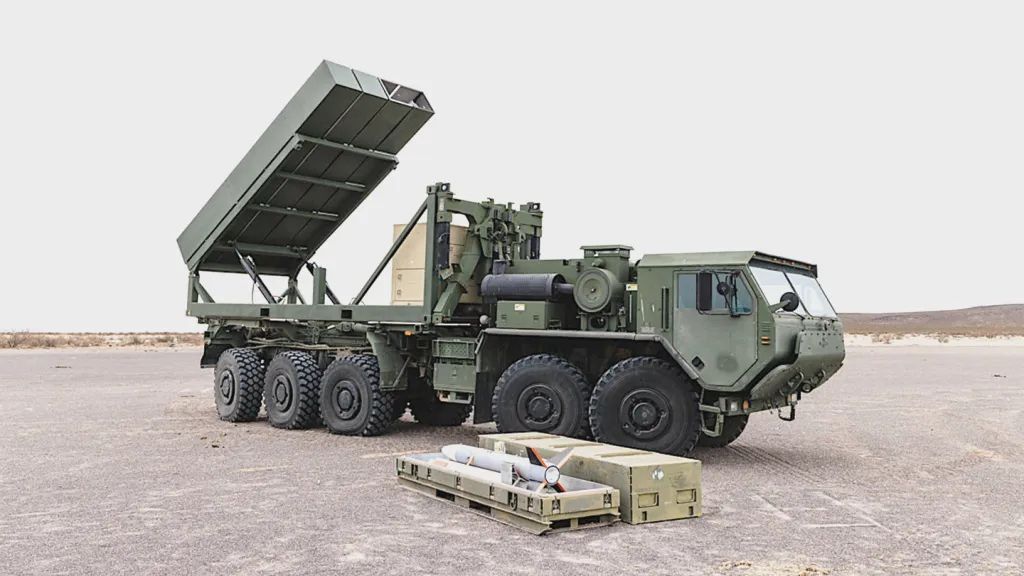
Castelion Blackbeard is a United States hypersonic strike missile developed for lower-cost, high-rate production. The weapon uses a rocket booster to accelerate an unpowered hypersonic glide vehicle before releasing it toward the target.
Blackbeard is being developed for deployment from multiple platforms, including the M142 HIMARS launcher and U.S. Navy carrier aircraft. Castelion has targeted initial fielding for 2027, but the missile remained subject to integration, flight testing, validation, and certification during 2026.
The program is intended to reduce the cost of conventional hypersonic strike weapons sufficiently to permit procurement in much larger quantities. Castelion describes Blackbeard as its first low-cost, mass-producible hypersonic strike missile.
Development and testing
Castelion was founded in 2022 by former SpaceX executives Bryon Hargis, Sean Pitt, and Andrew Kreitz. The company adopted a development approach based on vertical integration, frequent hardware testing, and designing weapons for high-rate manufacturing. According to reporting on the program, the interval from the beginning of Blackbeard development to test flights was about 18 months.
Blackbeard had reached flight testing by 2025. A publicly identified test took place in October 2025. Castelion later stated that the weapon had progressed from a clean-sheet design to a program of record in less than four years. The company continued repeated flight testing and operational integration while constructing dedicated production capacity.
In February 2026, the U.S. Navy awarded Castelion approximately $49.9 million to advance Blackbeard toward an early operational capability. In April, a further award of about $105 million supported integration, testing, and certification of Blackbeard on the F/A-18E/F Super Hornet. The Navy subsequently placed a $23.4 million firm-fixed-price order in June 2026 for 50 pre-production Blackbeard weapons and 50 shipping and storage containers. SpaceNews reported that operational fielding was still dependent on successful integration, flight testing, and certification.
In May 2026, the U.S. Department of Defense announced a production framework with Castelion. The framework contemplated a two-year multi-year procurement contract requiring a minimum production rate of 500 Blackbeard missiles per year after successful testing and validation. The Department was also seeking authorization and appropriations for procurement of more than 12,000 missiles over five years, although those purchases and the associated procurement contract were not yet in place at the time of the announcement.
U.S. Navy budget planning reported in April 2026 outlined a possible procurement of 3,510 Blackbeard missiles through 2031. The proposed sequence comprised 353 missiles in 2027, 691 in 2028, 976 in 2029, 1,115 in 2030, and 1,375 in 2031. These figures represented planning and remained dependent on budget approval. Defense Express reported an initial planned 2027 procurement cost of about $442,000 per missile based on the proposed 353-missile batch.
In August 2026, Castelion announced a Series C financing round combining $800 million in equity financing with a $250 million committed revolving credit facility. The company said the new capital would be used to expand Blackbeard production capacity and continue development of additional strike and defensive systems. Castelion stated that it had secured more than $500 million in U.S. military contracts during the preceding 18 months. Its August 2026 announcement continued to identify 2027 as the target for Blackbeard fielding.
Design
Blackbeard is a boost-glide hypersonic weapon. Its ground-launched configuration has been described as using a rocket booster resembling a ballistic-missile stage with an unpowered hypersonic glide vehicle mounted above it. The booster accelerates the glide vehicle to the required speed and altitude before separation. The glide vehicle then continues toward its target without its own propulsion system.
This architecture differs from an air-breathing hypersonic cruise missile, which uses an engine during sustained atmospheric flight. The Blackbeard concept instead combines rocket-powered acceleration with an unpowered maneuvering glide phase.
Castelion has not publicly released a complete set of Blackbeard dimensions, masses, propulsion details, or performance figures. Reporting has indicated a range slightly below 800 km, while other descriptions compare its planned performance with approximately 80 percent of the capability sought for the Precision Strike Missile Increment 4. These comparisons are not equivalent to an official published specification.
The weapon is intended for more than one launch environment. The ground-launched form is planned for the M142 High Mobility Artillery Rocket System, and the U.S. Army has also shown interest in launch from the future Common Autonomous Multi-Domain Launcher. The U.S. Navy is integrating Blackbeard with the F/A-18E/F Super Hornet. Reporting also identifies the F-35C as a planned carrier-aircraft platform, although the air-launched version may differ from the ground-launched missile.
Affordability and production scale are central design objectives. SpaceNews reported an expected price of approximately $384,000 per missile, while proposed Navy budget figures for the initial 2027 batch implied a higher unit procurement cost of about $442,000. These figures represent estimates or planned procurement costs rather than a demonstrated mature production price.
Program status
As of August 2026, Blackbeard was a flight-tested weapon moving through pre-production, platform integration, validation, and certification. It had not yet reached the planned operational fielding milestone. Castelion and the U.S. military were preparing for substantially higher production rates if testing and validation were completed successfully.
Castelion is expanding its Project Ranger manufacturing campus in Sandoval County, New Mexico. The site covers about 1,000 acres and is intended to provide dedicated high-rate hypersonic missile production capacity. The company said it had already committed more than $250 million in private infrastructure spending there and planned additional investment following its 2026 financing round.
Initial fielding of Blackbeard is targeted for 2027. Procurement planning indicates that the U.S. Navy is expected to be a major customer, while the weapon is also being developed for land-based launch. Large proposed acquisition totals remain dependent on successful testing, validation, certification, contracts, and appropriations.
Variants
- Ground-launched Blackbeard: boost-glide configuration intended for launch from M142 HIMARS and potentially the Common Autonomous Multi-Domain Launcher.
- Air-launched Blackbeard: configuration under integration with the F/A-18E/F Super Hornet. Reporting also identifies the F-35C as a planned platform. Public sources indicate that the air-launched configuration may differ from the ground-launched missile, but detailed specifications have not been released.
Operators
- United States Navy: development and integration customer. The service funded work toward early operational capability, F/A-18E/F integration and certification, and ordered 50 pre-production weapons in June 2026. Operational fielding is targeted for 2027.
- United States Army: interested in the ground-launched configuration for HIMARS and the future Common Autonomous Multi-Domain Launcher. The available sources do not establish operational fielding as of August 2026.
Specifications (Blackbeard ground-launched configuration)
General characteristics
- Type: hypersonic boost-glide strike missile
- Configuration: rocket booster with an unpowered hypersonic glide vehicle
- Launch platform: M142 HIMARS; Common Autonomous Multi-Domain Launcher planned as an additional ground-launch option
- Warhead: approximately 43 kg (95 lb), as reported from U.S. budget-related information; Castelion has not publicly released a complete official specification
Performance
- Speed class: hypersonic, meaning flight above Mach 5
- Range: reported as slightly less than 800 km; no complete official performance specification has been published
 Argentina
 Armenia
 Australia
 Austria
 Austria-Hungary
 Belgium
 Brazil
 United Kingdom
 Brunei
 Bulgaria
 Canada
 Chile
Chile China
China Colonial America
 Colombia
 Confederate States
 Croatia
 Czech
Czech Denmark
 Egypt
Egypt Finland
 France
 Georgia
 Germany
 German Imperial
 Greece
 Holland
 Hungary
 India
India Indonesia
 Iran
Iran Iraq
Iraq Ireland
 Israel
 Italy
Italy Japan
Japan Japan (1940)
 Jordan
 Kingdom of Italy
 Malaysia
 Mexico
 Myanmar
 Nazi Germany
 Netherlands
 New Zealand
 North Korea
 Norway
 Pakistan
 Peru
Peru Philippines
 Poland
 Portugal
 Prussia
 Romania
 Russia
 Saudi Arabia
 Serbia
 Singapore
 Slovakia
 Slovenia
 South Africa
 South Korea
 Soviet Union
 Spain
Spain Sweden
 Switzerland
 Syria
Syria Taiwan
 Thailand
 Turkey
 UAE
UAE Ukraine
 Vietnam
 Yugoslavia