
History
The CoAspire RAACM-ER is a United States-developed, extended-range cruise missile intended to provide a lower-cost standoff weapon for attacks against fixed land targets and moving maritime targets. The missile is being developed for multiple launch methods, including aircraft and surface-based launchers.
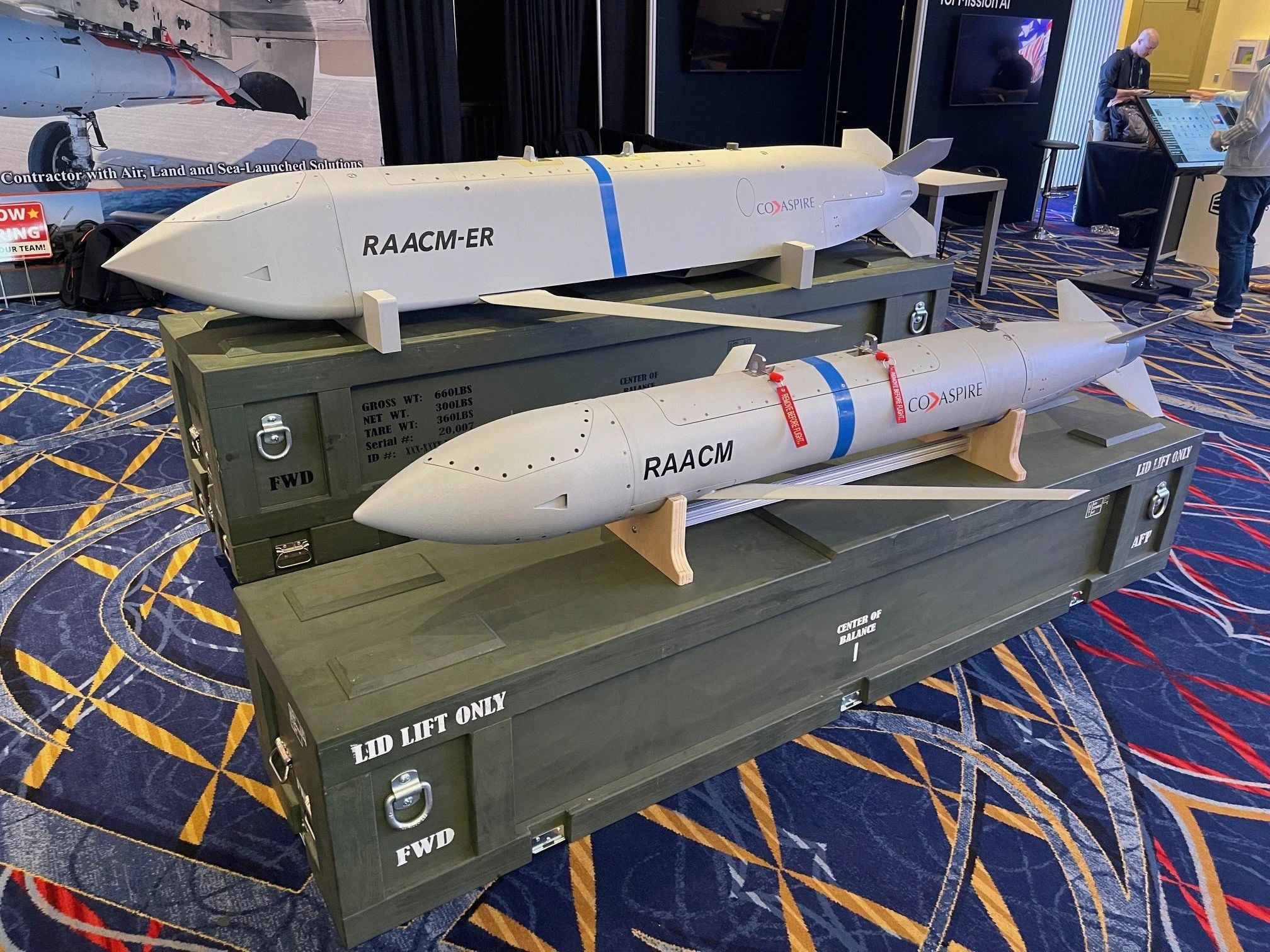
RAACM-ER was publicly unveiled in 2026 as a larger design conceptually derived from CoAspire's earlier Rapidly Adaptable Affordable Cruise Missile, or RAACM. CoAspire states that the two missiles are separate designs rather than simple versions of the same airframe.
In July 2026, the U.S. Navy selected CoAspire for Phases 1 and 2 of the Coalition Heterogenous Affordable Offensive Strike, or CHAOS, prototype effort. The agreement supports development of an affordable ground-launched missile system for security-assistance partners and other allied or coalition customers.
Development
The original RAACM was developed under the U.S. Air Force Extended Range Attack Munition program. CoAspire describes RAACM as an additively manufactured cruise missile designed to reduce tooling, assembly labor, and production cost. The company also emphasizes modular construction and the use of commercially available components. Information on the original missile is available from the CoAspire RAACM page.
RAACM-ER emerged as a substantially larger design intended to carry more fuel and accommodate the sensors and survivability features required for longer-range missions. CoAspire founder Doug Denneny said the larger missile was shaped around fuel volume, survivability, internal equipment, and aerodynamic requirements rather than simply reproducing the geometry of RAACM.
The air-launched RAACM-ER configuration was displayed at the Navy League Sea-Air-Space exhibition in April 2026. CoAspire also described ground- and ship-launched applications. Surface launch requires an additional rocket booster attached to the rear of the missile. The booster provides the initial acceleration and separates after launch.
CHAOS program
In July 2026, CoAspire received a $70 million prototype Other Transaction agreement associated with the U.S. Navy's CHAOS program. Under the effort, CoAspire is to design, build, test, and deliver an affordable ground-launched, mid-range cruise missile capable of engaging land targets and moving maritime targets. The intended Foreign Military Sales customers are allied and coalition partners.
The U.S. Navy subsequently stated that the agreement covered Phases 1 and 2 of the CHAOS prototype effort and represented a direct investment in the emerging low-cost cruise missile market. The Navy also said it had requested fiscal year 2027 funding to begin integration of the low-cost maritime strike capability on Navy platforms. The Navy expected at least one additional industry agreement under the competitive CHAOS strategy. Contemporary details of the award were reported by TWZ.
The CHAOS effort is part of a broader U.S. military push toward weapons that can be manufactured in larger quantities and at lower cost than traditional high-end cruise missiles. Related programs include the Air Force Family of Affordable Mass Missiles effort and the Army Low-Cost Containerized Missiles program.
Design
RAACM-ER is a turbojet-powered cruise missile with a broad, trapezoidal body. Its external form differs from the smaller RAACM and was developed to increase internal fuel volume and accommodate mission equipment. CoAspire has not released complete dimensions, launch weight, warhead weight, or other detailed physical specifications.
Guidance
The missile uses GPS-assisted navigation together with a long-wave infrared seeker mounted in the nose. This combination is intended to support attacks against predetermined fixed coordinates and moving targets. The passive infrared terminal seeker does not transmit radiofrequency energy during target acquisition, reducing dependence on active radar guidance and avoiding emissions from the seeker itself.
Propulsion and launch
RAACM-ER uses a turbojet engine for sustained cruise flight. CoAspire has described air-, ground-, and ship-launched configurations. Surface-launched missiles require a detachable rocket booster for initial acceleration before the turbojet-powered cruise phase.
Manufacturing approach
Affordability and scalable production are central objectives of the RAACM family. CoAspire has emphasized additive manufacturing, reduced tooling requirements, commercially available components, and modular construction. The company states that additive manufacturing can simplify modifications and reduce the need to interrupt a production line for extensive retooling.
Program status
As of July 2026, RAACM-ER remained a development and prototype program rather than an operational missile in established service. The CHAOS agreement calls for CoAspire to design, build, test, and deliver the ground-launched system. No confirmed production quantity, operational unit price, service-entry date, or deployed operator has been announced in the supplied sources.
The missile's exact range also remains undisclosed by CoAspire. TWZ reported that comments made by Doug Denneny could imply approximately 900 km, or about 485 nautical miles, based on comparison with the earlier RAACM. Other secondary reporting has claimed a range exceeding 1,800 km. CoAspire told TWZ that it had not discussed specific range capabilities and that estimates should be regarded as speculation. The conflicting public estimates therefore should not be treated as confirmed performance specifications.
Variants
- RAACM-ER air-launched configuration: Configuration publicly displayed in 2026 and intended for carriage by aircraft.
- RAACM-ER surface-launched configuration: Ground- or ship-launched arrangement using a detachable rocket booster for initial acceleration.
- GHOST: A separate surface-launched development based on the RAACM-ER design for the U.S. military's Low-Cost Containerized Missiles program.
Specifications (RAACM-ER)
General characteristics
- Type: Extended-range cruise missile.
- Manufacturer: CoAspire.
- Country of development: United States.
- Launch methods: Air launch; planned or developmental ground and ship launch.
Performance
- Propulsion: Turbojet engine; surface-launched configurations use an additional detachable rocket booster.
- Range: Not officially disclosed by CoAspire. Published estimates in secondary sources differ substantially and remain unconfirmed.
Guidance
- Navigation: GPS-assisted navigation.
- Terminal seeker: Long-wave infrared seeker.
- Target types: Fixed land targets and moving maritime targets.
Related equipment
- RAACM: Earlier, smaller CoAspire cruise missile developed under the Extended Range Attack Munition program. RAACM-ER evolved conceptually from this project but is described by CoAspire as a different missile.
- GHOST: Surface-launched missile development derived from RAACM-ER for the Low-Cost Containerized Missiles program.
 Argentina
 Armenia
 Australia
 Austria
 Austria-Hungary
 Belgium
 Brazil
 United Kingdom
 Brunei
 Bulgaria
 Canada
 Chile
Chile China
China Colonial America
 Colombia
 Confederate States
 Croatia
 Czech
Czech Denmark
 Egypt
Egypt Finland
 France
 Georgia
 Germany
 German Imperial
 Greece
 Holland
 Hungary
 India
India Indonesia
 Iran
Iran Iraq
Iraq Ireland
 Israel
 Italy
Italy Japan
Japan Japan (1940)
 Jordan
 Kingdom of Italy
 Malaysia
 Mexico
 Myanmar
 Nazi Germany
 Netherlands
 New Zealand
 North Korea
 Norway
 Pakistan
 Peru
Peru Philippines
 Poland
 Portugal
 Prussia
 Romania
 Russia
 Saudi Arabia
 Serbia
 Singapore
 Slovakia
 Slovenia
 South Africa
 South Korea
 Soviet Union
 Spain
Spain Sweden
 Switzerland
 Syria
Syria Taiwan
 Thailand
 Turkey
 UAE
UAE Ukraine
 Vietnam
 Yugoslavia