
History
The Affordable High-Speed Strike (AHSS) is a planned U.S. Army ground-launched missile intended to provide lower-cost, responsive strikes at ranges beyond 1,000 km (621 mi). The Army is pursuing the weapon for theater-level targets including air bases, air-defense nodes, missile launchers, and other high-value targets.
AHSS remains in an early development stage, and the Army has not selected a final missile configuration. Public concepts include both a conventional rocket-propelled ballistic missile-like design and an air-breathing design, while compatibility with mobile Army launch platforms is a central requirement.
The program is distinct from the Precision Strike Missile (PrSM) effort, although both address long-range precision fires. AHSS emphasizes affordability, high speed, mobile deployment, and a range exceeding 1,000 km.
Development
The U.S. Army's Combat Capabilities Development Command Aviation & Missile Center, or DEVCOM AvMC, is leading work associated with AHSS. According to Aviation Week, the Army released a request for industry white papers in May 2026 and began evaluating competing proposals. A DEVCOM spokesperson described AHSS as an entirely new missile rather than another PrSM increment.
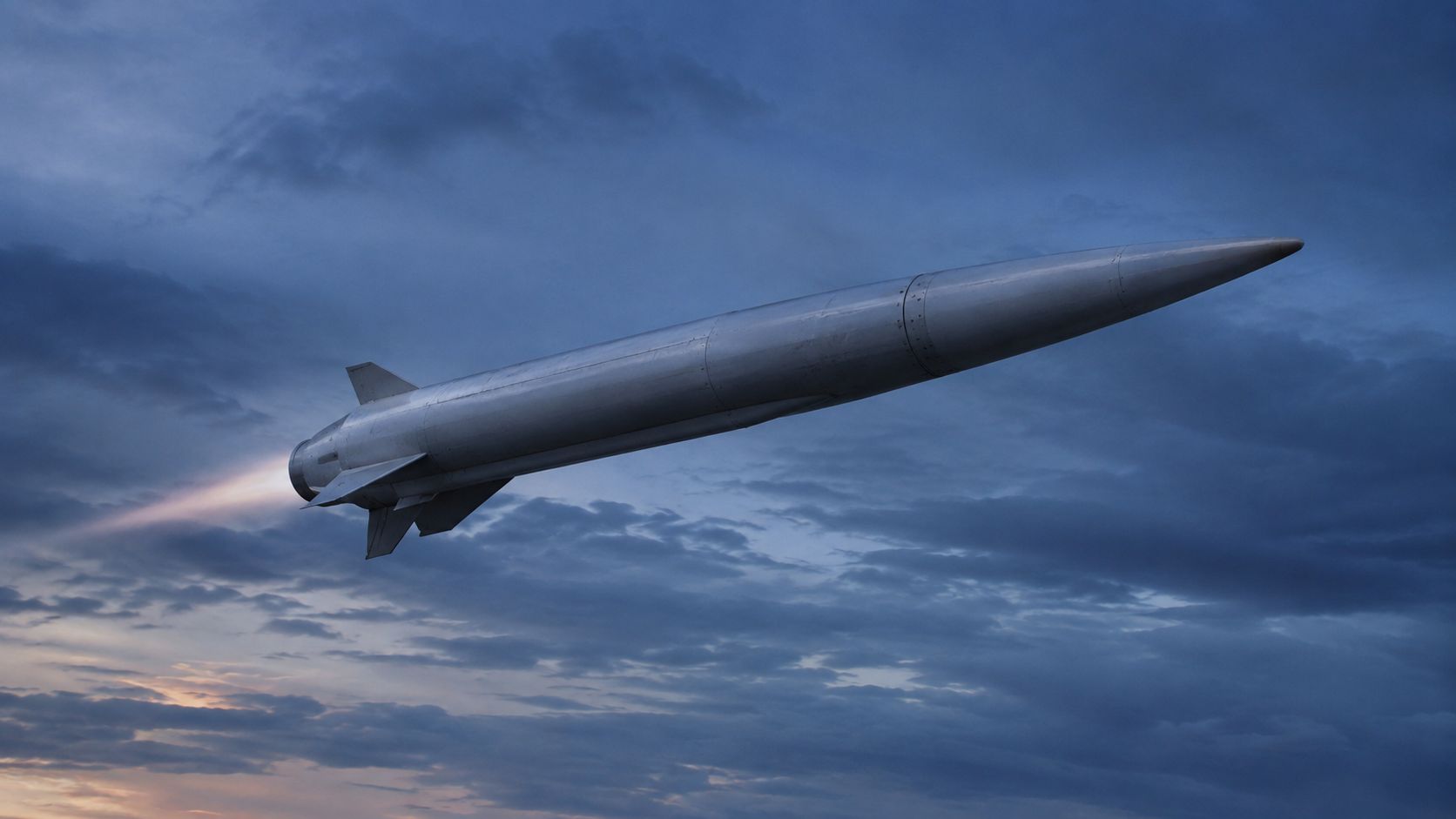
At the 2026 Space and Missile Defense Symposium in Huntsville, Alabama, DEVCOM displayed two notional AHSS configurations. One represented a conventional rocket-powered missile with a ballistic-missile-style body and cruciform tail fins. The other showed an air-breathing configuration with a nose intake and a substantially different tail arrangement. The concepts illustrate that the Army had not committed to a particular propulsion architecture.
The Army's fiscal year 2027 budget material describes AHSS as a technology-development effort supporting Precision Fires. Planned work covers affordable advanced propulsion, warhead technologies, guidance, navigation and control, and integration with Army mobile launch platforms. The Army requested just over $94.2 million for AHSS work in fiscal 2027, while Aviation Week reported approximately $246 million programmed for the effort across fiscal years 2027-2031. Fiscal 2027 therefore marks the earliest explicitly supported planned development and technology-demonstration period available for this still-preconceptual weapon, rather than an operational service-entry date.
Australia has been identified as an international participant in the AHSS effort. The available material does not establish an Australian operational requirement or identify Australia as an operator of the future missile.
Requirement
The Army describes the required weapon as an affordable, responsive high-speed strike system for theater-level targets. Its missions include conventional deep strike and offensive counter-air, meaning attacks on enemy aircraft, missiles, launch platforms, and their supporting systems at or near their source.
Range is one of the clearest requirements. Reporting from TWZ describes a weapon able to reach more than 1,000 km, while Aviation Week reports that the Army wants AHSS to exceed the 1,000-km-plus reach sought for PrSM Increment 4.
Affordability is also central to the program. The Army is seeking a weapon that can provide long-range precision effects while being more readily procured than higher-cost long-range missiles. No AHSS unit price or production objective has been publicly established in the supplied material.
Design
AHSS does not yet have a finalized design. DEVCOM's publicly displayed concepts indicate that the Army is allowing industry to propose different technical solutions rather than prescribing a single propulsion system or aerodynamic configuration.
Propulsion and configuration
One notional configuration resembles a conventional ballistic missile, with a rocket-powered body and cruciform fins at the rear. A second concept uses an air-breathing propulsion arrangement with an intake at the nose. Its external form also includes a different tail layout and a long stabilizing strake along the body.
The air-breathing concept's intake resembles arrangements associated with high-speed ramjet or scramjet propulsion, but the available evidence does not establish that the final AHSS will use either type. The Army has specifically left the propulsion solution open to competing proposals.
Guidance and warhead
The Army's budget description identifies guidance, navigation and control technologies and a complementary warhead among the areas to be developed and demonstrated. No specific seeker, navigation architecture, warhead type, warhead mass, accuracy figure, or terminal guidance method has been disclosed for AHSS.
Launch platforms
The AHSS concept includes an option for launch from the crewed M142 High Mobility Artillery Rocket System (HIMARS). HIMARS uses standardized ammunition pods, allowing it to employ different missile and rocket types from the same mobile launcher architecture.
The Army is also developing the Common Autonomous Multi-Domain Launcher family of uncrewed vehicles. AHSS is intended for integration with mobile, deployable and survivable Army launch platforms, and autonomous launchers could expand the number of firing vehicles while reducing the need to expose crews at forward positions.
Because the M270 Multiple Launch Rocket System uses ammunition-pod architecture related to HIMARS, compatibility has been suggested as technically plausible in reporting, but the supplied evidence does not confirm M270 as an AHSS launch platform.
Program status
As of August 2026, AHSS is an active U.S. Army development and competition effort rather than an operational missile. The Army is evaluating industry concepts and has not announced a selected contractor, final configuration, prototype, flight-test milestone, production contract, or service-entry date.
The program emerged as the Army expanded its long-range ground-strike portfolio following the end of the Intermediate-Range Nuclear Forces Treaty restrictions in 2019. The Army's fiscal 2027 budget material specifically notes that development is no longer constrained by the previous treaty framework governing ground-launched missiles in the 500-5,500 km range class.
If the final AHSS is a ballistic missile with a maximum range beyond 1,000 km, it could fall within the medium-range ballistic missile category. However, that classification cannot yet be assigned to AHSS as a whole because the Army is also considering air-breathing concepts.
Specifications (proposed AHSS concept)
General characteristics
- Type: Planned ground-launched high-speed precision strike missile
- Development authority: U.S. Army DEVCOM Aviation & Missile Center
- Development status: Competitive concept and technology-development phase as of 2026
- Propulsion: Not selected; conventional rocket propulsion and air-breathing propulsion are among the publicly shown concepts
- Launch platforms: M142 HIMARS option and planned integration with Army mobile launch platforms, including autonomous concepts
Performance
- Maximum firing range: More than 1,000 km (621 mi) sought
- Speed: High-speed capability required; exact velocity not disclosed
Armament and targeting
- Warhead: Undisclosed; warhead technology is part of the development effort
- Guidance: Undisclosed; guidance, navigation and control technologies are part of the development effort
- Intended targets: Theater-level targets including air bases, air-defense nodes, missile launchers, aircraft-supporting infrastructure, and other high-value targets
- Mission: Long-range precision strike and offensive counter-air
Related equipment
- Precision Strike Missile (PrSM): A separate U.S. Army missile family. Increment 4 is intended to extend PrSM range to at least about 1,000 km, while AHSS is described by DEVCOM as a distinct program.
- M142 HIMARS: Existing wheeled Army launcher identified as a potential crewed launch platform for AHSS.
- Common Autonomous Multi-Domain Launcher: Planned family of uncrewed Army launch vehicles that could support future long-range weapons such as AHSS.
 Argentina
 Armenia
 Australia
 Austria
 Austria-Hungary
 Belgium
 Brazil
 United Kingdom
 Brunei
 Bulgaria
 Canada
 Chile
Chile China
China Colonial America
 Colombia
 Confederate States
 Croatia
 Czech
Czech Denmark
 Egypt
Egypt Finland
 France
 Georgia
 Germany
 German Imperial
 Greece
 Holland
 Hungary
 India
India Indonesia
 Iran
Iran Iraq
Iraq Ireland
 Israel
 Italy
Italy Japan
Japan Japan (1940)
 Jordan
 Kingdom of Italy
 Malaysia
 Mexico
 Myanmar
 Nazi Germany
 Netherlands
 New Zealand
 North Korea
 Norway
 Pakistan
 Peru
Peru Philippines
 Poland
 Portugal
 Prussia
 Romania
 Russia
 Saudi Arabia
 Serbia
 Singapore
 Slovakia
 Slovenia
 South Africa
 South Korea
 Soviet Union
 Spain
Spain Sweden
 Switzerland
 Syria
Syria Taiwan
 Thailand
 Turkey
 UAE
UAE Ukraine
 Vietnam
 Yugoslavia