

History
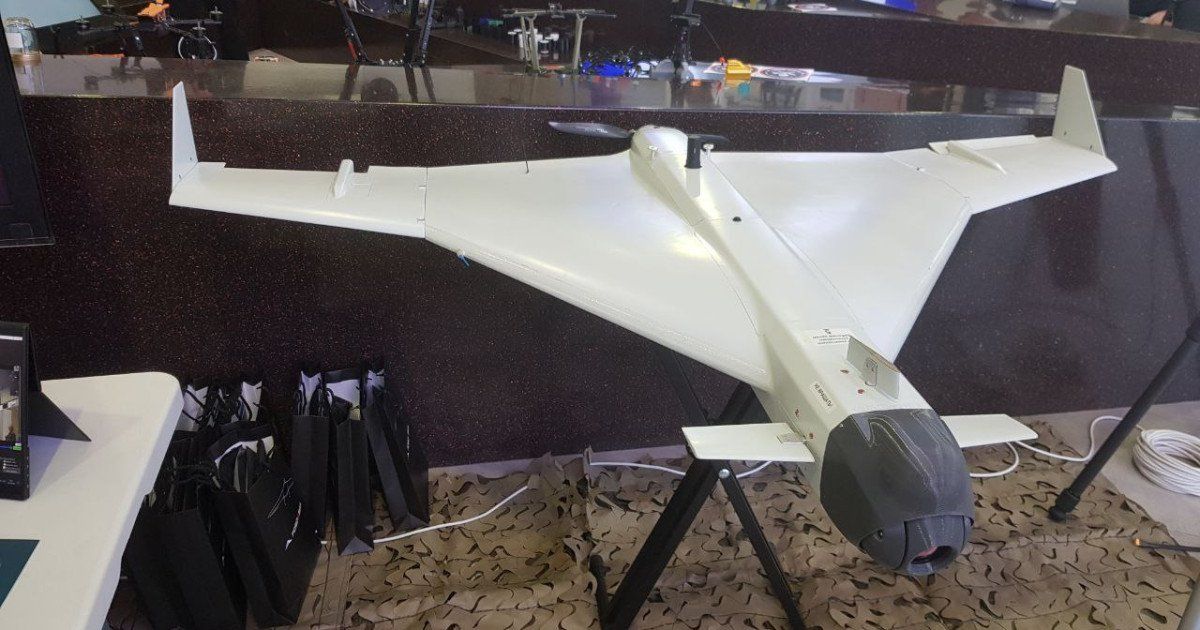
The Klyn was officially presented by Roboavia at a Russian exhibition in October 2025, where the manufacturer described the UAV as equipped with artificial intelligence for target detection. On 16 October 2026, Ukrainian forces struck Roboavia's production and storage facility near Khutor Lenina, Rostov Oblast, damaging the enterprise's infrastructure. A Klyn was subsequently shot down by Ukrainian forces, and the Main Intelligence Directorate of Ukraine published an interactive 3D model of the wreckage along with a detailed analysis of its foreign-made components.
Design
The Klyn uses a flying-wing (delta) configuration with developed forward control surfaces in both horizontal and vertical planes. This arrangement improves aerodynamic stability at high angles of attack and increases maneuverability. Before diving at a target, the drone can execute a hump maneuver to reach its maximum ceiling, then dive at angles up to 70 degrees, a profile that the manufacturer states helps the aircraft evade air-defense detection. The forward control surfaces allow the drone to adjust its approach course at different angles of attack and speeds. When combined with the "Vector" pneumatic catapult launcher, the system can be deployed without a runway. Control channels and video feed are relayed to the operator's ground control station via the Sarych reconnaissance UAV.
AI algorithms handle automatic target detection, recognition, tracking, and flight-path adjustment according to wind and terrain conditions. Machine vision is implemented on an NVIDIA Jetson TX2 computer module (USA). The flight controller is a Cube Orange (Australia); navigation uses a Holybro F9P module (China) with RTK mode for improved accuracy; and data link communication is provided by a LoRa modem built around the Ra-01H radio module from Ai-Thinker (China). Power is supplied by a Scorpion F-4225-500KV V2 brushless electric motor (China) driven by two 6S Li-AFB battery packs. Ukrainian intelligence identified additional components in the drone's electronics originating from American, Swiss, Taiwanese, and South Korean manufacturers.
The Klyn offers three targeting modes. The daylight optical seeker uses an optical head operating in the visible spectrum, with AI responsible for target recognition, automatic tracking, and terminal guidance. The thermal-imaging seeker employs an infrared camera to detect targets in low-visibility conditions such as smoke, fog, or darkness, with AI managing automatic tracking. The pre-programmed coordinate mode operates without an optical seeker, engaging targets based on preset GPS or GLONASS coordinates, which provides greater resilience to electronic-warfare interference. If satellite navigation is lost, the drone can continue its mission using image-based terrain correlation. Roboavia also declares the existence of naval and land modifications of the Klyn; in the naval variant, remote detonation is reportedly implemented by radar, while in the land variant it uses lidar.
Specifications
- Role: Loitering munition for engagement of stationary and moving ground targets
- Takeoff weight: 13.5 kg
- Warhead mass: 5 kg (cumulative-fragmentation or high-explosive)
- Fuselage length: 1.6 m
- Wingspan: 1.9 m
- Cruise speed: 108 km/h
- Maximum dive speed: up to 300 km/h (declared)
- Maximum altitude: 2,000 m
- Endurance: over 80 minutes
- Operating radius: up to 120 km (with relay)
Operational history
A Klyn was shot down by a Ukrainian interceptor UAV identified as General Cherry AIR. Ukrainian military advisor Serhiy Beskrestnov (call sign Flash) subsequently displayed the wreckage's components. Russian military sources claim the Klyn has proved effective in detecting and destroying Ukrainian vehicles and Magura V5/7 high-speed suicide boats, though independent verification of these claims has not been published.
 Argentina
 Armenia
 Australia
 Austria
 Austria-Hungary
 Belgium
 Brazil
 United Kingdom
 United States
 Brunei
 Bulgaria
 Canada
 Chile
 China
 Colonial America
 Colombia
 Confederate States
 Croatia
 Czech
 Denmark
 Egypt
 Finland
 France
 Georgia
 Germany
 German Imperial
 Greece
 Holland
 Hungary
 India
 Indonesia
 Iran
 Iraq
 Ireland
 Israel
 Italy
 Japan
 Japan (1940)
 Jordan
 Kingdom of Italy
 Malaysia
 Mexico
 Myanmar
 Nazi Germany
 Netherlands
 New Zealand
 North Korea
 Norway
 Pakistan
 Peru
 Philippines
 Poland
 Portugal
 Prussia
 Romania
 Saudi Arabia
 Serbia
 Singapore
 Slovakia
 Slovenia
 South Africa
 South Korea
 Soviet Union
 Spain
 Sweden
 Switzerland
 Syria
 Taiwan
 Thailand
 Turkey
 UAE
 Ukraine
 Vietnam
 Yugoslavia