
History
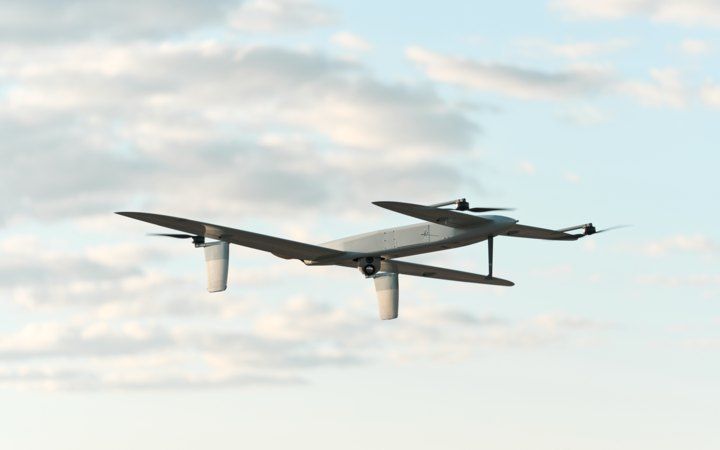
Mercury (БпАК Mercury) is a Ukrainian reconnaissance unmanned aerial vehicle system developed by Aviation New Technologies (ANT) in collaboration with military operators. Designed for tactical reconnaissance, target detection, and fire correction under conditions of active electronic warfare (EW), the system uses a vertical take-off and landing configuration that requires no catapult or runway. ANT, a collective of IT, aviation, and defense specialists, began developing UAVs in 2014 and moved to serial production after the 2022 full-scale invasion.
ANT presented Mercury in June 2025, with declared flight range of up to 200 km and flight duration of up to 3 hours. The complex subsequently underwent combat testing in border areas in cooperation with units of the Unmanned Systems Forces of the Armed Forces of Ukraine, the Defence Intelligence of Ukraine, and Operational Command North. It was codified by the Ministry of Defence of Ukraine, assigned a NATO Stock Number, and listed in the Armed Forces supply catalog. In September 2025, the system was displayed at the Defense Tech Valley exhibition; the complete set of two drones, a ground control station, and a communication antenna is designed for deployment by two operators within 15 minutes.
In April 2026, Mercury was fitted with a new high-sensitivity optical system combining a daylight camera and a thermal imager for day and night reconnaissance.
ANT has since presented an updated version of Mercury with increased range, extended airborne endurance, and improved resistance to electronic warfare.
Specifications
The following specifications describe the updated version of Mercury; previous-version values are noted in parentheses where applicable.
- Configuration: VTOL fixed-wing; launch and recovery site approximately 5×5 m
- Working altitude: 4,000 m (previous: 3,000 m)
- Flight duration: 4 hours (previous: 2.5 hours); up to 5 hours during practical operation
- Maximum distance: 250 km (previous: 170 km); up to 300 km in practical conditions per the developer
- Maximum speed: 126 km/h
- Cruise speed: 90 km/h
- Flight weight: 19 kg (previous: 13 kg)
- Communication channels: primary at 5.8 GHz; backup at 433 MHz using pseudo-random frequency hopping to complicate suppression by EW means
- Navigation: GPS and GLONASS satellite navigation; inertial navigation without satellite signal; radio beacon navigation
- Autonomous capabilities: automatic route flight; radio silence mode; automatic return to launch point
- Optical system (April 2026): daylight camera up to 210× zoom; thermal imager 1280×1024 pixels with 4× zoom; vehicle detection up to 20 km, personnel up to 15 km (per developer); 360° horizontal and up to 110° vertical field of view
 Argentina
 Armenia
 Australia
 Austria
 Austria-Hungary
 Belgium
 Brazil
 United Kingdom
 United States
 Brunei
 Bulgaria
 Canada
 Chile
 China
 Colonial America
 Colombia
 Confederate States
 Croatia
 Czech
 Denmark
 Egypt
 Finland
 France
 Georgia
 Germany
 German Imperial
 Greece
 Holland
 Hungary
 India
 Indonesia
 Iran
 Iraq
 Ireland
 Israel
 Italy
 Japan
 Japan (1940)
 Jordan
 Kingdom of Italy
 Malaysia
 Mexico
 Myanmar
 Nazi Germany
 Netherlands
 New Zealand
 North Korea
 Norway
 Pakistan
 Peru
 Philippines
 Poland
 Portugal
 Prussia
 Romania

 Russia
 Saudi Arabia
 Serbia
 Singapore
 Slovakia
 Slovenia
 South Africa
 South Korea
 Soviet Union
 Spain
 Sweden
 Switzerland
 Syria
 Taiwan
 Thailand
 Turkey
 UAE
 Vietnam
 Yugoslavia