
History
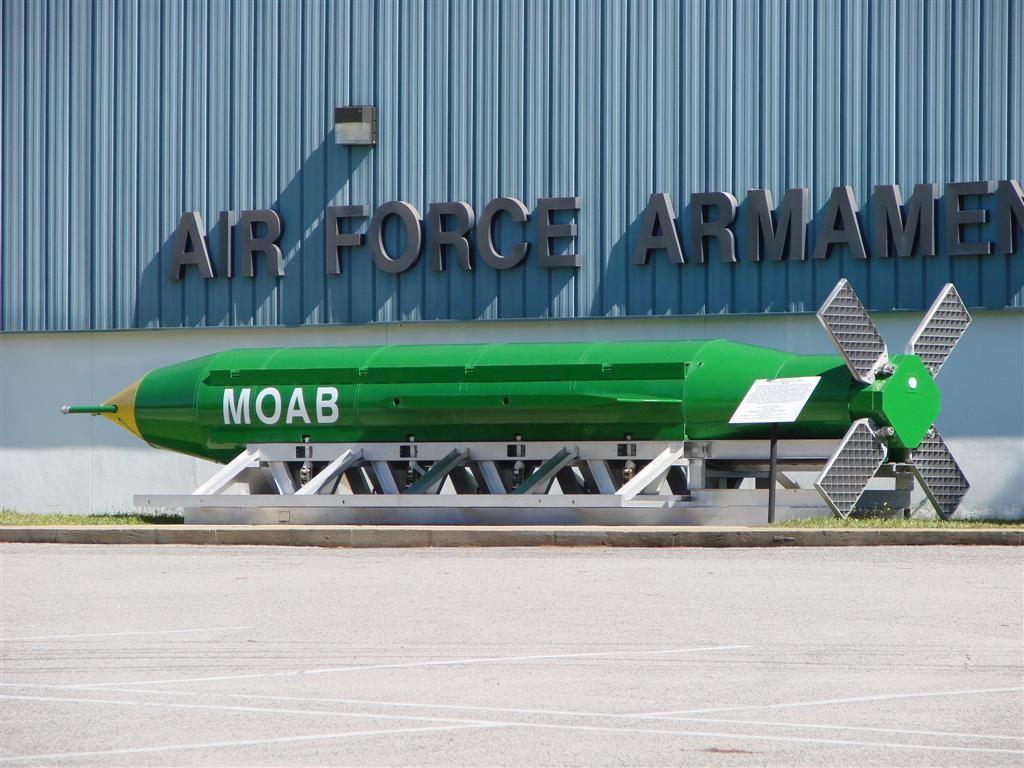
The GBU-43/B Massive Ordnance Air Blast (MOAB), nicknamed the "Mother of All Bombs," was developed for the U.S. military by Albert L. Weimorts Jr. of the Air Force Research Laboratory beginning in 2002. The name was inspired by Iraqi President Saddam Hussein's invocation of the "mother of all battles" during the 1991 Gulf War. The program moved rapidly: the first inert weapon flew on 26 February 2003, a guided flight test followed on 7 March 2003, and the first live test was conducted on 11 March 2003 at Eglin Air Force Base, Florida. A second live test took place on 21 November 2003. The first MOAB was delivered to the operational theater on 11 April 2003, and fifteen units were manufactured at McAlester Army Ammunition Plant in Oklahoma beginning that year. The weapon was first used in combat in 2017.
Design
The MOAB is an air-blast weapon rather than a penetrator. It is designed to detonate above the surface, projecting a massive blast across an area to destroy exposed structures, cave openings, and personnel. Its lightweight aluminum casing, weighing approximately 1,300 kg, prioritizes explosive filling over the structural strength needed to survive penetration into reinforced concrete or rock. This makes it effective against soft to medium surface targets and targets in contained environments such as cave systems, while limiting its effectiveness against deeply buried installations protected by thick rock. The basic principle resembles that of the earlier BLU-82 "Daisy Cutter" unguided bomb used in the Vietnam War. During the final stages of testing in 2003, U.S. military officials stated the MOAB was mainly conceived as a weapon for psychological operations, intended to rattle enemy troops and pressure them into surrender; the target set was later expanded to include targets buried under softer surfaces such as caves and tunnels. The U.S. military's most powerful penetrator, the GBU-57 Massive Ordnance Penetrator, uses a high-strength steel body to detonate after entering hardened material, a capability the MOAB does not possess.
Specifications
The GBU-43/B MOAB measures 9.1885 m (30 ft) in length and 1.03 m (40.5 in) in diameter, with a span of 1.52 m (5 ft) with fins retracted and 3.05 m (10 ft) with fins extended. Total weight is 9,850 kg (21,600 lb). The BLU-120/B warhead contains 8,500 kg of H-6 explosive (a mixture of RDX, TNT, and aluminum), accounting for 86.3% of the total mass. The estimated yield is 11 tons of TNT equivalent, corresponding to 46 gigajoules of energy. Guidance is provided by the KMU-593/B GPS/inertial system, with a guided range of 3 nautical miles. Stabilization is achieved through fixed wings and grid (lattice) fins. The launch platform is the C-130 Hercules, specifically the MC-130E/H Combat Talon variants. The weapon was manufactured by the Air Force Research Laboratory in cooperation with Dynetics, Inc., at a historical unit cost of $170,000.
Operational history
On 13 April 2017, a U.S. Air Force MC-130 dropped a MOAB against an Islamic State – Khorasan Province (ISKP) tunnel complex in Achin District, Nangarhar Province, Afghanistan. The strike was part of Operation Hamza, during which Afghan commandos had spent four weeks attempting to advance against fortified positions in difficult terrain. Afghan authorities reported the destruction of three tunnels and associated ammunition. Casualty estimates from Afghan authorities rose from 36 to 94–96 ISKP fighters, including four commanders; ISIS denied suffering casualties. U.S. and Afghan officials stated that no civilians were killed, although Afghan parliamentarian Esmatullah Shinwari alleged that a teacher and his son had died, and buildings in Shaddle Bazar, 2.4 km from the impact area, reportedly sustained damage.
As of October 2026, the U.S. military is considering employing the MOAB against Iranian nuclear facilities and energy infrastructure, including the underground Pickaxe Mountain installation, should President Donald Trump authorize further strikes. Military plans reportedly call for the weapon's use prior to a planned reduction in U.S. deployments in the CENTCOM area of responsibility. Officials and experts have raised questions about the MOAB's effectiveness against deeply buried targets protected by granite, noting that its airburst design releases most of its energy into the surrounding atmosphere rather than into the targeted structure. The weapon's original delivery aircraft, the MC-130E and MC-130H Combat Talon variants, have been retired from U.S. Air Force service, raising questions about which currently available platforms could support a new MOAB mission.
 Argentina
 Armenia
 Australia
 Austria
 Austria-Hungary
 Belgium
 Brazil
 United Kingdom
 Brunei
 Bulgaria
 Canada
 Chile
 China
 Colonial America
 Colombia
 Confederate States
 Croatia
 Czech
 Denmark
 Egypt
 Finland
 France
 Georgia
 Germany
 German Imperial
 Greece
 Holland
 Hungary
 India
 Indonesia
 Iran
 Iraq
 Ireland
 Israel
 Italy
 Japan
 Japan (1940)
 Jordan
 Kingdom of Italy
 Malaysia
 Mexico
 Myanmar
 Nazi Germany
 Netherlands
 New Zealand
 North Korea
 Norway
 Pakistan
 Peru
 Philippines
 Poland
 Portugal
 Prussia
 Romania

 Russia
 Saudi Arabia
 Serbia
 Singapore
 Slovakia
 Slovenia
 South Africa
 South Korea
 Soviet Union
 Spain
 Sweden
 Switzerland
 Syria
 Taiwan
 Thailand
 Turkey
 UAE
 Ukraine
 Vietnam
 Yugoslavia