
History
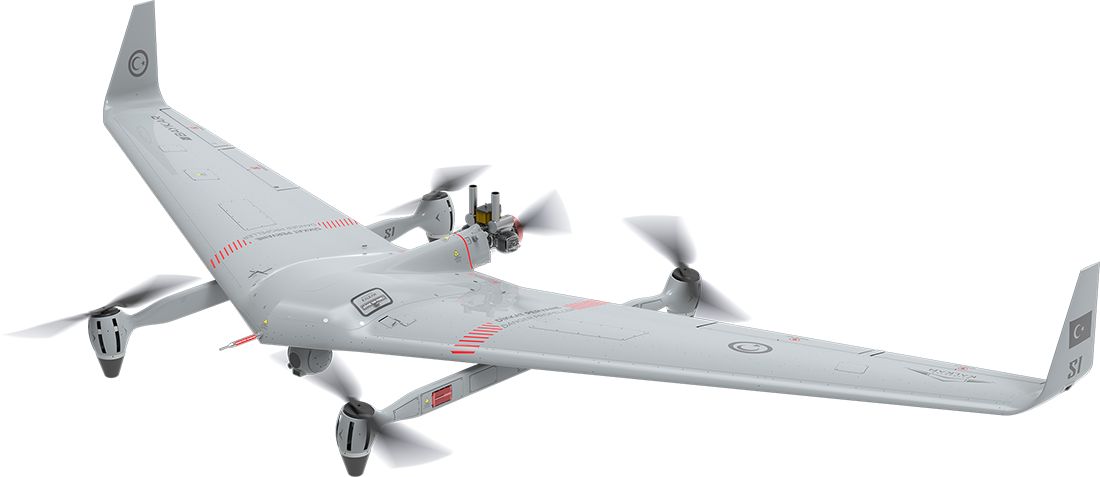
The Bayraktar KALKAN VTOL (DİHA) project was launched by Baykar in 2019. The aircraft was unveiled to the public at TEKNOFEST in 2021. Its first test flight took place on 19 April 2022 at Baykar's Flight Training and Test Center in Keşan. By 7 April 2024 the program had completed 30 test flights; the 40th was conducted on 27 July 2024. In early 2025 Baykar demonstrated the aircraft launching a compact FPV drone mid-air, a capability it described as "mothership" operation. Media reported on 19 August 2025 that the platform had entered serial production. On 27–29 November 2025 the KALKAN successfully deployed SkyDagger FPV kamikaze drones from beneath its wings during flight tests.
Baykar officially delivered the KALKAN to the Turkish Armed Forces at a ceremony aboard the frigate TCG Oruçreis during TEKNOFEST Mavi Vatan on 20 August 2026.
Specifications
The KALKAN uses a hybrid propulsion system: four electric motors provide vertical lift during take-off and landing, and a single internal combustion engine powers forward cruise flight. Baykar's published specifications are as follows:
- Maximum take-off weight: 78 kg
- Wingspan: 5 m
- Length: 1.9 m
- Height: 0.7 m
- Payload capacity: 3 kg
- Endurance: 6 hours
- Cruise speed: 48 KIAS
- Maximum speed: 55 KIAS (102 km/h)
- Service ceiling: 10,000 ft (3,048 m)
- Operational altitude: 6,000 ft (1,829 m)
- Communication range: 70+ km per Baykar's published data; other reporting cites more than 80 km
The standard ISR payload includes interchangeable electro-optical or infrared cameras, a tracker with multiple target identification, and a laser rangefinder. Baykar's BG-160 electro-optical module integrates camera and laser rangefinder functions and is mounted on the front underside of the airframe. The aircraft supports fully autonomous take-off, cruise, and landing as well as semi-autonomous cruise missions, with capabilities including automatic route following, object tracking, loitering, and return-to-home operations. The flight control architecture is fault-tolerant with triple-redundant systems.
Operational History
Following entry into inventory on 20 August 2026, the KALKAN conducted test flights aboard the amphibious assault ship TCG Anadolu and the corvette TCG Burgazada as part of naval platform integration trials. The aircraft also participated in Exercise Ateş Serbest-2026 at Polatlı on 13 October 2026, where it performed target detection, tracking, and control using the BG-180 3E three-axis stabilised electro-optical system, a Baykar-developed sensor used for the first time on that occasion.
The KALKAN completed its first at-sea flight tests from the frigate TCG Gelibolu, which was operating with the Somali Sea Task Group in the Indian Ocean; the tests were announced on 24 October 2026. As of that announcement, Baykar had disclosed no operational or combat employment of the platform.
 Argentina
 Armenia
 Australia
 Austria
 Austria-Hungary
 Belgium
 Brazil
 United Kingdom
 United States
 Brunei
 Bulgaria
 Canada
 Chile
 China
 Colonial America
 Colombia
 Confederate States
 Croatia
 Czech
 Denmark
 Egypt
 Finland
 France
 Georgia
 Germany
 German Imperial
 Greece
 Holland
 Hungary
 India
 Indonesia
 Iran
 Iraq
 Ireland
 Israel
 Italy
 Japan
 Japan (1940)
 Jordan
 Kingdom of Italy
 Malaysia
 Mexico
 Myanmar
 Nazi Germany
 Netherlands
 New Zealand
 North Korea
 Norway
 Pakistan
 Peru
 Philippines
 Poland
 Portugal
 Prussia
 Romania

 Russia
 Saudi Arabia
 Serbia
 Singapore
 Slovakia
 Slovenia
 South Africa
 South Korea
 Soviet Union
 Spain
 Sweden
 Switzerland
 Syria
 Taiwan
 Thailand
 UAE
 Ukraine
 Vietnam
 Yugoslavia