
History
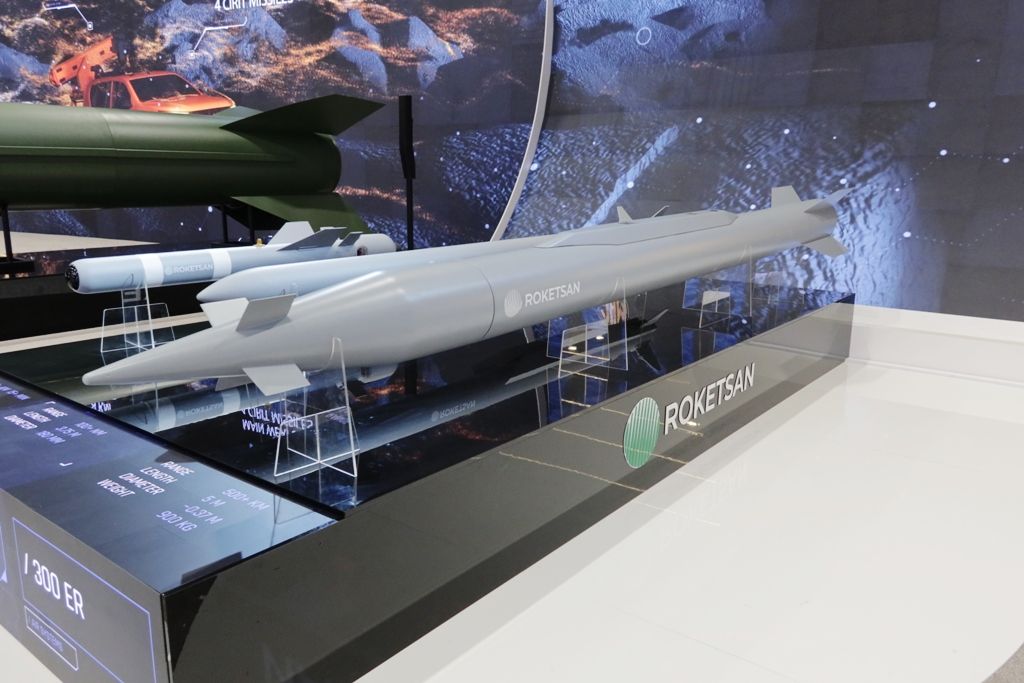
The Roketsan 300-ER is a Turkish long-range air-launched ballistic missile developed for fighter aircraft, unmanned combat aircraft, and other aerial launch platforms. Roketsan publicly unveiled the weapon at IDEF 2025 in Istanbul in July 2025.
The missile is intended to provide stand-off strike capability at ranges exceeding 500 km. It follows Roketsan's earlier UAV-122 and UAV-230 air-launched missile developments and represents a substantially larger weapon intended for longer-range missions.
As of September 2026, the 300-ER remained in development and had been fitted to the Bayraktar Akıncı unmanned combat aircraft in preparation for an expected first launch. It should therefore not yet be described as an operational weapon.
Roketsan introduced the 300-ER on 22 July 2025 as one of six new systems unveiled during IDEF 2025. Contemporary reporting based on the presentation described it as an advanced development related to the İHA-230 family, using ballistic-missile technology and intended for launch from fighters, UAVs, and other airborne platforms. The IDEF presentation reported a range exceeding 500 km. The unveiling was covered by Anadolu Agency and summarized by the KÜRE Encyclopedia.
TURDEF reported at the time of the unveiling that the 300-ER weighs about 900 kg, is approximately 5 m long, and has a diameter of 370 mm. The same report described its maximum range as more than 500 km depending on launch conditions and identified fighter aircraft and unmanned combat aircraft as intended carriers.
In February 2026, Defence Security Asia reported that an inaugural test launch was planned for later in 2026. That report also described a solid-propellant propulsion system, inertial and satellite-aided navigation, and a television seeker for terminal guidance. These details were reported before the first flight and should be treated as development-stage configuration information rather than evidence of an operational capability.
By September 2026, Baykar had fitted the 300-ER to an Akıncı unmanned combat aircraft, with the first launch from that platform expected soon. This represented a physical integration step but did not establish that testing, qualification, production, or service entry had been completed.
Design
The 300-ER is an air-launched ballistic or aeroballistic missile designed to exploit the altitude and forward speed of its carrier aircraft. The missile is intended to provide a long-range strike option while allowing the launch platform to remain at stand-off distance from the target area.
The missile is approximately 5 m long, has a diameter of about 370 mm, and weighs about 900 kg according to reporting from its IDEF 2025 unveiling. Its reported range exceeds 500 km, although the achievable distance depends on launch conditions such as carrier altitude and speed.
Guidance and propulsion
Development-stage reporting describes the 300-ER as using a solid-propellant rocket motor. Defence Security Asia reported an inertial navigation system with satellite-navigation updates during flight and a television seeker for terminal guidance. Because the system was still awaiting its first launch from the Akıncı in September 2026, the final qualified guidance configuration and demonstrated accuracy had not been established by the supplied sources.
Launch platforms
The 300-ER was presented for use from fighter aircraft, unmanned combat aircraft, and other aerial platforms. TURDEF identified the Bayraktar Akıncı as a suitable carrier and suggested that an F-16 could carry two missiles, but those carriage quantities were analytical assessments rather than confirmed operational loadouts. By September 2026, physical integration with the Akıncı had been reported, with a first launch expected soon.
Defence Security Asia also reported planned integration with the Baykar Kızılelma unmanned combat aircraft. This should be regarded as planned integration until supported by completed flight testing.
Program status
The 300-ER was publicly displayed in 2025 and remained under development through 2026. Reporting in early 2026 anticipated an inaugural test launch during the year, while the September 2026 source stated that the missile had been fitted to an Akıncı and that its first launch from the UAV was expected soon.
No supplied source confirms completed qualification, serial production of the 300-ER, formal service entry, or an operational operator. The weapon should therefore be described as a development-stage air-launched ballistic missile undergoing integration and preparation for flight testing.
Specifications (300-ER)
General characteristics
- Type: Air-launched ballistic or aeroballistic missile
- Manufacturer: Roketsan
- Length: Approximately 5 m
- Diameter: Approximately 370 mm
- Launch weight: Approximately 900 kg
- Propulsion: Solid-propellant rocket motor, as reported during development
Performance
- Range: More than 500 km, depending on launch conditions
Guidance
- Mid-course guidance: Inertial navigation with satellite-navigation updates, as reported during development
- Terminal guidance: Television seeker, as reported during development
Launch platforms
- Bayraktar Akıncı: Missile fitted to the aircraft by September 2026; first launch was still expected
- Fighter aircraft: Intended launch-platform class presented for the missile
- Baykar Kızılelma: Reported as a planned integration platform
Related equipment
- UAV-230: Earlier Roketsan air-launched supersonic missile development cited as a predecessor to the 300-ER concept.
- UAV-122: Earlier Roketsan air-launched missile derived from the company's guided-rocket family and cited as part of the development path preceding the 300-ER.
 Argentina
 Armenia
 Australia
 Austria
 Austria-Hungary
 Belgium
 Brazil
 United Kingdom
 United States
 Brunei
 Bulgaria
 Canada
 Chile
Chile China
China Colonial America
 Colombia
 Confederate States
 Croatia
 Czech
Czech Denmark
 Egypt
Egypt Finland
 France
 Georgia
 Germany
 German Imperial
 Greece
 Holland
 Hungary
 India
India Indonesia
 Iran
Iran Iraq
Iraq Ireland
 Israel
 Italy
Italy Japan
Japan Japan (1940)
 Jordan
 Kingdom of Italy
 Malaysia
 Mexico
 Myanmar
 Nazi Germany
 Netherlands
 New Zealand
 North Korea
 Norway
 Pakistan
 Peru
Peru Philippines
 Poland
 Portugal
 Prussia
 Romania
 Russia
 Saudi Arabia
 Serbia
 Singapore
 Slovakia
 Slovenia
 South Africa
 South Korea
 Soviet Union
 Spain
Spain Sweden
 Switzerland
 Syria
Syria Taiwan
 Thailand
 UAE
UAE Ukraine
 Vietnam
 Yugoslavia