
History
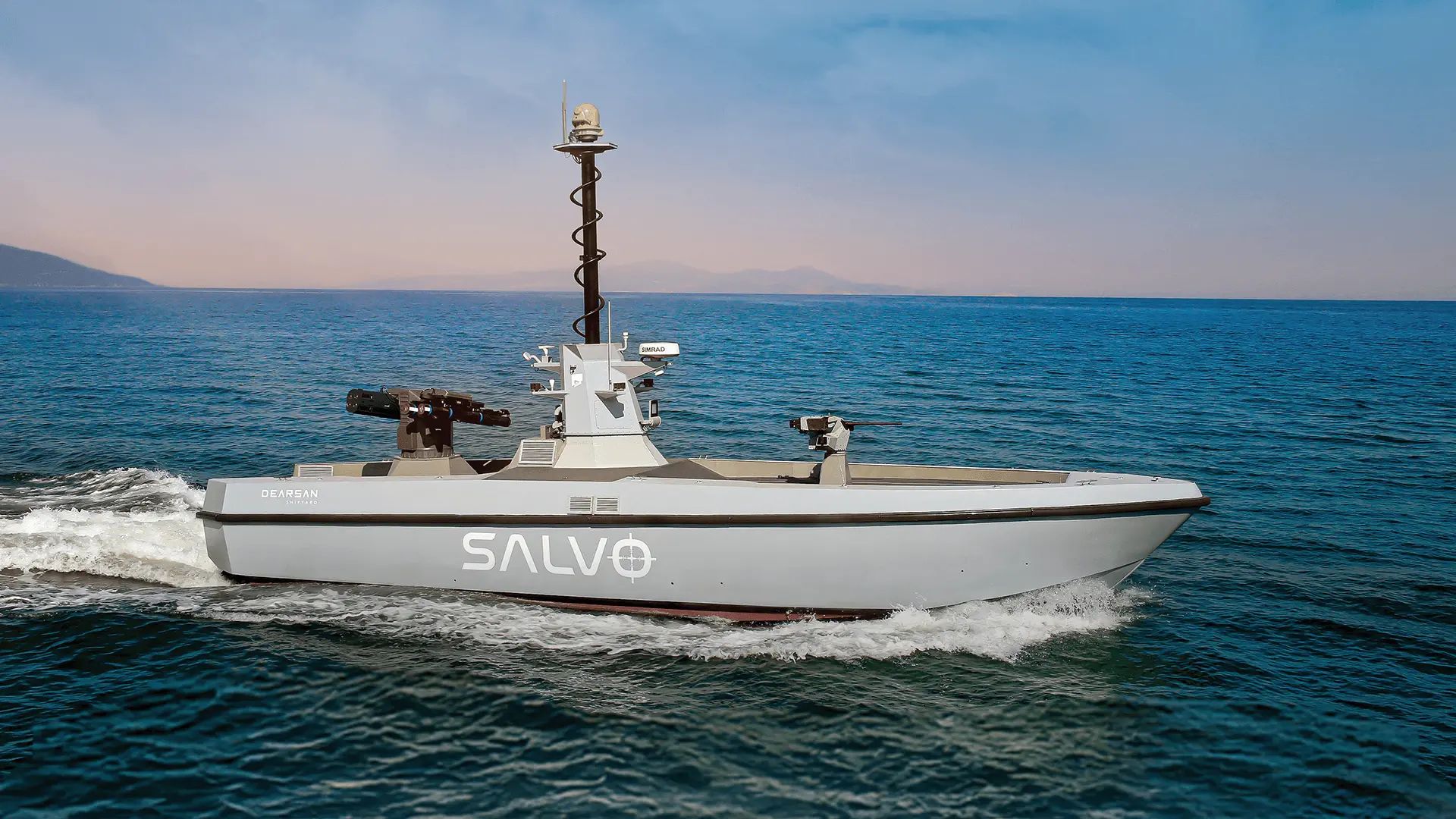
The Dearsan SALVO is an armed unmanned surface vessel developed by Turkish shipbuilder DEARSAN for naval and maritime security missions. The reusable platform is designed for operations including surface warfare, surveillance, interception, coastal patrol, and responses to asymmetric threats.
SALVO has also become part of Azerbaijan's effort to establish domestic production of unmanned naval systems. In September 2026, Azerbaijani officials demonstrated locally produced SALVO vessels during a visit by President Ilham Aliyev and First Vice-President Mehriban Aliyeva to the Azerbaijani Navy.
The platform has also entered Turkish Navy service. A Turkish Navy SALVO equipped with a lightweight remote weapon station was reported commissioned as TCB 1401 in November 2025.
Development and early demonstrations
SALVO was developed by DEARSAN in Turkey. Reporting on the program has also identified Aselsan, Roketsan, and Yaltes as participating companies associated with the vessel's systems and weapons integration. A physical SALVO vessel was publicly shown in Azerbaijan in August 2025 during exercises concerned with the protection and defense of maritime energy infrastructure.
Published reporting from 2025 described Azerbaijani SALVO vessels as Turkish-developed systems used for reconnaissance, surveillance, coastal defense, and strike missions. Some reports showed the platform during trials with a missile launcher and described configurations using either four L-UMTAS guided missiles or as many as eight Cirit missiles. These weapon fits represent reported armed configurations of the platform and should not be assumed to be installed on every SALVO vessel.
Turkish Navy configuration
In November 2025, SALVO was reported commissioned into the Turkish Navy as TCB 1401. This vessel carried the Unirobotics TRAKON Lite remote-controlled weapon station. The naval TRAKON Lite installation on SALVO used a CANiK M2 QCB 12.7 x 99 mm machine gun. The vessel was also reported to have a flight pad for operating small unmanned aerial vehicles.
TRAKON Lite was developed for lightweight platforms. The system has a reported unloaded mass of 180 kg and can carry 200 rounds when fitted with a 12.7 mm machine gun. Its supported weapon class extends from 5.56 mm machine guns to 40 mm grenade launchers, although the SALVO configuration reported in Turkish Navy service used the 12.7 mm weapon. Further information on this configuration was published by TURDEF.
Production in Azerbaijan
By September 2026, SALVO was being manufactured in Azerbaijan at a joint production facility operated by the Azerbaijani Ministry of Defence's MIRAS Military-Industrial Company and DEARSAN Shipyard. The same facility was also producing the smaller KAYRA kamikaze unmanned surface vessel.
On 6 September 2026, Ilham Aliyev and Mehriban Aliyeva visited the Azerbaijani Navy and received a briefing on SALVO and KAYRA. They also inspected the joint production facility. The vessels subsequently underwent practical testing, although the Azerbaijani government did not disclose detailed results or production quantities. Naval Today reported the tests and the establishment of the joint DEARSAN-MIRAS production arrangement.
Coverage of the program noted that SALVO had already been displayed in Azerbaijan in 2025, so the September 2026 event primarily demonstrated the transition toward local production rather than the first appearance of the vessel. The amount of hull construction, propulsion equipment, electronics, communications equipment, and control-system manufacturing performed domestically has not been publicly disclosed. Production volumes, program cost, and delivery schedules were also not announced. These uncertainties were noted by JAMnews.
Design
SALVO is a 14.79 m unmanned surface vessel with an aluminum hull. DEARSAN specifications cited in 2026 reporting give a beam of 3.85 m and a draft of 0.75 m. The vessel is intended to operate without an embarked crew and can perform repeated missions rather than functioning as a one-way attack craft.
The platform is intended for littoral and coastal operations. Listed missions include surface warfare, engagement of asymmetric threats, surveillance, interception, border patrol, coast guard duties, anti-smuggling operations, anti-drug-trafficking missions, and support for search and rescue.
Propulsion and performance
Reporting on SALVO describes twin diesel engines driving waterjets, with a diesel generator supporting onboard systems. DEARSAN data cited by Naval Today lists a maximum speed of more than 35 knots, a maximum continuous speed of more than 25 knots, and a range of up to 400 nautical miles.
Some 2025 reporting stated a higher maximum speed of up to 50 knots and a range exceeding 555 km. Because later reporting explicitly attributes the lower speed and 400-nautical-mile range figures to DEARSAN, the manufacturer-linked figures are used for the specification section. The differing earlier figures may reflect another configuration or reporting methodology, but the available sources do not establish the reason for the discrepancy. The earlier claims appeared in UNITED24 Media.
Sensors and mission equipment
Images and reports from trials have shown SALVO with a small maritime radar and a retractable mast carrying an electro-optical targeting system. These systems support surveillance and target engagement. The platform has also been demonstrated with remotely operated weapons, while the Turkish Navy configuration includes a flight pad for small UAVs.
Armament
SALVO can be configured as an armed surface combat platform. Reported weapon fits include a stabilized remotely operated 12.7 mm machine gun and a missile launcher capable of carrying four L-UMTAS guided missiles or up to eight Cirit missiles. The Turkish Navy's TCB 1401 configuration was specifically reported with the TRAKON Lite remote weapon station and CANiK M2 QCB 12.7 mm machine gun.
Not all vessels have been displayed with the same weapons. Photographs of some Azerbaijani SALVO vessels showed no visible weapon installation, so the presence of a particular gun or missile package should be treated as configuration-dependent rather than standard for every example.
Program status
SALVO is in service with the Turkish Navy, where one reported vessel carries the designation TCB 1401. Azerbaijan has also displayed and tested SALVO vessels and, by September 2026, was manufacturing the platform locally through the joint MIRAS-DEARSAN production facility.
Public sources do not provide the number of SALVO vessels produced in Azerbaijan, the size of planned batches, the cost of the program, or a confirmed delivery schedule for locally manufactured examples.
Variants
- SALVO with missile armament: Reported armed configuration using a stabilized 12.7 mm remote weapon station and a launcher for either four L-UMTAS guided missiles or up to eight Cirit missiles.
- TCB 1401: Turkish Navy SALVO configuration reported with the TRAKON Lite remote-controlled weapon station, CANiK M2 QCB 12.7 mm machine gun, and a flight pad for small UAVs.
- Azerbaijani-produced SALVO: Locally manufactured vessels produced through the joint MIRAS-DEARSAN facility in Azerbaijan and subjected to practical testing in September 2026. Public reporting does not establish whether their equipment fit is identical to the Turkish Navy configuration.
Operators
- Turkey: SALVO has entered Turkish Navy service. TCB 1401 was reported commissioned in November 2025.
- Azerbaijan: The Azerbaijani Navy has displayed and tested SALVO vessels, and local production was underway through the MIRAS-DEARSAN facility by September 2026.
Specifications (SALVO)
General characteristics
- Length: 14.79 m
- Beam: 3.85 m
- Draft: 0.75 m
- Hull: Aluminum
- Propulsion: Two diesel engines with waterjet propulsion
- Electrical generation: Diesel generator
Performance
- Maximum speed: More than 35 knots
- Maximum continuous speed: More than 25 knots
- Range: Up to 400 nautical miles
Armament
- Gun armament: Configuration-dependent; reported installations include a stabilized 12.7 mm remote weapon station. Turkish Navy TCB 1401 uses a TRAKON Lite station with a CANiK M2 QCB 12.7 x 99 mm machine gun.
- Missile armament: Reported launcher configuration for four L-UMTAS guided missiles or up to eight Cirit missiles.
 Argentina
 Armenia
 Australia
 Austria
 Austria-Hungary
 Belgium
 Brazil
 United Kingdom
 United States
 Brunei
 Bulgaria
 Canada
 Chile
Chile China
China Colonial America
 Colombia
 Confederate States
 Croatia
 Czech
Czech Denmark
 Egypt
Egypt Finland
 France
 Georgia
 Germany
 German Imperial
 Greece
 Holland
 Hungary
 India
India Indonesia
 Iran
Iran Iraq
Iraq Ireland
 Israel
 Italy
Italy Japan
Japan Japan (1940)
 Jordan
 Kingdom of Italy
 Malaysia
 Mexico
 Myanmar
 Nazi Germany
 Netherlands
 New Zealand
 North Korea
 Norway
 Pakistan
 Peru
Peru Philippines
 Poland
 Portugal
 Prussia
 Romania
 Russia
 Saudi Arabia
 Serbia
 Singapore
 Slovakia
 Slovenia
 South Africa
 South Korea
 Soviet Union
 Spain
Spain Sweden
 Switzerland
 Syria
Syria Taiwan
 Thailand
 UAE
UAE Ukraine
 Vietnam
 Yugoslavia