

History
The BM-35 entered the public record in August 2025, when Ukraine's Defense Intelligence described an unnamed delta-wing drone with a nose-mounted engine, a camera, and two LTE modems. In early September 2025, Serhii Beskrestnov intercepted video from a drone attacking Sumy and identified it as the BM-35. Intercepted footage from the night of 28 to 29 September 2025 showed the drone carrying a thermal imager, the first of its kind recorded on the type.
On 15 January 2026, Ukrainian air defense intercepted a BM-35 controlled through a Starlink satellite communications terminal found on the wreckage. A Starlink-linked BM-35 reached Dnipro, approximately 86 km from the front, on 26 January 2026. Following SpaceX-imposed terminal restrictions in February 2026, use of the type fell sharply; by June 2026 a new wave of attacks had begun at shorter range. On 15 August 2026, a Russian television report showed a BM-35 fitted with a jet engine, and within two months Ukrainian units recorded interceptions of the jet version.
Design
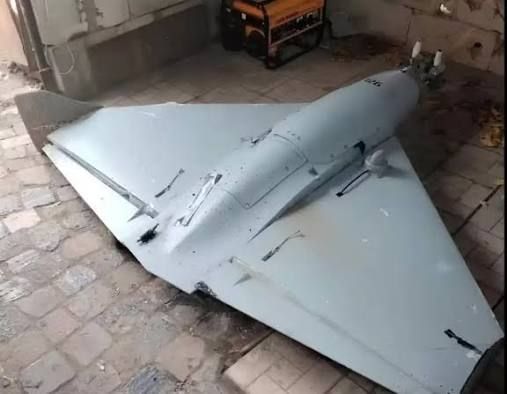
The BM-35 is a tailless delta-wing one-way strike drone with a nose-mounted engine driving a tractor propeller. A forward-facing course camera provides the operator's view, and the drone is flown manually to impact, functioning as an enlarged first-person-view attack drone. Some models carry a thermal imager for night operations.
Ukrainian and Russian sources remain divided on the drone's relationship to ZALA Aero's Italmas, a delta-wing UAV announced in October 2023. Some analysts regard the BM-35 as a separate development with distinctive technical solutions; others, including Russian state media, describe it as a ZALA product. The question of common origin is unresolved.
Propulsion and control are independent attributes, and multiple configurations are in use simultaneously. The piston version uses a two-stroke DLE gasoline engine from China's Mile Haoxiang Technology. Control links include a 360 MHz radio channel with a 10 MHz signal width, video in the 3,000–3,700 MHz band, two LTE modems for transmission through mobile base stations, and, in the Starlink variant, a satellite terminal. HUR's component record for the BM-35 lists 41 entries, 40 of which are attributed to foreign manufacturers, including 19 Chinese, 15 American, 3 Swiss, 2 Taiwanese, and 1 Japanese part, along with one unidentified camera.
Specifications
Piston version (radio or Starlink control)
- Configuration: Tailless delta wing, nose tractor propeller
- Length: 2 m; span: 1.8 m
- Engine: DLE two-stroke gasoline engine; twin-cylinder standard, four-cylinder type also described
- Cruise speed: Up to approximately 120 km/h
- Terminal dive speed: More than 200 km/h near the ground
- Maximum altitude: Up to 4 km
- Range: About 200 km (Ukrainian field figure); up to 500 km (Starlink version, per Beskrestnov's single statement)
- Warhead: Up to 5 kg, or up to 15 kg in one to three munitions (twin-cylinder); 27 kg (four-cylinder; this figure may belong to the BM-70)
- Fuze: Four-sensor detonation system
Jet version (Russian claims, from an NTV report of 15 August 2026)
- Speed: More than 350 km/h
- Range: More than 200 km
- Warhead: 10 kg
Operational history
Russian forces use the BM-35 to strike targets in the Ukrainian rear without expending missiles or Shahed raids. The radio-controlled version is reserved for large stationary objects because the line-of-sight link prevents effective engagement of moving targets. The Starlink variant extended reach and opened moving targets, with reports of strikes on mobile fire groups and, after 30 December 2025, on shipping in the Black Sea. A 425th Separate Assault Regiment "Skelia" assessment describes Russian use of the jet BM-35 against vehicles, military equipment, and logistics routes.
Reliability has been a significant constraint. In May 2026, Beskrestnov reported that Russia had launched BM types in large numbers and then paused because of the defect rate, with more than half of BM-35s failing to reach their targets as propellers broke and engines seized or stopped in flight. The four-sensor fuze, by contrast, is credited with functioning in 99.5 percent of detonations that occur on arrival.
Ukrainian forces have intercepted BM-35s at every stage of its evolution. On 19 October 2026, operators of the Redneck unit of the 78th Separate Air Assault Brigade published footage of a jet-powered BM-35 being intercepted: the first FPV drone damaged the wing but the UAV continued flying, and a second interceptor destroyed it. The 425th Regiment reported shooting down jet BM-35s, noting that speed above 350 km/h, low altitude, and maneuvering make interception harder. The 42nd Separate Mechanized Brigade's air defense missile unit released footage on 23 October 2026 of destroying a jet-powered BM-70, a closely related type.
Operators
Rubicon, the Russian Ministry of Defense's Center for Advanced Unmanned Technologies, is the formation most consistently associated with the BM-35. Brigadier General Yevhen Lasiichuk of Ukraine's 7th Air Assault Corps placed Rubicon drone units in the Pokrovsk sector, where a Starlink-controlled BM-35 appeared in July 2026.
 Argentina
 Armenia
 Australia
 Austria
 Austria-Hungary
 Belgium
 Brazil
 United Kingdom
 United States
 Brunei
 Bulgaria
 Canada
 Chile
 China
 Colonial America
 Colombia
 Confederate States
 Croatia
 Czech
 Denmark
 Egypt
 Finland
 France
 Georgia
 Germany
 German Imperial
 Greece
 Holland
 Hungary
 India
 Indonesia
 Iran
 Iraq
 Ireland
 Israel
 Italy
 Japan
 Japan (1940)
 Jordan
 Kingdom of Italy
 Malaysia
 Mexico
 Myanmar
 Nazi Germany
 Netherlands
 New Zealand
 North Korea
 Norway
 Pakistan
 Peru
 Philippines
 Poland
 Portugal
 Prussia
 Romania
 Saudi Arabia
 Serbia
 Singapore
 Slovakia
 Slovenia
 South Africa
 South Korea
 Soviet Union
 Spain
 Sweden
 Switzerland
 Syria
 Taiwan
 Thailand
 Turkey
 UAE
 Ukraine
 Vietnam
 Yugoslavia