


History
Geoffrey de Havilland was hired by the Airco company as chief designer in June 1914 and quickly used his design talents to create the Airco "DH. 1" ("DH" is a tribute to the designer himself). Department of Health.
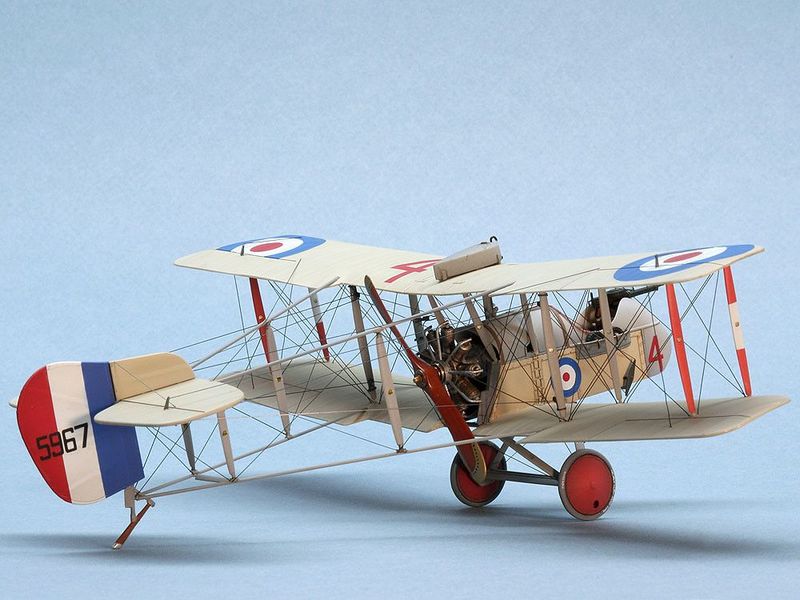
1 is a two-seat reconnaissance biplane with inline water-cooled engines in a "propeller" arrangement. While most modern engines are "pull rods" in nature - that is, they mount to the front of the fuselage and "pull" the aircraft through the sky - the thrust arrangement requires the engines to be in the rear of the fuselage.
Instead, push the fuselage through the sky. This arrangement was necessary because a fully functioning synchronized gear (also known as "interruption gear") had not been developed for the Allies. The Germans initially succeeded in this endeavor and proved its dire effects in their Fokker monoplane and later biplanes and triplanes. Crusher gear is just that - a component in the machine gun/propeller function that allows the pilot to fire "through" his spinning propeller blade arc without damaging the blades in the process (hence the dub).
This provides the pilot with all the performance benefits of a front engine and the stability of a solid artillery platform. So the Allies got their due by adding rear-mounted engines to the thruster configuration and redistributing machine weapons to other parts of the aircraft.
This often resulted in a slower aircraft platform and the machine guns unable to reach the pilot, which proved to be disadvantageous when stalling in dogfights.
De Havilland's second project, aptly named DH. 2. The same thruster arrangement is used, but an air-cooled rotary engine is installed. She's still a biplane, no different from a DH. 1. Although it is smaller, there is only space for one person. Department of Health.
Due to the lack of a good combat platform, the No. 2 was promising, and the British military sent it to France for operational trials in July 1915. Of course, these inexperienced DHs. 2 pilots face a determined and battle-hardened opponent and at least one DH. 2 Fall victim to German guns, the technology captured and transformed by the enemy.
Over time, she formed the 24th Squadron, the first to achieve aerial victories with DH. 2 on April 2, 1916. DH. The 2 essentially became the first "true" dedicated combat platform for the Royal Flying Corps (RFC), and it did not disappoint when it entered service.
Weapons are placed directly in front of the pilot for easy access and clearing of jams during operation. This includes a semi-trainable. 303 Lewis machine gun fed by a 47-round drum.
The machine gun can be mounted in three preset positions in the cockpit, allowing the pilot to fix the machine gun at a favorable firing angle. Of course, this proved to be extremely impractical once it was put into practice. The weapon must be detached from one base and attached to the other during flight, and the total weight of the weapon is approximately 17.5 pounds. Training machine guns to aim in this way, while still performing flying duties, often resulted in pilots running out of ammunition while practicing inaccurate shots in the heat of battle.
The move also distracted the pilots from the upcoming battle. While these three preset positions are good, most pilots quickly learn to lock the machine gun in place and instead aim the entire aircraft at the intended target and are thus largely ignored. Senior members naturally disapprove of such live improvisation and limit it until formal editing can be designed and implemented. Major Lanoe Hawker made such clips and even redesigned the sight to improve accuracy by allowing target guidance. Once in place, the new magazines and sights - along with the fixed machine gun - greatly reduced the pilot's workload, allowing him to focus on driving his machine and firing only at its best.
This new weapon quickly turned all kinds of DH into an ace. 2 pilots and shooting accuracy steadily improved, as did the kill count.
Department of Health. The 2 measures 25 feet 2.5 inches in length and has a wingspan of 28 feet 3 inches. She is reported to be 9 feet 6.5 inches tall. Her curb weight is 942 pounds, while her maximum takeoff weight is in the 1,441-pound range.
Power is provided by a single French Gnome Monosoupape (meaning "single valve") 100 hp rotary engine. This provides DH. 2 has a top speed of 93 mph and a range of 250 miles. Total engine life is reported to be 2.75 hours.
The service ceiling was specified at 14,000 feet, and the climb rate at the time was a respectable 545 ft/min.
About 453 DH. The 2s are made by Airco.
Specification
Basic
Production
Roles
- Fighter
- Reconnaissance (RECCE)
Dimensions
25.20 ft (7.68 m)
28.25 ft (8.61 m)
2.91m
Weight
428 kg
645 kg
Performance
Performance
93 mph (150 km/h; 81 knots)
4,265 ft (1,300 m; 0.81 mi)
249 miles (400 km; 216 nautical miles)
166 m/min
Armor
1 x 7.62mm forward-firing Lewis machine gun, mounted on a flexible mount.
Changes
DH. 2 - Base series name
 Argentina
 Armenia
 Australia
 Austria
 Austria-Hungary
 Belgium
 Brazil
 United States
 Brunei
 Bulgaria
 Canada
 Chile
Chile China
China Colonial America
 Colombia
 Confederate States
 Croatia
 Czech
Czech Denmark
 Egypt
Egypt Finland
 France
 Georgia
 Germany
 German Imperial
 Greece
 Holland
 Hungary
 India
India Indonesia
 Iran
Iran Iraq
Iraq Ireland
 Israel
 Italy
Italy Japan
Japan Japan (1940)
 Jordan
 Kingdom of Italy
 Malaysia
 Mexico
 Myanmar
 Nazi Germany
 Netherlands
 New Zealand
 North Korea
 Norway
 Pakistan
 Peru
Peru Philippines
 Poland
 Portugal
 Prussia
 Romania
 Russia
 Saudi Arabia
 Serbia
 Singapore
 Slovakia
 Slovenia
 South Africa
 South Korea
 Soviet Union
 Spain
Spain Sweden
 Switzerland
 Syria
Syria Taiwan
 Thailand
 Turkey
 UAE
UAE Ukraine
 Vietnam
 Yugoslavia