
History
The Pantsir is a family of short- to medium-range air-defense systems developed by the KBP Instrument Design Bureau. It combines surface-to-air missiles with automatic cannon armament on its principal mobile versions, while later specialized variants omit the guns and emphasize missile capacity for counter-drone missions.
Development began in 1990 as a planned successor to the Tunguska M1. The first prototype was completed in 1994 and displayed publicly at MAKS in 1995. The program subsequently underwent major redesigns of its turret, radar equipment and electronics before reaching production.
Pantsir systems are intended for point defense of military, industrial and administrative targets against aircraft, helicopters, cruise missiles, precision-guided weapons and unmanned aerial vehicles. The family has expanded into mobile, stationary, tracked, Arctic and naval configurations.
Development and testing
The original Pantsir-S program was conceived around a wheeled chassis, which offered greater road mobility and simpler maintenance than a tracked platform. Funding difficulties interrupted development after the initial prototype, but KBP continued work and redesigned the weapon station and radar systems.
Live-fire testing took place at the Kapustin Yar range in June 2006. A final test series before initial deliveries was conducted there in May 2007 and included a 250 km movement to an unprepared firing position. Production of the Pantsir-S1 began in 2008, and the system was adopted for service with the Russian Ground Forces in November 2012. The modernized Pantsir-S2 entered service in 2015. A broader history and variant overview is available from the Pantsir system reference.
Recent development
Later development has increasingly addressed unmanned-aircraft threats. The Pantsir-S1M was unveiled in 2019 with new radar equipment and an extended-range missile. The Pantsir-SM introduced a new targeting station with a reported detection range of up to 75 km and engagement range of up to 40 km. The tracked Pantsir-SM-SV was tested for Russian Ground Forces and Airborne Forces.
The Pantsir-SMD-E, unveiled at the Army-2024 forum, removes the automatic cannons and can carry either 12 conventional missiles, up to 48 TKB-1055 very-short-range interceptors, or a mixed load. Deliveries of small counter-drone missiles for the Pantsir family began in 2025. Four small missiles can occupy the launcher position normally used by one conventional missile, raising the maximum missile load to 48. The reported delivery program is described by Defense Arabia.
In August 2026, the Russian army received another batch containing mobile Pantsir-S systems and stationary Pantsir-SMD systems. The supplied report states that the equipment had completed required testing and passed military acceptance. The number delivered was not disclosed. A previous Pantsir-S batch had been delivered in March 2026, according to Militarnyi.
Design
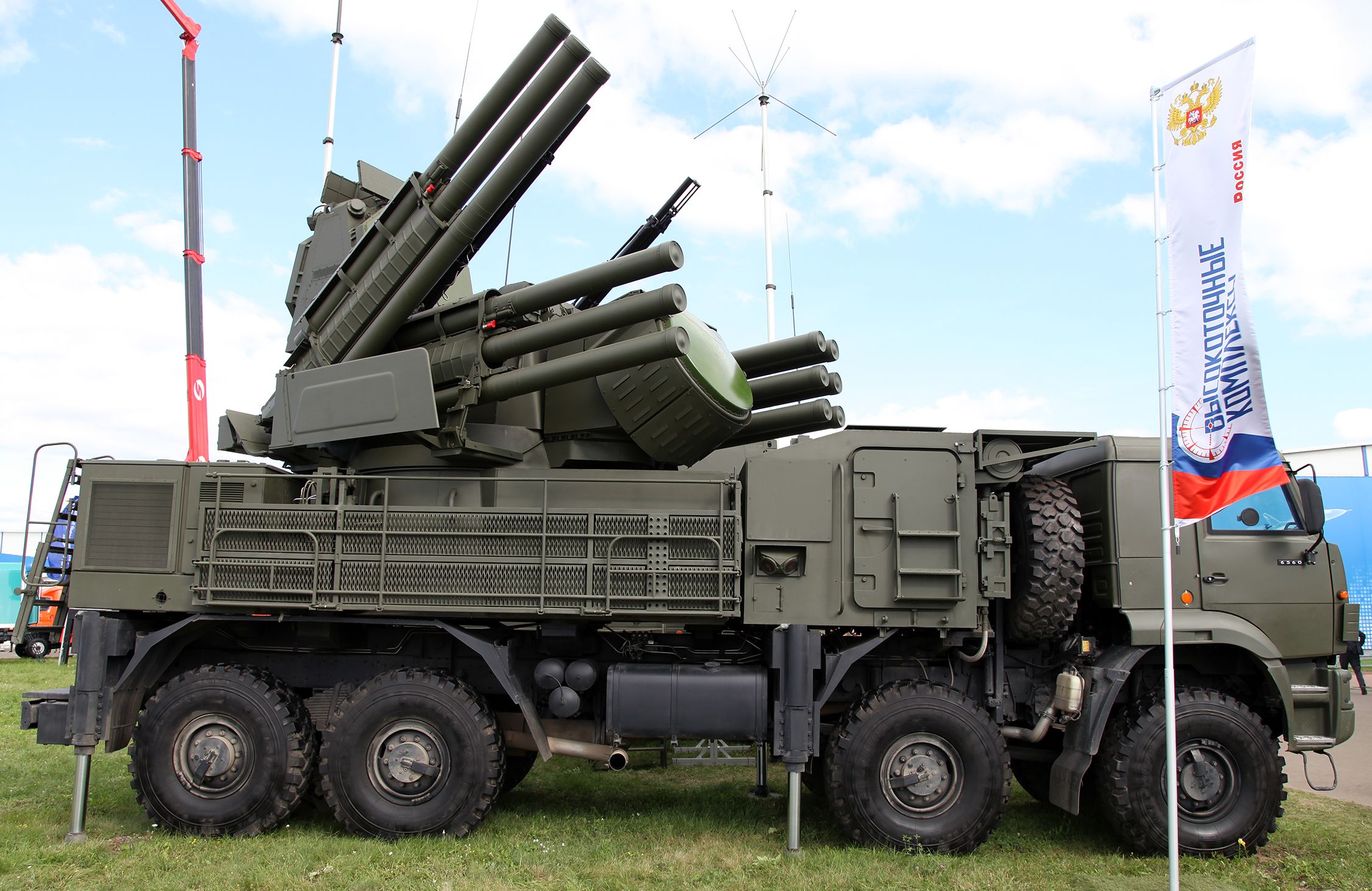
The Pantsir family combines radar and electro-optical target detection and tracking with command-guided surface-to-air missiles. On the Pantsir-S1, the missile launchers are mounted on both sides of the weapon station together with two twin-barrel 30 mm 2A38M automatic cannons. The arrangement provides missile engagement at longer distances and gun engagement against targets in the close zone.
Sensors and fire control
The Pantsir-S1 fire-control system includes a target-acquisition radar and a tracking radar. Published figures for the system give an acquisition range of approximately 32–36 km and a tracking range of approximately 24–28 km against a target with a radar cross-section of 2 m². An electro-optical channel incorporates a thermal imager and infrared direction finder for automatic target tracking.
The radar and electro-optical channels allow the system to track targets and guide missiles without requiring missile-mounted seekers. Digital communications also permit several Pantsir combat vehicles to operate together. A vehicle can operate independently, as a master vehicle assigning targets to subordinate vehicles, or under a separate command post receiving information from an early-warning radar.
Missile armament
The Pantsir-S1 carries up to 12 two-stage solid-propellant command-guided surface-to-air missiles in sealed launch containers. The missiles are arranged in two groups of six. The standard 57E6-series missile uses a booster for initial acceleration followed by an unpowered sustainer section carrying the warhead, fuzes and command-guidance equipment.
For the baseline configuration described in the supplied material, the missile engagement zone extends from approximately 1.2 to 20 km in range and up to 15 km in altitude. Later Pantsir versions employ improved missiles with longer engagement ranges.
Gun armament
The Pantsir-S1 uses two 2A38M twin-barrel 30 mm automatic anti-aircraft guns. Each gun can fire at up to approximately 2,500 rounds per minute, producing a combined maximum rate of about 5,000 rounds per minute. Maximum gun range is approximately 4 km. The weapons can use high-explosive fragmentation, fragmentation-tracer and armor-piercing tracer ammunition.
Wheeled Pantsir-S1 combat vehicles use hydraulic jacks to stabilize the chassis for accurate cannon fire. The later Pantsir-SMD-E omits the guns entirely, exchanging the combined gun-and-missile arrangement for a missile-focused configuration intended particularly for defense against unmanned aircraft.
Operational history
Pantsir-S1 systems have been used in Syria, Libya and the Russo-Ukrainian War. The system has been employed against unmanned aircraft, rockets, missiles and other aerial targets, although combat reports include disputed claims from opposing forces and should not be treated uniformly as independently verified.
During operations in Libya, Pantsir-S1 systems supplied by the United Arab Emirates were used by the Libyan National Army. Several were claimed destroyed during fighting in 2019 and 2020, and one system was captured at Al-Watiya Air Base in May 2020.
In Syria, Pantsir systems were used by Syrian and Russian forces. Russian officials attributed numerous interceptions of drones, rockets and guided weapons to the system, while several Pantsir vehicles were also damaged or destroyed in Israeli and Turkish strikes.
Pantsir-S1 systems have been documented extensively during the Russo-Ukrainian War. Russian systems have been destroyed, abandoned and captured, and Ukrainian forces reported using at least one captured example against an aerial target. Pantsir systems have also been deployed around Moscow and other sensitive sites as point-defense weapons against drone attacks.
In May 2026, a Pantsir-SMD-E was documented being installed on a high-rise building in Moscow as part of defenses against long-range Ukrainian drones. The supplied August 2026 report states that further Pantsir-S and Pantsir-SMD systems were subsequently delivered to Russian forces.
Variants
- Pantsir-S: Original development version. A prototype was completed in 1994 on a Ural-5323 8×8 chassis.
- Pantsir-S1: Principal production missile-and-gun version, normally carrying 12 surface-to-air missiles and two twin-barrel 30 mm 2A38M automatic cannons.
- Pantsir-S1M: Upgraded export-oriented version unveiled in 2019 with improved search and fire-control radars and the 57E6M-E missile.
- Pantsir-S2: Modernized version with improved radar equipment, introduced into Russian service in 2015.
- Pantsir-SM: Further development with a new multifunction targeting station and longer-range missile capability.
- Pantsir-SM-SV: Tracked version developed for the Russian Ground Forces and Airborne Forces.
- Pantsir-SA: Arctic version mounted on an articulated tracked Vityaz vehicle. It omits the 30 mm cannons and is designed for operation in extremely low temperatures.
- Pantsir-SMD-E: Stationary missile-only configuration unveiled in 2024. It can carry 12 conventional missiles, up to 48 TKB-1055 short-range counter-drone missiles, or mixed ammunition loads.
- Pantsir-M/ME: Naval derivative using eight ready-to-fire missiles and two six-barrel 30 mm rotary cannons.
Operators
- Russia: Operates Pantsir-S1, Pantsir-S2 and other members of the family. Additional Pantsir-S and Pantsir-SMD systems were delivered in 2026.
- Algeria: Operates Pantsir-S1 systems.
- Ethiopia: Operates Pantsir-S1 systems delivered from Russia.
- Iraq: Received 24 Pantsir-S1 systems, with deliveries completed in 2016.
- Libyan National Army: Received Pantsir-S1 systems transferred by the United Arab Emirates.
- Serbia: Operates Pantsir-S1 systems and has also acquired Pantsir-S1M systems.
- United Arab Emirates: Launch export customer for the Pantsir-S1 and received systems mounted on MAN SX45 8×8 vehicles.
Specifications (Pantsir-S1)
General characteristics
- Crew: 3
- Configuration: Wheeled, tracked or stationary configurations are possible within the Pantsir family; the principal Pantsir-S1 production vehicle uses an 8×8 wheeled chassis.
- Ready-to-launch missiles: Up to 12
- Automatic cannon ammunition: 700 rounds per gun
Performance
- Baseline missile engagement range: approximately 1.2–20 km
- Baseline missile engagement altitude: up to 15 km
- Gun maximum range: approximately 4 km
- Gun maximum altitude: approximately 3 km
- Target-acquisition radar range: approximately 32–36 km under the stated reference conditions
- Target-tracking radar range: approximately 24–28 km against a 2 m² radar-cross-section target
- Reaction time: approximately 4–6 seconds for target acquisition and first missile launch
Armament
- Missiles: Up to 12 two-stage 57E6-series command-guided surface-to-air missiles
- Guns: Two twin-barrel 30 mm 2A38M automatic anti-aircraft guns
- Maximum gun rate of fire: approximately 2,500 rounds per minute per gun, approximately 5,000 rounds per minute combined
Related equipment
- 2K22 Tunguska: Soviet tracked missile-and-gun air-defense system that preceded the Pantsir development program.
- Pantsir-M: Naval derivative of the Pantsir family adapted for close-range ship defense.
 Argentina
 Armenia
 Australia
 Austria
 Austria-Hungary
 Belgium
 Brazil
 United Kingdom
 United States
 Brunei
 Bulgaria
 Canada
 Chile
Chile China
China Colonial America
 Colombia
 Confederate States
 Croatia
 Czech
Czech Denmark
 Egypt
Egypt Finland
 France
 Georgia
 Germany
 German Imperial
 Greece
 Holland
 Hungary
 India
India Indonesia
 Iran
Iran Iraq
Iraq Ireland
 Israel
 Italy
Italy Japan
Japan Japan (1940)
 Jordan
 Kingdom of Italy
 Malaysia
 Mexico
 Myanmar
 Nazi Germany
 Netherlands
 New Zealand
 North Korea
 Norway
 Pakistan
 Peru
Peru Philippines
 Poland
 Portugal
 Prussia
 Romania
 Russia
 Saudi Arabia
 Serbia
 Singapore
 Slovakia
 Slovenia
 South Africa
 South Korea
 Spain
Spain Sweden
 Switzerland
 Syria
Syria Taiwan
 Thailand
 Turkey
 UAE
UAE Ukraine
 Vietnam
 Yugoslavia