
History
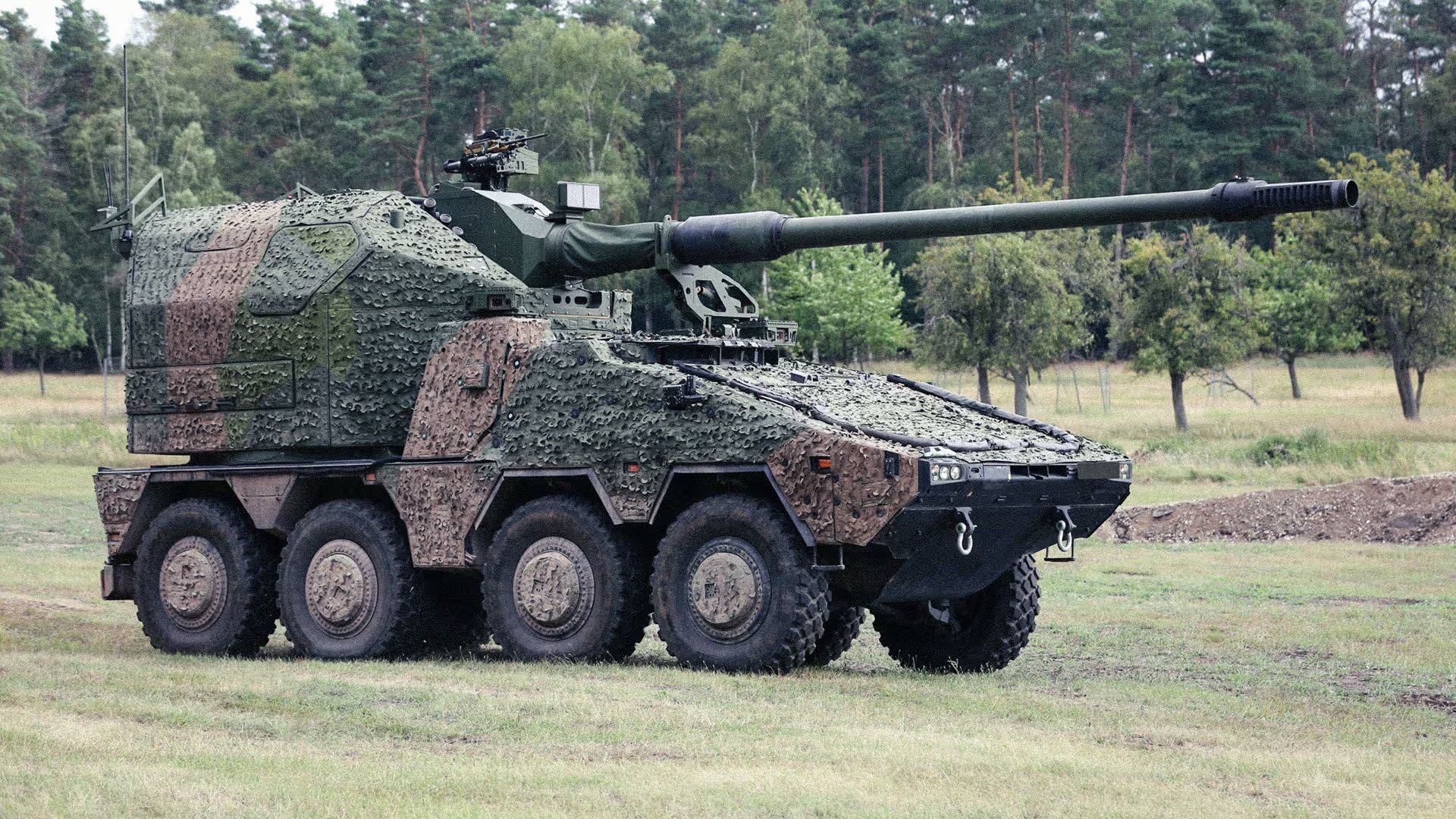
The KNDS RCH 155 is a German wheeled self-propelled howitzer that combines the Boxer 8×8 armored vehicle with an unmanned and fully automated Artillery Gun Module. Its primary weapon is a NATO-compatible 155 mm L/52 gun derived from the weapon system of the PzH 2000.
The system is operated by a crew of two located inside the protected Boxer drive module. Automated loading, gun laying, navigation and fire control reduce crew requirements and allow the vehicle to receive and execute fire missions without personnel entering the gun module.
The RCH 155 is designed for rapid indirect-fire missions and immediate relocation. Its defining capabilities include firing while moving, 360-degree engagement without support legs and Multiple Round Simultaneous Impact fire missions.
Development
The RCH 155 developed from the Artillery Gun Module created by Krauss-Maffei Wegmann, now KNDS Deutschland. The earlier module combined components of the PzH 2000 weapon system with a compact automated installation. It was also installed on an ASCOD 2 tracked chassis to create the DONAR demonstrator.
Interest in mounting the Artillery Gun Module on the Boxer platform was reported in 2014. In 2021, KMW produced the modified, lower-profile configuration identified as the RCH 155. Production is reported to have begun in 2022, while the Bundeswehr started testing the wheeled howitzer in February 2023.
Ukraine requested an initial 18 systems in July 2022. The planned supply was subsequently expanded to 54 vehicles. Germany handed over the first RCH 155 intended for Ukraine in January 2025, with the first six systems scheduled for delivery during that year.
German and British procurement
Germany selected the RCH 155 for its future medium-range indirect-fire program. In December 2025, the Bundestag approved funding associated with a framework arrangement covering prototypes, German procurement and vehicles available for export.
On 30 April 2026, the Organisation for Joint Armament Co-operation awarded ARTEC a contract on behalf of the UK Ministry of Defence for 72 RCH 155 howitzers. The British government announced the agreement in May 2026 and valued the package, including initial training and in-service support, at nearly GBP 1 billion.
Rheinmetall received a related contract in the second quarter of 2026 for 72 remote-controlled 155 mm L/52 weapon systems, onboard equipment and supporting services. The contract was valued in the low three-digit million-euro range. Deliveries are scheduled between May 2028 and June 2031, according to the Rheinmetall announcement.
The British weapon systems are planned for production at Rheinmetall's new large-caliber gun facility in Telford. Steel supplied by Sheffield Forgemasters is intended for the barrel, breech, recoil system and trunnions. KNDS UK is responsible for manufacturing the Boxer B0 drive modules in Stockport. Germany and the United Kingdom are qualifying the 155 mm L/52 remote-controlled weapon system before deliveries begin.
Design
Vehicle and crew
The wheeled RCH 155 uses the Boxer 8×8 drive module and carries its Artillery Gun Module above the rear portion of the vehicle. The gun module is physically separated from the crew compartment. The driver-system operator and commander remain inside the protected hull during operation.
The Boxer chassis provides wheeled strategic and tactical mobility. The vehicle uses an MTU 8V199 TE21 V8 diesel engine rated at 600 kW and an Allison HD4800SP automatic transmission. Its eight-wheel running gear has double-wishbone suspension with coil springs and shock absorbers.
The crew compartment incorporates ballistic, mine, improvised explosive device and nuclear, biological and chemical protection. A heating and cooling system serves both the crew area and the gun module.
Automation and fire control
The RCH 155 has automatic systems for loading projectiles and propellant charges, setting fuzes, laying the gun and calculating firing data. Its fire-control computer uses positioning, target and ammunition information to calculate azimuth, elevation, charge selection, fuze settings and the timing between rounds.
Navigation combines an inertial navigation system with satellite positioning. Target information can be received through an artillery command-and-control network or entered manually. The network-based architecture is intended to support integration with customer battlefield-management systems and possible future remotely controlled driving.
A muzzle-velocity radar measures projectile performance and supplies data to the fire-control system. The vehicle can prepare for a fire mission while moving and is designed to fire without deploying stabilizing support legs.
Armament
The primary weapon is a 155 mm L/52 gun compatible with the NATO Joint Ballistics Memorandum of Understanding. The automated magazines hold 30 fuzed projectiles and 144 modular propellant charges. Inductive fuze programming takes place during the loading process.
The mounting provides 360-degree coverage, with elevation from −2.5 to +65 degrees. The system supports indirect fire, Multiple Round Simultaneous Impact missions involving up to five projectiles and direct fire when fitted with suitable optronics. Published figures describe a sustained short-duration firing rate of eight rounds per minute, while some descriptions state a maximum of nine rounds per minute.
Maximum range depends on ammunition. Reported figures include approximately 40 km with base-bleed ammunition, 54 km with V-LAP projectiles and up to 70 km with Vulcano ammunition. An optional remote-controlled weapon station can provide secondary armament and observation equipment.
Program status
The RCH 155 has entered production and has been ordered for Ukraine and the United Kingdom. Germany is also procuring and qualifying the system. British production and deliveries remain planned activities, with the first weapon-system deliveries scheduled for May 2028.
The British program uses ARTEC, the Rheinmetall and KNDS Deutschland joint venture responsible for the Boxer family, as the main industrial organization. Rheinmetall and KNDS act as subcontractors to ARTEC for their respective vehicle and weapon-system work.
Variants
- RCH 155 wheeled: The principal version, combining the unmanned Artillery Gun Module and 155 mm L/52 gun with a Boxer 8×8 drive module.
- RCH 155 Tracked: A tracked version using the Boxer Tracked platform. KNDS describes it as a two-person system with a combat weight below 45 tonnes, a road speed of 70 km/h and an 800–900 kW engine. Further details are available from the KNDS product page.
- RCH 155 LORAS: A tracked development presented at Eurosatory 2026 with a KNDS France 155 mm L/58 gun. Trials were planned to begin in 2026.
Operators and customers
- Germany: Selected the RCH 155 for its future medium-range indirect-fire requirement and is participating in qualification of the 155 mm L/52 weapon system.
- Ukraine: A total of 54 wheeled RCH 155 howitzers is reported as ordered. The first system was handed over in January 2025.
- United Kingdom: Ordered 72 wheeled RCH 155 howitzers in 2026 for the British Army. Weapon-system deliveries are scheduled from May 2028 to June 2031.
Specifications (RCH 155 wheeled)
General characteristics
- Crew: 2
- Overall length with gun: 10.50 m
- Vehicle length: 7.93 m
- Width: 2.99 m
- Height to turret roof: 3.60 m
- Ground clearance: 0.50 m
- Combat weight: Less than 39 tonnes
- Engine: MTU 8V199 TE21 V8 diesel
- Engine power: 600 kW
- Transmission: Allison HD4800SP automatic, seven forward and three reverse ratios
Performance
- Maximum road speed: 100 km/h
- Road range: More than 700 km
- Gradient: 60 percent
- Side slope: 30 percent
- Vertical obstacle: 0.80 m
- Trench: 2.00 m
- Fording depth: 1.20 m without preparation
Armament
- Main weapon: 155 mm L/52 gun
- Traverse: 360 degrees
- Elevation: −2.5 to +65 degrees
- Ammunition: 30 fuzed projectiles and 144 modular charges
- Rate of fire: 8 rounds per minute for three minutes
- MRSI capability: Up to five projectiles
- Maximum published range: Up to 70 km with Vulcano ammunition
- Secondary armament: Optional remote-controlled weapon station
Related equipment
- Artillery Gun Module: The automated and remote-controlled gun installation from which the RCH 155 was developed.
- PzH 2000: The tracked self-propelled howitzer that supplied the basis for the RCH 155 gun and fire-control technology.
- Boxer: The modular armored vehicle family providing the wheeled drive module for the standard RCH 155.
- DONAR: An earlier combination of the Artillery Gun Module with an ASCOD 2 tracked chassis.
 Argentina
 Armenia
 Australia
 Austria
 Austria-Hungary
 Belgium
 Brazil
 United Kingdom
 United States
 Brunei
 Bulgaria
 Canada
 Chile
Chile China
China Colonial America
 Colombia
 Confederate States
 Croatia
 Czech
Czech Denmark
 Egypt
Egypt Finland
 France
 Georgia
 German Imperial
 Greece
 Holland
 Hungary
 India
India Indonesia
 Iran
Iran Iraq
Iraq Ireland
 Israel
 Italy
Italy Japan
Japan Japan (1940)
 Jordan
 Kingdom of Italy
 Malaysia
 Mexico
 Myanmar
 Nazi Germany
 Netherlands
 New Zealand
 North Korea
 Norway
 Pakistan
 Peru
Peru Philippines
 Poland
 Portugal
 Prussia
 Romania
 Russia
 Saudi Arabia
 Serbia
 Singapore
 Slovakia
 Slovenia
 South Africa
 South Korea
 Soviet Union
 Spain
Spain Sweden
 Switzerland
 Syria
Syria Taiwan
 Thailand
 Turkey
 UAE
UAE Ukraine
 Vietnam
 Yugoslavia