
History
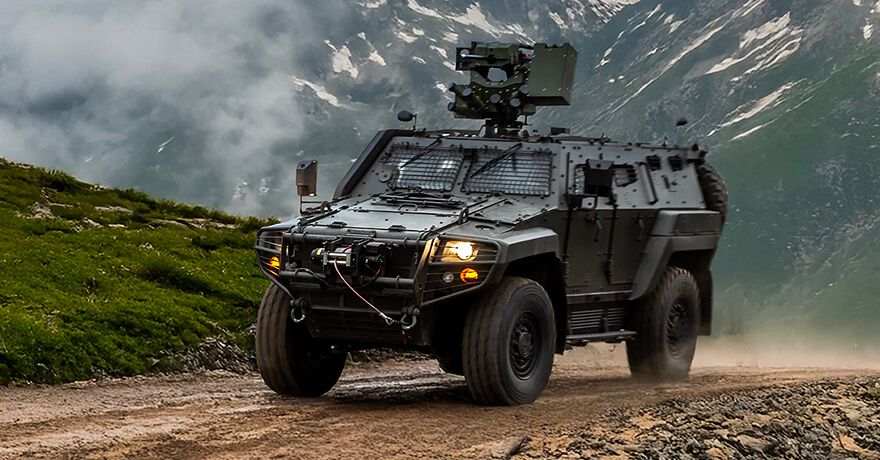
The Otokar Cobra II 4x4 is a Turkish tactical armoured vehicle developed as a larger and more heavily protected successor to the original Cobra. Otokar designed the modular platform for troop transport, border security, reconnaissance, peacekeeping and other military or internal-security missions.
The vehicle combines a mine-protected armoured hull with independent suspension, four-wheel drive and configurable mission equipment. Depending on its configuration, it can carry as many as ten people, including the driver and commander.
Cobra II was first publicly presented at the IDEF defence exhibition in May 2013. It subsequently entered Turkish service and was exported to customers in Africa, Asia, Europe and the Middle East.
Development and initial production
Otokar developed Cobra II from the earlier Cobra family while increasing internal volume, payload capacity, ballistic protection and mine protection. The new vehicle was also wider, longer and substantially heavier than its predecessor.
The first orders came from an undisclosed customer and the Turkish Armed Forces. In late 2015, Turkey ordered 82 vehicles together with associated equipment, maintenance and support. A further Turkish contract followed in June 2016.
Romanian production program
Romania selected Cobra II for its 4x4 Light Armoured Tactical Vehicle program after technical evaluation, field testing and financial assessment. On 27 November 2024, Otokar and C.N. Romtehnica signed a multi-year contract valued at 4.26 billion Romanian lei for 1,059 vehicles.
The program calls for the first 278 vehicles to be supplied from Turkey and the remaining 781 to be manufactured in Romania. Deliveries were scheduled to begin in the final quarter of 2025 and continue in batches over five years.
In April 2025, Otokar and Automecanica S.A. agreed to establish an equally owned Romanian joint venture. The company was assigned local production, engineering, marketing and after-sales work. A report dated 31 July 2026 stated that Romania had received its first domestically produced Cobra II vehicles. Further information about the production agreement is available from EDR Magazine.
Design
Hull and crew arrangement
Cobra II uses a modular armoured hull intended to protect its occupants against ballistic threats, land mines and improvised explosive devices. The manufacturer lists a floating floor, five-point seat belts, roof hatches, gun ports and vision blocks among the standard features. Maximum capacity is ten people, including the driver and commander, although the number of seats varies by mission configuration.
The standard vehicle can be built with right- or left-hand drive. Driver equipment includes an integrated display and a vision-enhancement system. A video and vehicle-data logging system, embedded diagnostics, blackout lighting and provisions for radios are also listed as standard.
Automotive system
Power is supplied by a 360 hp turbocharged diesel engine connected to an automatic transmission. A two-speed transfer case with a differential lock distributes power through axles equipped with locking differentials and geared wheel hubs.
All four wheels have independent suspension with springs and shock absorbers. The braking system uses discs at each wheel, dual circuits, anti-lock braking and air-over-hydraulic operation. The vehicle has hydraulically assisted power steering and 395/85 R20 radial tyres with run-flat inserts. A central tyre-inflation system allows tyre pressure to be adjusted for different terrain.
Protection and mission equipment
Available equipment includes a CBRN filtration system, automatic fire-extinguishing and explosion-suppression equipment, winterization, a self-recovery winch, an auxiliary power unit, navigation equipment and radio or intercom systems. Situational-awareness equipment and integrated commander displays can also be installed.
An amphibious option allows prepared variants to travel through water. Other optional equipment includes smoke-grenade launchers, a rear ramp with an emergency exit and a barricade remover. The manufacturer's 2021 Cobra II brochure notes that equipment and specifications can change with the selected configuration.
Armament
Cobra II does not have one fixed armament. It can carry an open cupola, a crew-operated machine gun or a remote-controlled weapon station. Supported mission fits include grenade launchers, automatic weapons of up to 30 mm, anti-tank guided missiles and short-range surface-to-air missiles. Weapon choice depends on payload, protection level and the customer's operational requirements.
Operational history
In 2017, Turkey deployed Cobra II vehicles along the Turkish-Syrian border. Vehicles used for border patrol were observed with surveillance radar, thermal cameras and target-detection equipment.
Bangladesh received Cobra II vehicles during 2017 and 2018. Bangladeshi vehicles have also supported United Nations peacekeeping operations.
Cobra II vehicles were documented with the Armed Forces of Ukraine in 2023. A medical-evacuation version was subsequently observed during Ukrainian operations in the Kursk region in 2024.
By 2025, Otokar described Cobra II as being used by more than 20 end users in 13 countries. Published operator lists also identify vehicles or orders in Europe, Africa, Asia and the Middle East.
Variants
- Personnel carrier: Armoured troop-transport configuration with seating determined by the selected protection and equipment package.
- Amphibious personnel carrier: Personnel carrier equipped for water operations.
- Reconnaissance and surveillance vehicle: Mission version fitted with observation, sensor and communications equipment.
- Command-and-control vehicle: Mobile command configuration with additional communications and operator workstations.
- Internal-security vehicle: Configuration intended for protected security and public-order duties.
- Jammer platform: Electronic-warfare version carrying communications-jamming equipment.
- Mortar-fire detection radar vehicle: Sensor platform equipped to locate hostile mortar fire.
- Field ambulance and medical-evacuation vehicle: Protected medical version for transporting and treating casualties.
- Anti-aircraft missile carrier: Personnel-carrier derivative fitted with a short-range surface-to-air missile launcher.
- Anti-tank vehicle: Weapon-carrier configuration; Romania's planned fleet includes a version armed with Spike missiles.
- Mortar carrier: Fire-support version included among Romania's planned configurations.
- CBRN vehicle: Specialized Romanian configuration for chemical, biological, radiological and nuclear missions.
- Engineering vehicle: Mission-specific version included in the Romanian procurement program.
- Pickup: Reduced-capacity open-rear-body version displayed for the Romanian requirement.
Operators
- Azerbaijan: Reported Cobra II operator.
- Bangladesh: Received 67 Cobra II vehicles during 2017–2018.
- Ecuador: Operates Cobra II vehicles.
- Ghana: Operates Cobra II vehicles.
- Ivory Coast: Operates Cobra II vehicles.
- Kazakhstan: Operates locally associated Cobra II vehicles.
- Morocco: Reported Cobra II customer.
- Pakistan: Reported Cobra II customer.
- Romania: Ordered 1,059 vehicles in nine configurations, with most vehicles assigned to domestic production.
- Rwanda: Operates Cobra II vehicles.
- Saudi Arabia: Reported operator.
- Senegal: Operates Cobra II vehicles, including vehicles used by the National Gendarmerie.
- Syria: Cobra II vehicles have been reported in Syrian service.
- Tunisia: Operates Cobra II vehicles.
- Turkey: Operated by the Turkish Armed Forces and security organizations.
- Ukraine: Operates personnel and medical-evacuation versions.
Specifications (Cobra II standard configuration)
General characteristics
- Configuration: 4x4 tactical armoured vehicle
- Gross vehicle weight: Up to 13,500 kg
- Maximum capacity: Up to 10 people, including driver and commander
- Length: 6.4 m with winch and spare wheel
- Width: 2.5 m
- Height over hull: 2.3 m
- Ground clearance: 0.4 m
- Engine: Turbocharged diesel
- Power: 360 hp
- Transmission: Automatic
- Transfer case: Two-speed, with differential lock
- Suspension: Fully independent, with springs and shock absorbers
- Tyres: 395/85 R20, with run-flat system
- Electrical system: 24 V
Performance
- Maximum road speed: 110 km/h
- Maximum swimming speed: At least 8 km/h for the amphibious version
- Range: 700 km
- Fording depth: 1 m
- Gradeability: 60 percent
- Side slope: 30 percent
- Vertical obstacle: 0.5 m
- Trench crossing: 1 m
- Approach angle: 45 degrees
- Departure angle: 55 degrees
Armament
- Primary armament: Mission-dependent crew-operated weapon or remote-controlled weapon station
- Supported weapon options: Machine guns, automatic weapons of up to 30 mm, grenade launchers, anti-tank guided missiles or short-range surface-to-air missiles
- Defensive equipment: Optional smoke-grenade launchers
Related equipment
- Otokar Cobra: Earlier and lighter armoured vehicle family from which Cobra II was developed.
 Argentina
 Armenia
 Australia
 Austria
 Austria-Hungary
 Belgium
 Brazil
 United Kingdom
 United States
 Brunei
 Bulgaria
 Canada
 Chile
Chile China
China Colonial America
 Colombia
 Confederate States
 Croatia
 Czech
Czech Denmark
 Egypt
Egypt Finland
 France
 Georgia
 Germany
 German Imperial
 Greece
 Holland
 Hungary
 India
India Indonesia
 Iran
Iran Iraq
Iraq Ireland
 Israel
 Italy
Italy Japan
Japan Japan (1940)
 Jordan
 Kingdom of Italy
 Malaysia
 Mexico
 Myanmar
 Nazi Germany
 Netherlands
 New Zealand
 North Korea
 Norway
 Pakistan
 Peru
Peru Philippines
 Poland
 Portugal
 Prussia
 Romania
 Russia
 Saudi Arabia
 Serbia
 Singapore
 Slovakia
 Slovenia
 South Africa
 South Korea
 Soviet Union
 Spain
Spain Sweden
 Switzerland
 Syria
Syria Taiwan
 Thailand
 UAE
UAE Ukraine
 Vietnam
 Yugoslavia