
History
KNDS CaPINT is a proposed main battle tank intended to replace the French Army's Leclerc fleet before the introduction of the Franco-German Main Ground Combat System. Its name is derived from the French term for intermediate capability.
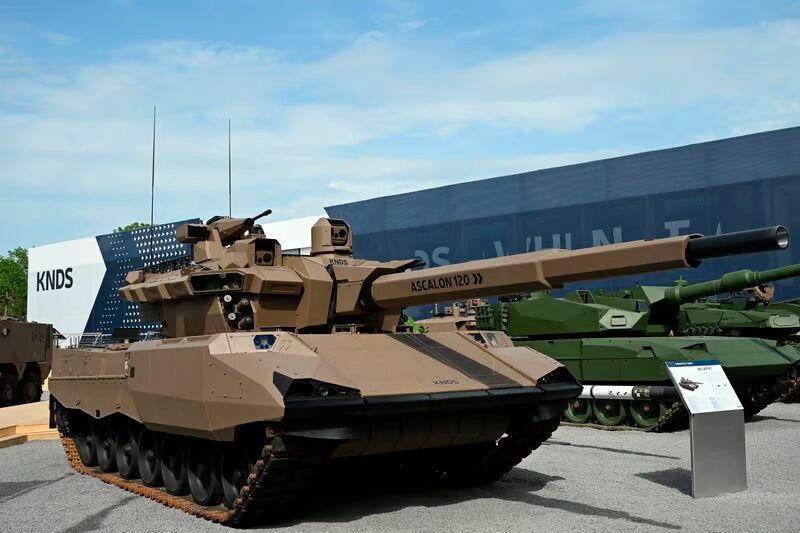
The design combines a Leopard 2-derived chassis developed in Germany with an unmanned ASCALON turret and gun system from KNDS France. It is intended to introduce some technologies planned for MGCS while remaining available earlier.
KNDS had already presented several intermediate tank concepts before CaPINT. Its 2024 main battle tank roadmap included the Leopard 2 A-RC 3.0, Leclerc Evolution and EMBT ADT140 demonstrator. These projects explored modular turrets, autoloading systems, larger-caliber ASCALON weapons, active protection and digital integration.
In January 2026, KNDS tested firing on the move with a remotely operated turret in Portugal. The company subsequently unveiled CaPINT at Eurosatory in June 2026. The displayed proposal used an upgraded chassis derived from the Leopard 2 A8 and an unmanned turret armed with a 120 mm autoloaded smoothbore gun.
The program responds to the expected gap between the retirement of the Leclerc and the arrival of MGCS, which was not expected before the mid-2040s. KNDS described CaPINT as a French national intermediate project and a possible building block for technologies that could later support MGCS.
KNDS planned to present a demonstrator to the French Directorate General for Armament as early as 2030. The stated schedule called for the first production vehicles in 2035 and deployment to French forces in 2037. These dates remained program targets rather than completed milestones.
Design
Layout and crew
CaPINT is designed for a crew of three. All crew members are positioned in a protected compartment at the front of the hull, while the main armament is installed in an unmanned turret. Removing personnel from the turret allows the crew compartment and weapon installation to be protected separately.
The proposed chassis is derived from the Leopard 2 A8. KNDS France and KNDS Deutschland were still determining responsibility for individual components. KNDS indicated that chassis protection and system interfaces would probably be French. If the Leopard-derived chassis is retained, the company intends to manufacture it in France.
Armament
The primary weapon is a 120 mm ASCALON autoloaded smoothbore gun developed by KNDS France. The turret architecture is intended to permit replacement of the 120 mm weapon with a 140 mm ASCALON gun. KNDS reported that the ASCALON development program had completed approximately 300 firings by the time CaPINT was presented.
The larger-caliber option remains a proposed upgrade rather than the armament of an operational vehicle. The modular approach is intended to allow the tank's firepower to evolve without replacing the complete platform.
Protection
The proposed protection system combines passive composite armor with reactive and active protection. Active-protection components are to be distributed between the turret and chassis. KNDS stated that it planned to use internally developed defensive effectors, but technical details remained classified.
Counter-drone warfare is one of the program's principal design areas. The vehicle is also intended to combine sensors, defensive systems and digital tools to improve protection against threats approaching from different directions.
Digital systems and robotic support
CaPINT is planned around an open digital architecture and a digital core designed to simplify later upgrades. Proposed capabilities include integrated artificial intelligence, sensor and effector coordination, and engagement of targets beyond direct line of sight.
The wider combat system is intended to include one or two robotic wingmen. These unmanned vehicles would need sufficient mobility to accompany the tank while remaining less expensive than the crewed platform. Their number and level of passive protection could change as the concept develops.
Program status
CaPINT remained a proposed intermediate main battle tank when it was unveiled in 2026. KNDS had demonstrated related turret and firing technologies, but France had not yet placed the vehicle in operational service. The planned sequence was a government demonstrator in 2030, initial production vehicles in 2035 and deployment in 2037.
The future of CaPINT is connected to French requirements and the schedule of MGCS. KNDS presented the vehicle as a way to replace the Leclerc without waiting until the projected MGCS introduction in the mid-2040s. A contemporary report on the CaPINT proposal described the production and deployment dates as company goals.
Specifications (proposed KNDS CaPINT configuration)
General characteristics
- Type: Proposed main battle tank
- Crew: Three
- Crew position: Protected compartment in the forward hull
- Chassis: Upgraded chassis derived from the Leopard 2 A8
- Turret: Unmanned modular ASCALON turret
Armament
- Main gun: 120 mm autoloaded ASCALON smoothbore gun
- Planned gun option: 140 mm ASCALON gun
Protection and equipment
- Armor: Proposed combination of passive composite and reactive protection
- Active protection: Distributed installation on the turret and chassis
- Additional capabilities: Counter-drone systems, open digital architecture, artificial-intelligence integration and support for robotic wingmen
Related equipment
- Leclerc: French main battle tank that CaPINT is intended to replace.
- Leopard 2 A8: German main battle tank serving as the basis for the proposed CaPINT chassis.
- Leopard 2 A-RC 3.0: KNDS development featuring an unmanned modular turret compatible with 120 mm and 140 mm guns.
- EMBT ADT140: KNDS technology demonstrator used to develop and display the 140 mm ASCALON turret concept.
- Main Ground Combat System: Franco-German future combat-system program for which CaPINT may provide intermediate technologies.
 Argentina
 Armenia
 Australia
 Austria
 Austria-Hungary
 Belgium
 Brazil
 United Kingdom
 United States
 Brunei
 Bulgaria
 Canada
 Chile
Chile China
China Colonial America
 Colombia
 Confederate States
 Croatia
 Czech
Czech Denmark
 Egypt
Egypt Finland
 Georgia
 Germany
 German Imperial
 Greece
 Holland
 Hungary
 India
India Indonesia
 Iran
Iran Iraq
Iraq Ireland
 Israel
 Italy
Italy Japan
Japan Japan (1940)
 Jordan
 Kingdom of Italy
 Malaysia
 Mexico
 Myanmar
 Nazi Germany
 Netherlands
 New Zealand
 North Korea
 Norway
 Pakistan
 Peru
Peru Philippines
 Poland
 Portugal
 Prussia
 Romania
 Russia
 Saudi Arabia
 Serbia
 Singapore
 Slovakia
 Slovenia
 South Africa
 South Korea
 Soviet Union
 Spain
Spain Sweden
 Switzerland
 Syria
Syria Taiwan
 Thailand
 Turkey
 UAE
UAE Ukraine
 Vietnam
 Yugoslavia