
History
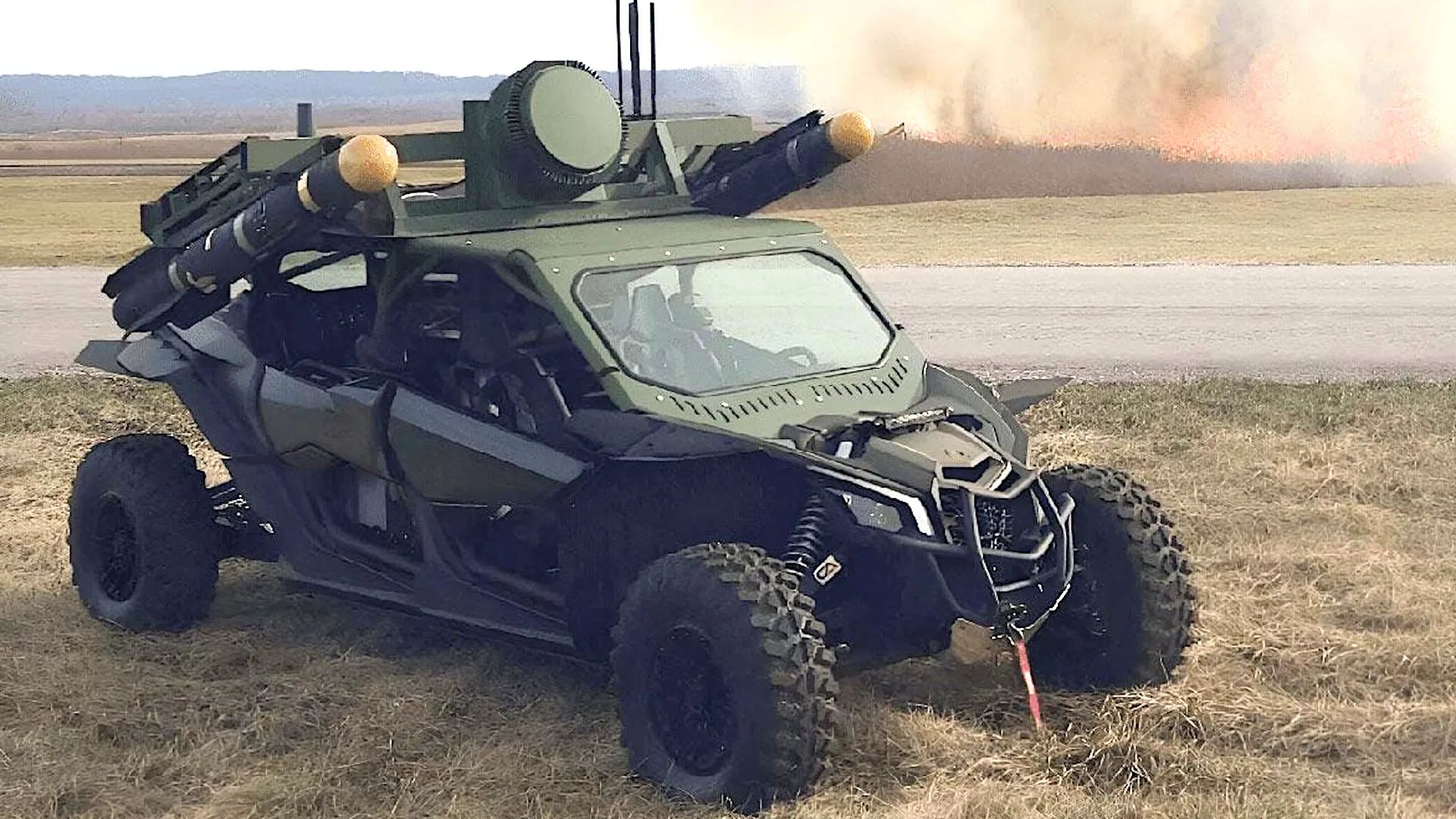
The V2X Tempest is a lightweight mobile counter-unmanned aircraft system developed in the United States for kinetic defense against Class 2 and Class 3 unmanned aerial systems. It combines a commercially derived 4x4 all-terrain vehicle with an organic radar and two ready-to-fire missiles, emphasizing rapid deployment, short exposure at the firing position, and immediate relocation after engagement.
The publicly demonstrated mobile configuration uses a Can-Am side-by-side vehicle, a roof-mounted RADA RPS-42 Multi-Mission Hemispheric Radar, and two AGM-114L Longbow Hellfire missiles. The active millimeter-wave seeker of the AGM-114L supports fire-and-forget employment, allowing the vehicle to begin withdrawing after launch rather than remaining in place to provide continuous guidance.
V2X publicly debuted Tempest at the Association of the United States Army Annual Meeting in Washington, D.C., in October 2025. The system was later observed in Ukraine in early 2026, and in August 2026 the U.S. Marine Corps ordered 10 Tempest vehicles under a $19.06 million contract that also covers software management, spares, ancillary equipment, training, and services.
Development and public debut
V2X developed Tempest in response to an immediate operational requirement from a U.S. Department of Defense partner for a highly mobile platform able to employ the AGM-114L Longbow Hellfire in the counter-UAS role. The design followed a commercial off-the-shelf approach intended to shorten development and fielding time. According to V2X information reported in the technical profile by Army Recognition, the initial commercial vehicle was obtained only a few days after the relevant contract award.
On October 13, 2025, V2X announced that Tempest would make its public debut at AUSA 2025. The company described it as a rugged, commercially based mobile fires platform with dual weapon launchers and a counter-UAS capability for detecting, engaging, and defeating Class 2–3 unmanned aircraft in adverse weather. The V2X announcement also stated that stationary, trailer-mounted variants were available for fixed-site defense.
Operational deployment and Marine Corps procurement
Tempest was publicly identified in operational use in Ukraine in early 2026. Footage released by the Ukrainian Air Force showed the mobile configuration engaging aerial targets, and subsequent reporting identified the system as Tempest. The observed vehicles carried two AGM-114L missiles and the upper-mounted radar. Ukrainian use has included engagements against Shahed/Geran-type attack drones. Reported interception totals remain operational claims rather than independently verified results.
On August 11, 2026, the U.S. Marine Corps awarded Vertex Modernization and Sustainment, operating as part of V2X, a $19.06 million contract for 10 Tempest vehicles. The award also includes software management, spare parts, ancillary equipment, training, and support services, with completion scheduled for August 10, 2027. Because the contract includes substantial support and software elements, its total value does not represent a clean per-vehicle price.
The Marine Corps contract confirms procurement of the Tempest system but does not publicly identify the receiving unit or disclose the final production chassis, missile type, radar and electro-optical sensor arrangement, engagement range, reload time, or detailed software architecture. The publicly demonstrated AGM-114L configuration therefore should not be treated as confirmed for all 10 Marine Corps vehicles until the service or contractor releases further details.
Design
Platform and mobility
The mobile Tempest is based on a commercial Can-Am 4x4 side-by-side vehicle associated with the Maverick X3 family. The open, lightweight platform prioritizes mobility and a compact profile rather than heavy ballistic protection. V2X's operating concept is built around short-duration sorties: the vehicle leaves a protected position, moves to an engagement point, launches an interceptor, and then rapidly withdraws before hostile forces can effectively cue counterfire.
The commercial-off-the-shelf architecture was selected to reduce development time and use an existing mobility platform rather than create a new military chassis. No substantial armor package has been publicly identified. Survivability therefore depends mainly on speed, dispersion, concealment, a small vehicle footprint, and frequent repositioning.
Radar and targeting
The publicly displayed configuration carries a RADA RPS-42 MHR radar above the vehicle. The RPS-42 belongs to the Multi-Mission Hemispheric Radar family and provides the system's organic detection and tracking function. The observed Tempest installation uses a single radar panel, giving it sector-oriented coverage rather than the continuous 360-degree surveillance associated with multi-panel radar arrangements.
Published descriptions also indicate that Tempest can receive or benefit from target information generated elsewhere in a wider air-defense network, allowing the vehicle to operate as a distributed shooter. The exact external-cueing and command-and-control architecture for the U.S. Marine Corps version has not been disclosed. Software management is specifically included in the 2026 Marine Corps contract, showing that software support and integration form part of the procurement.
Armament
The AUSA 2025 mobile configuration carries two AGM-114L Longbow Hellfire missiles on independent launch rails, providing two ready-to-fire interceptors. The AGM-114L uses an active millimeter-wave radar seeker and supports lock-on before launch and lock-on after launch. This fire-and-forget guidance allows the launch vehicle to begin relocating after firing without maintaining continuous laser illumination or other terminal guidance from the vehicle.
The AGM-114L is approximately 1.76 m long, 178 mm in diameter, and about 49 kg in mass. Its warhead is approximately 9 kg. Published U.S. Army performance data cited for the missile gives an engagement range of about 0.5 to 8 km, but this is missile performance data rather than a guaranteed Tempest engagement envelope. Actual counter-UAS performance depends on target altitude, speed, trajectory, detection conditions, and engagement geometry.
With two missiles ready to fire, the demonstrated Tempest configuration is optimized for selected airborne threats rather than independent defense against a mass raid of numerous low-cost drones. V2X specifically presents the system for Class 2 and Class 3 UAS, including reconnaissance, attack, and loitering-munition threats that justify a kinetic missile engagement.
Operational history
Ukraine is the first publicly known combat user of the mobile Tempest. The system was observed in Ukrainian Air Force service in early 2026 and was reported engaging Russian Shahed/Geran-type one-way attack drones. Defence Blog reported that at least two vehicles were operating in Ukraine and that the Ukrainian Air Force credited the system with 21 Shahed interceptions. That tally is a wartime claim and has not been independently verified in the supplied material.
The U.S. Marine Corps became a confirmed customer in August 2026 with an order for 10 vehicles. The service intends Tempest to add a mobile kinetic counter-UAS option for maneuver formations. The contract is scheduled for completion by August 10, 2027, but the supplied sources do not confirm that the Marine Corps vehicles are already operational.
Variants
- Tempest mobile configuration: Commercial Can-Am 4x4-based mobile counter-UAS vehicle with dual missile launchers. The publicly demonstrated configuration uses two AGM-114L Longbow Hellfire missiles and an RPS-42 MHR radar.
- Stationary trailer-mounted configuration: Fixed-site defense variant offered by V2X. A V2X engineer cited by Army Recognition stated at AUSA 2025 that more than 30 examples of a stationary configuration had already been fielded, although the supplied sources do not identify their users.
Operators
- Ukraine: Publicly observed operating the mobile Tempest in early 2026. At least two vehicles were reported in service; reported combat interception totals are operational claims.
- United States: The U.S. Marine Corps ordered 10 Tempest vehicles in August 2026. The contract includes software, spares, ancillary equipment, training, and services and is scheduled for completion in August 2027. Operational fielding of the ordered vehicles is not confirmed in the supplied sources.
Specifications (V2X Tempest mobile AUSA 2025 configuration)
General characteristics
- Type: Mobile counter-UAS and short-range air-defense system
- Platform: Commercial Can-Am 4x4 all-terrain side-by-side vehicle associated with the Maverick X3 family
- Protection concept: Mobility, dispersion, compact profile, concealment, and rapid relocation; no substantial armor package is publicly identified
- Primary sensor: RADA RPS-42 Multi-Mission Hemispheric Radar
- Radar arrangement: Single panel on the publicly observed configuration
- Operational roles: Counter-UAS, mobile short-range air defense, maneuver-force protection, and point defense
Armament
- Ready-to-fire weapons: 2 AGM-114L Longbow Hellfire missiles on two independent launch rails
- Missile guidance: Active millimeter-wave radar seeker; lock-on before launch and lock-on after launch; fire-and-forget
- Missile length: Approximately 1.76 m
- Missile diameter: 178 mm
- Missile mass: Approximately 49 kg each
- Warhead mass: Approximately 9 kg
- Published missile engagement range: Approximately 0.5–8 km; this figure does not define a guaranteed Tempest engagement envelope
- Intended target class: Class 2 and Class 3 unmanned aerial systems
Related equipment
- Marine Air Defense Integrated System (MADIS): A broader U.S. Marine Corps short-range air-defense system built around two Joint Light Tactical Vehicles carrying sensors, command-and-control equipment, electronic-warfare systems, and kinetic weapons including Stinger missiles and a 30 mm cannon. Tempest is presented as a more focused mobile missile-based counter-UAS asset rather than a replacement for MADIS.
 Argentina
 Armenia
 Australia
 Austria
 Austria-Hungary
 Belgium
 Brazil
 United Kingdom
 Brunei
 Bulgaria
 Canada
 Chile
Chile China
China Colonial America
 Colombia
 Confederate States
 Croatia
 Czech
Czech Denmark
 Egypt
Egypt Finland
 France
 Georgia
 Germany
 German Imperial
 Greece
 Holland
 Hungary
 India
India Indonesia
 Iran
Iran Iraq
Iraq Ireland
 Israel
 Italy
Italy Japan
Japan Japan (1940)
 Jordan
 Kingdom of Italy
 Malaysia
 Mexico
 Myanmar
 Nazi Germany
 Netherlands
 New Zealand
 North Korea
 Norway
 Pakistan
 Peru
Peru Philippines
 Poland
 Portugal
 Prussia
 Romania
 Russia
 Saudi Arabia
 Serbia
 Singapore
 Slovakia
 Slovenia
 South Africa
 South Korea
 Soviet Union
 Spain
Spain Sweden
 Switzerland
 Syria
Syria Taiwan
 Thailand
 Turkey
 UAE
UAE Ukraine
 Vietnam
 Yugoslavia