
History
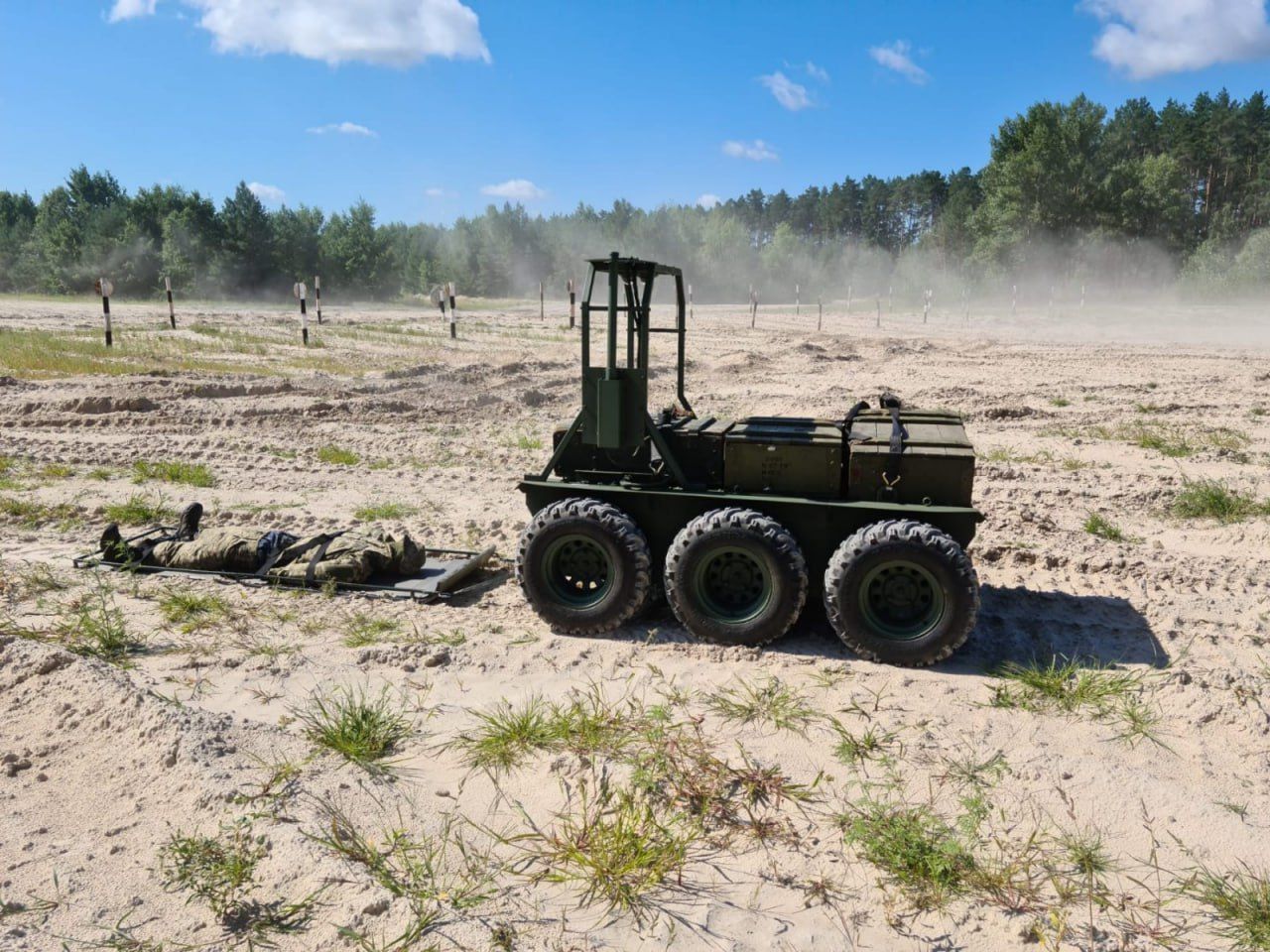
The UMP-2 Ravlyk is a Ukrainian modular unmanned ground robotic complex developed by Ukrainian Unmanned Technologies (UUT). The electrically powered 6×6 platform is intended for missions including battlefield logistics, casualty evacuation, transport of heavy equipment, reconnaissance support, and the carriage of specialized mission modules.
Ravlyk, also transliterated as Ravlik, was conceived as a common mobility platform that can be adapted for different tasks rather than as a single-purpose vehicle. Publicly available information indicates that the platform underwent field trials in frontline operational conditions in 2023 and was subsequently codified and approved for use by the Armed Forces of Ukraine.
By 2025 and 2026, the Ravlyk family had expanded to include logistics, evacuation, sensor, firefighting, industrial, and weapon-carrying configurations. UUT also began establishing European industrial partnerships intended to increase production capacity while retaining development and systems engineering in Ukraine.
Development and testing
The earliest supported physical milestone for the UMP-2 in the available material is 2023, when the platform completed field trials under frontline operational conditions. According to the RAVLYK product information, the system later completed Ukrainian military codification, received approval for use by the Armed Forces of Ukraine, and was assigned a NATO Stock Number.
The basic concept uses an electric six-wheel-drive chassis with a flat modular deck. Different equipment packages can be installed on the same mobility base, allowing the platform to serve as a cargo carrier, casualty evacuation vehicle, sensor carrier, firefighting robot, or other specialized system.
In June 2025, a Ravlyk platform was integrated with the Wolly 12.7 remotely operated weapon module and an M2 Browning 12.7 mm heavy machine gun. The resulting configuration was identified as Droid Raw 12.7. During the same month, UUT also presented a Ravlyk-based system carrying a combat module with the Ukrainian Luch Amulet anti-tank guided missile system. These weapon integrations demonstrated the ability of the modular chassis to accept combat payloads, but the available material does not establish that either configuration became a standard production variant.
European industrial partnerships
At Eurosatory 2026 in Paris, UUT entered an industrial partnership with French mobile-equipment manufacturer Haulotte concerning support for production of the UMP-2 Ravlyk platform in European Union countries. A report on the arrangement and subsequent Ravlyk development was published by Mezha Defense.
In June 2026, UUT also displayed a smaller four-wheel Ravlyk configuration at Eurosatory. The 4×4 vehicle was substantially smaller than the six-wheeled UMP-2 and was intended primarily for logistics and casualty evacuation. UUT stated that it had been built approximately two weeks before the exhibition, had completed internal testing, and was expected to proceed to joint testing with the military and product codification. The reported payload was about 300 kg. Because testing and codification were still pending, the 4×4 model should be regarded as a developing member of the Ravlyk family rather than an established operational variant.
Production in Denmark
In August 2026, Ukrainian Unmanned Technologies and Denmark's Vidar Industries agreed to establish a joint venture in Denmark for serial production of Ravlyk ground robotic systems. UUT was to retain responsibility for development, systems engineering, and further improvement of the platform in Ukraine. Vidar Industries was assigned industrialization, preparation of production lines, assembly, quality management, component logistics, regulatory compliance, and Danish corporate functions. United Tech Assets assisted with coordination between the companies. The division of responsibilities was also reported by dev.ua.
At the time of the announcement, the partners were moving through legal, engineering, and regulatory steps required to launch the project. Production therefore remained dependent on permits and commercial agreements. UUT told RBC-Ukraine that the Danish site was planned for approximately 3,000 unmanned ground vehicles per year, with an initial batch of 500 units planned during 2026 and about 200 employees at the facility. A separate report by UA.NEWS similarly described annual capacity of more than 3,000 platforms and reported planned Danish financing for approximately 1,000 systems for the Ukrainian Defense Forces.
Design
The UMP-2 Ravlyk uses a 6×6 electric drivetrain and a modular upper structure intended to accept different payloads. The electric propulsion system provides a comparatively low acoustic signature, which is useful for operations close to contested areas. The platform is remotely controlled and can carry cargo or tow a separate trailer.
Published descriptions indicate that the hull is sealed against dust and water and uses soft all-terrain tires. The system is sufficiently compact to be transported on an ordinary vehicle trailer. The modular deck provides common mechanical and electrical interfaces for mission equipment.
Modular mission system
The modular architecture is central to the Ravlyk concept. Mission modules can be changed without replacing the basic drivetrain. Published product information gives a typical module-change time of approximately 15 to 30 minutes. This allows one chassis type to support logistics, casualty evacuation, surveillance, detection, firefighting, and other tasks while using common mobility components.
Logistics configurations can carry provisions, water, fuel, ammunition, radar equipment, or other supplies. Casualty evacuation configurations use a stretcher installation to remove wounded personnel while the recovery team remains farther from exposed positions. Sensor configurations can carry cameras, thermal imagers, acoustic equipment, and other surveillance systems.
Performance figures
Published Ravlyk specifications differ between sources and configurations. Contemporary reports about the Danish production project cited a maximum speed of 12 km/h, a payload of 300 kg, a towing capacity of 2,000 kg, a range of 30 km, and up to six hours of continuous operation. Other Ravlyk material identifies heavier UMP-2 configurations with payloads of up to 500 kg and longer ranges.
The RAVLYK product information lists the UMP-2 base platform with an operational range of up to 40 km and an active operating time of up to eight hours, while individual configurations are listed with ranges from 35 to 50 km. Because these figures refer to different configurations and operating assumptions, they should not be treated as interchangeable specifications for every Ravlyk vehicle.
Operational history
The UMP-2 completed field trials in frontline operational conditions in Ukraine in 2023. The platform was subsequently codified and approved for use by the Armed Forces of Ukraine and received a NATO Stock Number. Operational service in Ukraine is reported by Iron Shield Systems through its Ukrainian technology partners.
The available material describes Ravlyk as being used or intended for frontline logistics, casualty evacuation, transport of equipment, reconnaissance support, and other missions that would otherwise expose personnel to danger. The evidence provided does not establish publicly verified fleet totals for systems already in Ukrainian service.
Variants
- UMP-2 Ravlyk: Basic modular 6×6 electric unmanned ground platform forming the core of the Ravlyk family.
- RAVLYK 2.0 Cargo: Logistics configuration listed with a 350 kg deck payload, 2,000 kg towing capacity, and 35 km range.
- RAVLYK-ARQS: Heavy-payload configuration listed with a 500 kg payload, 2,000 kg towing capacity, and range of up to 50 km.
- RAVLYK 2.0 Medevac: Casualty evacuation configuration using a stretcher module on the common 6×6 electric chassis.
- RAVLYK 2.0 Shahed Detector: Air-defense support configuration carrying an acoustic detection system and mast-mounted electro-optical equipment for detection and observation of Shahed-type unmanned aircraft.
- RAVLYK-FireGuard: Robotic firefighting configuration intended for hazardous or inaccessible areas, using water, foam, pumping, and filtration equipment.
- RAVLYK-Industrial: Civil configuration proposed for autonomous patrol of industrial facilities and critical infrastructure.
- Ravlyk 4×4: Lightweight four-wheel logistics and evacuation version unveiled at Eurosatory 2026. It was reported with a payload of about 300 kg and was still awaiting joint military testing and codification after internal testing.
- Droid Raw 12.7: Ravlyk-based weapon integration demonstrated in 2025 with the Wolly 12.7 combat module and M2 Browning 12.7 mm machine gun.
- Ravlyk with Amulet ATGM: Demonstrated Ravlyk configuration carrying a combat module with the Luch Amulet anti-tank guided missile system.
Operators
- Armed Forces of Ukraine: The UMP-2 Ravlyk has been codified and approved for use by the Ukrainian armed forces. Operational service is reported, although the available sources do not provide a confirmed public fleet total.
Specifications (UMP-2 Ravlyk base platform)
General characteristics
- Configuration: Modular unmanned ground robotic platform
- Drive: 6×6 electric
- Curb weight: 635–800 kg
- Payload: Up to 500 kg, depending on configuration
- Towing capacity: 2,000 kg
- Module change time: Approximately 15–30 minutes
Performance
- Maximum speed: 12 km/h
- Operational range: Up to 40 km for the UMP-2 base platform
- Active operating time: Up to 8 hours
 Argentina
 Armenia
 Australia
 Austria
 Austria-Hungary
 Belgium
 Brazil
 United Kingdom
 United States
 Brunei
 Bulgaria
 Canada
 Chile
Chile China
China Colonial America
 Colombia
 Confederate States
 Croatia
 Czech
Czech Denmark
 Egypt
Egypt Finland
 France
 Georgia
 Germany
 German Imperial
 Greece
 Holland
 Hungary
 India
India Indonesia
 Iran
Iran Iraq
Iraq Ireland
 Israel
 Italy
Italy Japan
Japan Japan (1940)
 Jordan
 Kingdom of Italy
 Malaysia
 Mexico
 Myanmar
 Nazi Germany
 Netherlands
 New Zealand
 North Korea
 Norway
 Pakistan
 Peru
Peru Philippines
 Poland
 Portugal
 Prussia
 Romania
 Russia
 Saudi Arabia
 Serbia
 Singapore
 Slovakia
 Slovenia
 South Africa
 South Korea
 Soviet Union
 Spain
Spain Sweden
 Switzerland
 Syria
Syria Taiwan
 Thailand
 Turkey
 UAE
UAE Vietnam
 Yugoslavia