
History
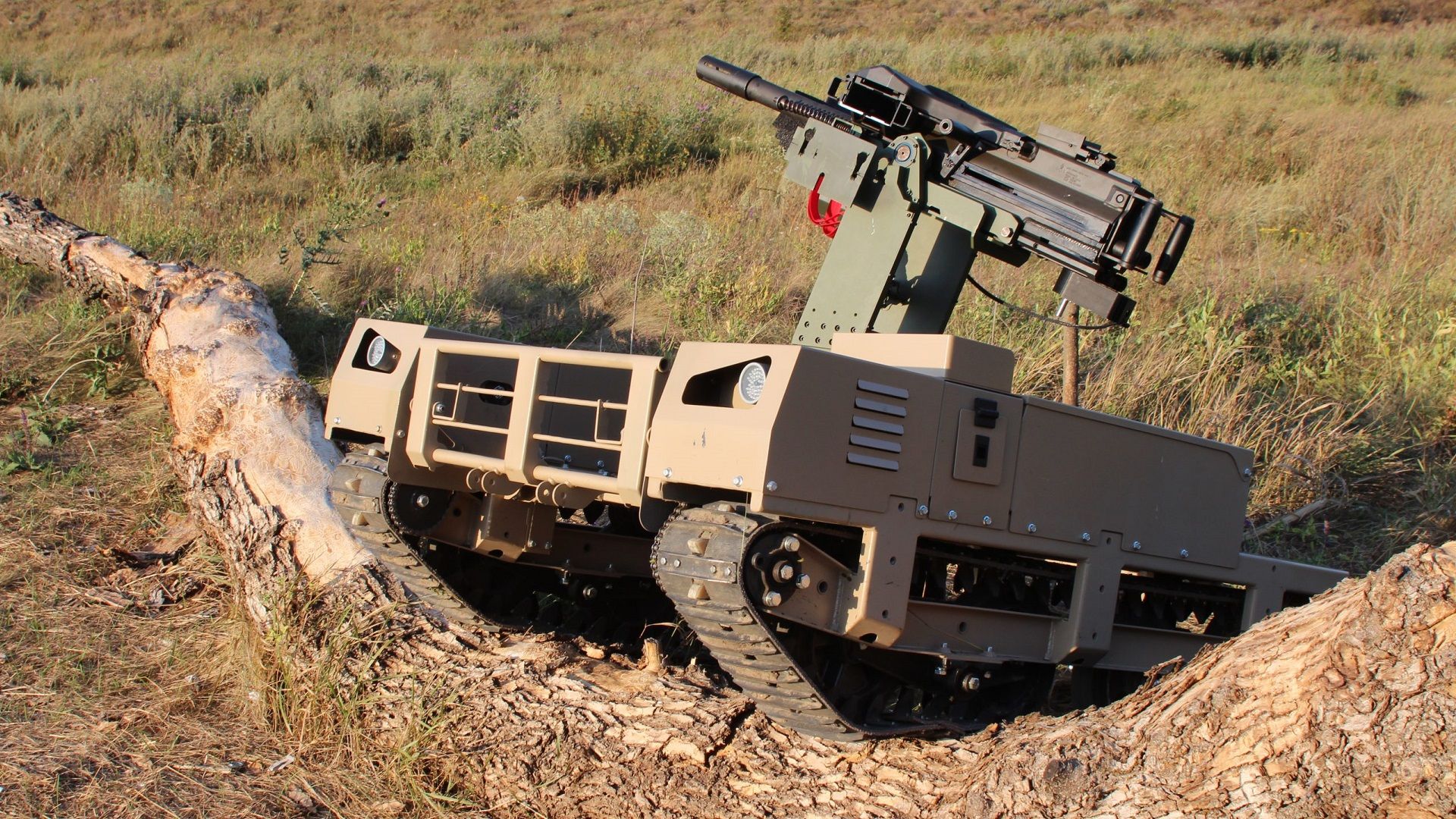
The TerMIT–Khizhak is a Ukrainian unmanned ground combat system developed by integrating Tencore's tracked TerMIT platform with the Khizhak remotely operated weapon station from UGV Robotics. The combination provides a mobile platform for ground fire support and short-range engagement of aerial targets.
The two components were initially developed and codified separately. Their subsequent integration produced a single officially recognized combat vehicle with stabilized armament, automated target tracking, and a modular tracked chassis.
Tencore originally developed TerMIT as a logistics vehicle for transporting supplies, towing equipment, and evacuating casualties. The platform later evolved to accept engineering, electronic-warfare, mine-laying, and weapon modules. Earlier TerMIT versions were reportedly used by more than 20 Ukrainian brigades, while the manufacturer subsequently introduced TerMIT 2.0 with greater speed and range.
By May 2025, Tencore was testing the Khizhak module on TerMIT alongside other Ukrainian weapon stations. The company's development account is described in an interview with Tencore. The TerMIT platform was codified and approved for Ukrainian military use in June 2025. The Ministry of Defence separately approved Khizhak in July 2025, as reported by Ukrinform.
In August 2026, Tencore announced that the integrated TerMIT–Khizhak configuration had been codified as a single combat system. Codification made the combined vehicle eligible for serial production and formal procurement. The manufacturer planned to present it in Denmark at DALO Industry Days to NATO delegations, Danish military representatives, and foreign procurement agencies. Details of the announcement were also published by Mezha Defense.
Design
Tracked platform
TerMIT 2.0 is a modular, remotely controlled tracked vehicle intended for logistics, casualty evacuation, engineering work, and combat missions. Its low center of gravity and tracked running gear are intended to support movement over rough terrain, slopes, trenches, sand, snow, and other surfaces that can restrict wheeled vehicles.
The unarmored TerMIT 2.0 base vehicle has a reported mass of 570 ± 20 kg. The armored configuration weighs 640 ± 20 kg and incorporates protection tested under STANAG 2920/AEP-2920 V50 criteria. The platform reaches 15 km/h on firm surfaces and 12 km/h off road, with a reported maximum travel range of 40 km.
The vehicle is operated remotely through a ground-control station. Earlier TerMIT configurations offered compact, analog, and digital control arrangements. The available evidence does not identify which communication package is standard on the codified TerMIT–Khizhak system.
Khizhak combat module
Khizhak is a lightweight remotely operated weapon station that can be installed at a fixed position or on a mobile carrier. Its mounting rotates through 360 degrees. Standard vertical aiming limits are from −12 to +80 degrees, while an alternative installation can increase maximum depression to −20 degrees.
The module accepts 7.62 mm machine guns using either Soviet-pattern or NATO-standard ammunition. The available sources do not identify a single standard machine-gun model for the integrated system.
A gyrostabilized mounting supports aimed fire while the carrier is moving. The system also incorporates a ballistic computer and software described as using artificial intelligence for automatic target recognition and tracking. Reported target classes include ground targets and small unmanned aircraft, including FPV drones at short range. Human control and engagement procedures are not described in the available material.
Modular roles
TerMIT's interchangeable equipment architecture allows the base vehicle to perform missions beyond the Khizhak configuration. Reported alternatives include a casualty-evacuation module with a payload of 215 ± 10 kg, a 400-litre cargo body carrying up to 270 kg, remote mine-laying equipment, and a module for deploying barbed wire. These are platform options and are not part of the codified Khizhak combat configuration.
Program status
As of August 2026, the TerMIT–Khizhak combination had received Ukrainian codification as one combat system. This status supports procurement and serial manufacture, but the available sources do not confirm production quantities, deliveries, or operational deployment of the exact integrated configuration.
Specifications (TerMIT 2.0–Khizhak)
General characteristics
- Type: Tracked unmanned ground combat system
- Manufacturers: Tencore for the TerMIT platform; UGV Robotics for the Khizhak combat module
- Base-platform mass without armor: 570 ± 20 kg
- Base-platform mass with armor: 640 ± 20 kg
- Protection: STANAG 2920/AEP-2920 V50 ballistic-fragmentation protection for the base platform
- Control: Remote operation
Performance
- Maximum speed on firm surfaces: 15 km/h
- Maximum off-road speed: 12 km/h
- Maximum travel range: 40 km
Armament and fire control
- Armament: One compatible 7.62 mm Soviet-pattern or NATO-standard machine gun
- Traverse: 360 degrees
- Elevation: −12 to +80 degrees
- Optional maximum depression: −20 degrees
- Stabilization: Gyrostabilized weapon mounting
- Fire-control equipment: Ballistic computer with automatic target recognition and tracking
 Argentina
 Armenia
 Australia
 Austria
 Austria-Hungary
 Belgium
 Brazil
 United Kingdom
 United States
 Brunei
 Bulgaria
 Canada
 Chile
Chile China
China Colonial America
 Colombia
 Confederate States
 Croatia
 Czech
Czech Denmark
 Egypt
Egypt Finland
 France
 Georgia
 Germany
 German Imperial
 Greece
 Holland
 Hungary
 India
India Indonesia
 Iran
Iran Iraq
Iraq Ireland
 Israel
 Italy
Italy Japan
Japan Japan (1940)
 Jordan
 Kingdom of Italy
 Malaysia
 Mexico
 Myanmar
 Nazi Germany
 Netherlands
 New Zealand
 North Korea
 Norway
 Pakistan
 Peru
Peru Philippines
 Poland
 Portugal
 Prussia
 Romania
 Russia
 Saudi Arabia
 Serbia
 Singapore
 Slovakia
 Slovenia
 South Africa
 South Korea
 Soviet Union
 Spain
Spain Sweden
 Switzerland
 Syria
Syria Taiwan
 Thailand
 Turkey
 UAE
UAE Vietnam
 Yugoslavia