
History
The Navy-Marine Expeditionary Ship Interdiction System (NMESIS) and the Amphibious Combat Vehicle (ACV) represent two complementary parts of the U.S. Marine Corps' shift toward distributed littoral operations. NMESIS provides mobile land-based anti-ship fires, while the ACV moves Marines from ship to shore and onward across land. The two systems were shown together during the 250th Amphibious Capabilities Demonstration at Marine Corps Base Camp Pendleton, California, in 2026.
NMESIS combines the remotely operated ROGUE-Fires vehicle with the Naval Strike Missile (NSM). The launcher vehicle is derived from the Joint Light Tactical Vehicle (JLTV), while the missile was developed by Kongsberg Defence & Aerospace and is produced in cooperation with RTX/Raytheon. The ACV was developed by BAE Systems in partnership with Iveco Defence Vehicles as the replacement for the Marine Corps' long-serving Assault Amphibious Vehicle.
In Marine Corps doctrine, the systems serve different but connected functions. ACVs provide protected amphibious mobility for small expeditionary formations, while NMESIS gives those formations a long-range weapon for engaging hostile surface ships from dispersed coastal positions. Their joint presentation in 2026 illustrated the service's emphasis on mobility, precision fires, survivability, and naval integration under Force Design 2030.
Development of NMESIS
The NMESIS program emerged from the Marine Corps requirement for a ground-based anti-ship missile capability suited to contested littoral areas. Research on the program describes ROGUE-Fires as an unmanned JLTV-derived platform able to carry the NSM and operate under remote control. A Naval Postgraduate School study of NMESIS battery organization also identifies ROGUE-Fires as the vehicle element of the broader ship-interdiction system and discusses the Marine Corps' plan to replace parts of its legacy cannon artillery structure with missile units. The study is available from the Naval Postgraduate School.
NMESIS reached an important physical test milestone in 2021. The Marine Corps and Raytheon tested the system off California in April 2021, firing an NSM against a surface target. In August 2021, NMESIS participated in a Sink at Sea live-fire event in Hawaii during Large Scale Exercise 2021. These events demonstrated the basic concept of launching a naval anti-ship missile from an unmanned land vehicle. A technical overview of the program and the 2021 tests is provided by Naval Technology.
On November 26, 2024, the 3rd Marine Littoral Regiment, 3rd Marine Division, formally received NMESIS at Marine Corps Base Hawaii following initial operational test and evaluation activity. On March 3, 2025, the 12th Marine Littoral Regiment in Okinawa integrated an NMESIS anti-ship missile battery into the 12th Littoral Combat Team. These milestones moved the system from demonstration toward regular use within Marine Littoral Regiment formations.
Development of the Amphibious Combat Vehicle
The ACV was developed to replace the tracked Assault Amphibious Vehicle after more than fifty years of Marine Corps service. BAE Systems worked with Iveco Defence Vehicles on an 8x8 wheeled design intended to improve protection, road and cross-country mobility, and flexibility during amphibious operations. The vehicle retains the ability to operate from water to land while providing a protected troop compartment for embarked Marines.
By the 2026 Camp Pendleton demonstration, the Marine Corps was presenting the ACV as the armored mobility component of a wider expeditionary force that also included long-range precision fires, aviation, reconnaissance, and logistics. The event did not depict a return to concentrated amphibious assaults. Instead, it emphasized smaller formations moving from ships to temporary coastal positions and then repositioning as required.
2026 Amphibious Capabilities Demonstration
A U.S. Marine Corps video produced on July 31, 2026, documented the 250th Amphibious Capabilities Demonstration at Camp Pendleton. NMESIS and ACVs were shown as part of the Corps' 250th-anniversary activities and the United States Semiquincentennial. The demonstration combined amphibious armored maneuver with precision anti-ship fires to show how Marine units can contribute to distributed maritime operations.
The demonstration also highlighted the relationship between Marine ground units and the wider naval force. Amphibious ships, aviation, reconnaissance, logistics, armored vehicles, and missile systems were presented as parts of a common expeditionary structure. The concept relies on dispersed forces that can establish temporary positions, receive targeting information through joint command-and-control networks, conduct strikes, and then move before an adversary can respond effectively.
Design
NMESIS architecture
NMESIS consists of the ROGUE-Fires launcher vehicle, the Naval Strike Missile, and command-and-control elements. ROGUE-Fires is an unmanned or remotely operated derivative of the Oshkosh JLTV. Unlike a standard crewed JLTV, the launcher configuration does not require a conventional crew cab. Cameras, sensors, remote-control equipment, and the missile launcher are integrated on the vehicle so Marines can operate it from a separated control position.
Sources consistently describe the operational launcher configuration as carrying two NSMs in sealed launch canisters. Some secondary material gives conflicting descriptions of the launcher cell count, but the 2026 demonstration account and multiple technical descriptions support a two-missile load per ROGUE-Fires vehicle. The system is therefore treated here as the two-missile NMESIS launcher configuration.
The vehicle's JLTV-derived chassis provides road and off-road mobility for dispersed coastal operations. Remote operation reduces the need to expose personnel at the launcher during movement and firing. The launcher is intended to move between concealed or temporary firing positions rather than remain in a fixed coastal battery.
Naval Strike Missile
The NSM is a subsonic, sea-skimming cruise missile designed for engagements against surface ships. The supplied sources give a range of approximately 185 km (100 nautical miles), with some descriptions stating more than 100 nautical miles. The missile uses inertial and GPS navigation for mid-course guidance and an imaging infrared seeker for terminal target discrimination. Terrain-following and a low-altitude flight profile are used to reduce exposure to shipboard sensors, while terminal maneuvers complicate interception.
The NSM is associated with Kongsberg Defence & Aerospace and RTX/Raytheon cooperation. The missile and launcher are integrated into a networked fire-control arrangement rather than operating as a fully autonomous weapon. The self-driving or remote-control functions of ROGUE-Fires do not independently authorize or conduct missile firing; a Marine operator remains responsible for mission planning and launch control.
Command and control
NMESIS is designed to receive targeting information from external sensors and higher-level command networks. A command-and-control vehicle supports fire planning, communications, and coordination between launcher sections. The Naval Postgraduate School material describes the NSM weapon-control arrangement as including a fire-direction terminal, arming and control equipment, a radio-frequency link to the fire-control system, and interfaces for tactical networks such as Link 16 and Variable Message Format.
This architecture supports the Marine Corps concept of separating sensors, command nodes, and launchers across a wider area. The system's effectiveness therefore depends not only on the missile and launcher, but also on resilient communications, targeting data, logistics, and the ability to move launchers between firing positions.
Amphibious Combat Vehicle layout
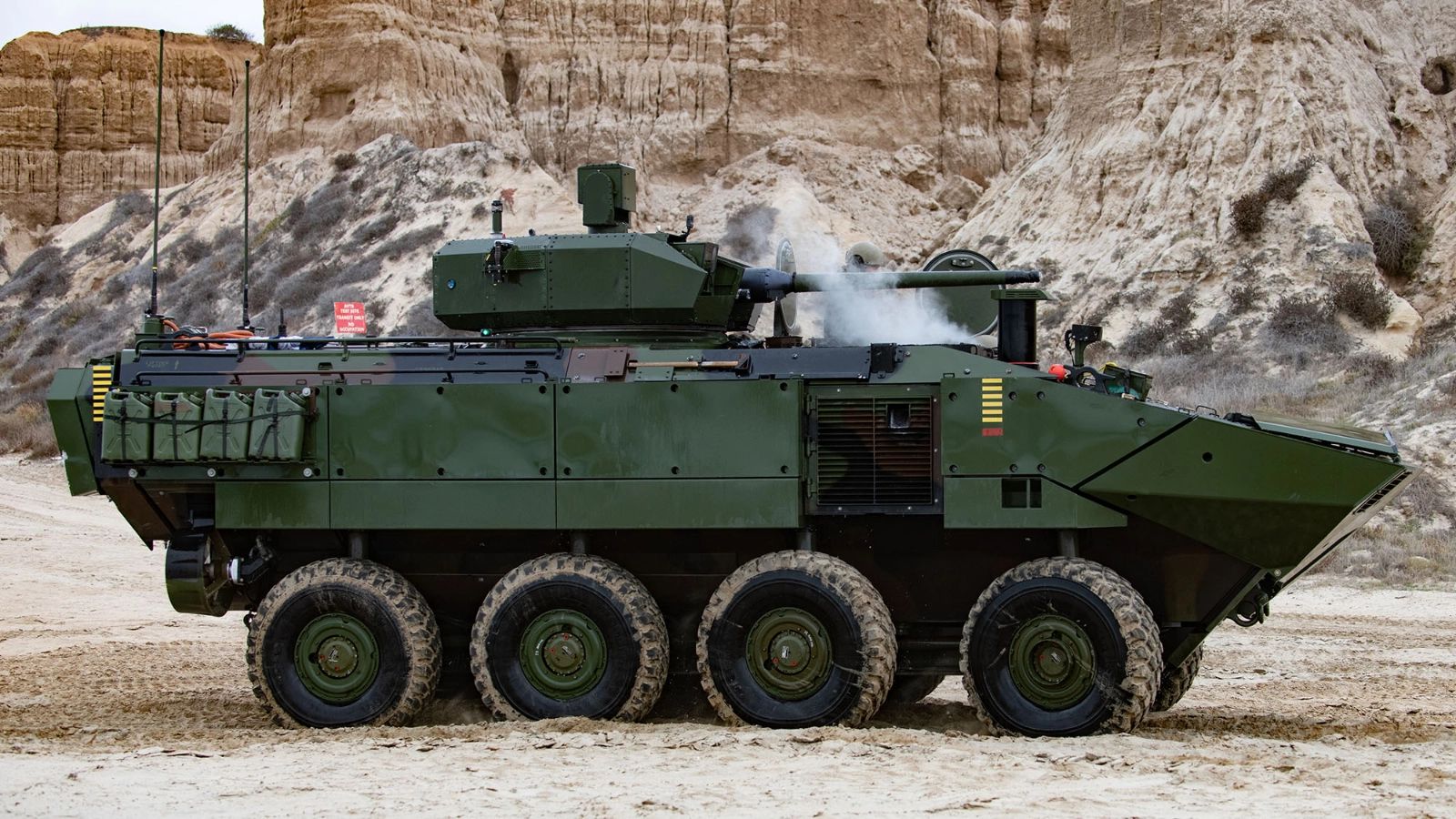
The ACV is an 8x8 wheeled amphibious armored vehicle with a crew of three and space for thirteen combat-equipped Marines in the personnel-carrier configuration described in the source material. It uses a V-shaped hull intended to improve survivability against mines and improvised explosive devices, together with improved ballistic protection compared with the legacy Assault Amphibious Vehicle.
The vehicle is designed to transition from water to land without transferring the embarked infantry to another platform at the shoreline. This allows Marine units to move from amphibious ships toward inland objectives while remaining inside an armored vehicle. The wheeled layout also gives the ACV a different land-mobility concept from the tracked vehicle it replaces.
The ACV family includes personnel-carrier, command, recovery, and 30 mm cannon configurations. This family approach allows the same basic vehicle architecture to support troop transport, command functions, recovery support, and direct-fire missions.
Operational history
NMESIS has been used in Marine Corps test, training, and force-integration events since 2021. The April 2021 California firing and August 2021 Hawaii SINKEX established the basic land-based anti-ship launch concept. Formal receipt by the 3rd Marine Littoral Regiment in November 2024 marked a later stage in fielding, while integration with the 12th Marine Littoral Regiment in Okinawa in 2025 expanded the system's presence in the Indo-Pacific.
Secondary reporting also describes NMESIS deployments and exercises in the Philippines during 2025, including movement of launchers to Batanes Province during Balikatan. Such deployments illustrate the intended expeditionary role: launchers can be moved to islands or coastal terrain, dispersed, connected to external sensors, and used to threaten surface ships approaching key maritime passages. A detailed secondary overview of this concept and timeline is available from CombatTech.
The ACV's operational role is different. It is the protected amphibious mobility element for Marine infantry and supporting units. At the 2026 Camp Pendleton event, ACVs demonstrated movement from the amphibious environment into land operations while NMESIS represented the long-range anti-ship fires element. The pairing showed how a Marine formation could combine maneuver and sea-denial capabilities without treating the two vehicles as a single integrated weapon system.
In the Indo-Pacific context described by the source material, Marine Littoral Regiments equipped with NMESIS are intended to support sea denial from dispersed positions, while ACVs can move personnel and equipment across littoral terrain. The concept depends on joint sensors, naval aviation, surface forces, logistics, and command-and-control networks. The sources also emphasize that sustained operations would require reliable resupply and continued access to forward positions under contested conditions.
Variants
- NMESIS: The supplied technical source identifies no separate NMESIS variants. The system described here is the ROGUE-Fires launcher carrying the Naval Strike Missile.
- ACV personnel carrier: Troop-transport configuration with a crew of three and capacity for thirteen combat-equipped Marines.
- ACV command variant: Command-and-control configuration within the ACV family.
- ACV recovery variant: Recovery and support configuration for the ACV family.
- ACV-30: Direct-fire variant equipped with a 30 mm cannon.
Operators
- United States Marine Corps: Operator of both NMESIS and the Amphibious Combat Vehicle family. NMESIS has been assigned to Marine Littoral Regiment formations, while ACVs provide amphibious armored mobility for Marine units.
Specifications
NMESIS with ROGUE-Fires and Naval Strike Missile
- Type: Ground-based anti-ship missile system.
- Launcher vehicle: ROGUE-Fires remotely operated/unmanned vehicle derived from the Joint Light Tactical Vehicle.
- Missile: Naval Strike Missile.
- Missiles per launcher: 2.
- Missile range: Approximately 185 km (100 nautical miles).
- Missile speed: Subsonic, approximately Mach 0.9.
- Guidance: Inertial navigation and GPS with imaging infrared terminal guidance; terrain-following and sea-skimming flight are described in the supplied sources.
- Operation: Remotely controlled launcher with Marine-operated mission planning and fire control.
Amphibious Combat Vehicle personnel carrier
- Type: 8x8 wheeled amphibious armored personnel carrier.
- Crew: 3.
- Embarked Marines: 13 combat-equipped personnel.
- Protection: Ballistic protection and a V-shaped hull designed to improve survivability against mines and improvised explosive devices.
- Mobility: Amphibious operation with transition from water to land and continued movement inland.
Related equipment
- Joint Light Tactical Vehicle: The chassis family from which the ROGUE-Fires NMESIS launcher vehicle is derived.
- Naval Strike Missile: The anti-ship cruise missile carried by NMESIS.
- Assault Amphibious Vehicle: The legacy Marine Corps amphibious vehicle replaced by the ACV family.
 Argentina
 Armenia
 Australia
 Austria
 Austria-Hungary
 Belgium
 Brazil
 United Kingdom
 Brunei
 Bulgaria
 Canada
 Chile
Chile China
China Colonial America
 Colombia
 Confederate States
 Croatia
 Czech
Czech Denmark
 Egypt
Egypt Finland
 France
 Georgia
 Germany
 German Imperial
 Greece
 Holland
 Hungary
 India
India Indonesia
 Iran
Iran Iraq
Iraq Ireland
 Israel
 Italy
Italy Japan
Japan Japan (1940)
 Jordan
 Kingdom of Italy
 Malaysia
 Mexico
 Myanmar
 Nazi Germany
 Netherlands
 New Zealand
 North Korea
 Norway
 Pakistan
 Peru
Peru Philippines
 Poland
 Portugal
 Prussia
 Romania
 Russia
 Saudi Arabia
 Serbia
 Singapore
 Slovakia
 Slovenia
 South Africa
 South Korea
 Soviet Union
 Spain
Spain Sweden
 Switzerland
 Syria
Syria Taiwan
 Thailand
 Turkey
 UAE
UAE Ukraine
 Vietnam
 Yugoslavia