
History
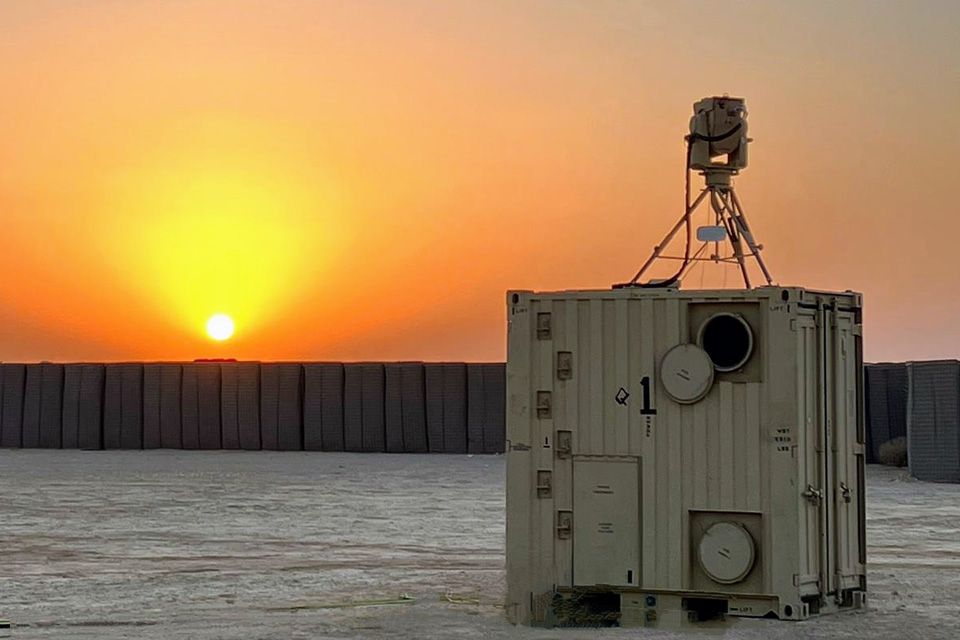
The Boeing Compact Laser Weapon System, commonly abbreviated CLWS, is an American modular high-energy laser developed to detect, track, and defeat unmanned aerial vehicles. It can be installed in fixed, containerised, and vehicle-mounted configurations and integrated with external radars and military command-and-control networks.
Boeing developed the compact system during the 2010s as a lower-power and more deployable alternative to large experimental laser weapons. CLWS is intended primarily for counter-UAS defence of bases, infrastructure, mobile forces, and forward operating locations rather than for interception of high-speed missiles or crewed combat aircraft.
The United States Marine Corps used CLWS during a multi-year overseas deployment. The system also participated in repeated American and international counter-drone exercises, allowing military personnel to operate it against individual targets and groups of drones under different environmental conditions.
Testing
During Canada's 2024 Innovation for Defence Excellence and Security Counter-UAS Sandbox, two CLWS units operated in fixed and Polaris RZR-mounted configurations. They received radar tracks, visually identified targets, and engaged high-performance first-person-view drones and a five-drone swarm.
The demonstrated engagement sequence covered distances from approximately 200 m to 2.5 km. The two systems operated independently and cooperatively, showing that more than one lower-power laser could be connected to the same defensive network.
At the 2024 Red Sands exercise in Saudi Arabia, a 5 kW CLWS defeated Group 3 unmanned aircraft, a category that can include substantially larger vehicles than commercial quadcopters. Boeing integrated the laser with the U.S. Army Forward Area Air Defense Command and Control network and received radar cueing.
European deployment
In July 2026, United States Air Forces in Europe–Air Forces Africa announced that CLWS had been assessed and deployed to undisclosed locations in its theatre. Operators received training as part of a layered air-base defence effort.
The deployed architecture combined directed energy with electronic warfare and kinetic interceptors. A laser is not suitable for every target or weather condition, so commanders can select a different effector when jamming is ineffective, immediate destruction is required, or the laser cannot maintain sufficient energy on the target.
Design
CLWS combines a solid-state laser, beam director, electro-optical sensors, tracking equipment, operator controls, power and thermal-management hardware, and network interfaces. Its modular architecture permits components to be packaged for a fixed site, container, or light tactical vehicle.
Detection and tracking
An external surveillance radar can detect an approaching object and automatically transfer its track to CLWS. The optical system then follows the target and provides imagery for classification. An operator confirms that the object is hostile or unauthorised before authorising engagement.
Human identification is important around airfields and populated areas, where friendly drones, crewed aircraft, birds, and civilian objects may occupy the same airspace. Open interfaces allow CLWS to exchange cueing and status with compatible command systems.
Laser effector
The 5 kW version concentrates continuous laser energy on a selected part of the target. Sustained heating can damage a propeller, motor, control surface, sensor, battery, or structural element until the aircraft can no longer fly.
Unlike a missile or projectile, the beam travels at the speed of light and does not require ammunition in the conventional sense. The number of engagements is limited mainly by available electrical power, cooling, component condition, and the time required for each target.
Operational limitations
Effective range depends on visibility, dust, rain, fog, turbulence, target material, target motion, beam quality, and the ability to hold the beam on one vulnerable area. Smoke or obscurants can reduce energy reaching the target.
A laser also works along a line of sight. Terrain, buildings, vegetation, and the horizon restrict coverage, while the beam director can address only a limited number of aimpoints at the same instant. These constraints explain why CLWS is fielded as one layer rather than a complete air-defence solution.
Operational history
Boeing reported that military operators had defeated hundreds of drones with CLWS across demonstrations, scenarios, and deployments by 2024. Targets included FPV aircraft, swarms, and Group 3 systems. Manufacturer totals combine testing and operational events and do not disclose every engagement condition.
The 2026 USAFE-AFAFRICA deployment placed CLWS within a theatre-wide effort to protect dispersed air operations. Exact sites, quantities, readiness, and operational engagements were not disclosed.
Variants
- Fixed CLWS — site-defence configuration using stationary power and support equipment.
- Containerised CLWS — deployable package for base and expeditionary protection.
- Mobile CLWS — system integrated on a light tactical or all-terrain vehicle.
- 5 kW CLWS — demonstrated configuration used against Group 3 unmanned aircraft at Red Sands.
Operators
- United States — United States Marine Corps and United States Air Force deployments and evaluation; Army organisations have supported integration and testing.
Specifications (CLWS 5 kW configuration)
General characteristics
- Type: Solid-state high-energy laser counter-UAS system.
- Laser power: 5 kW for the demonstrated configuration.
- Configurations: Fixed, containerised, and vehicle-mounted.
- Targeting: Radar cueing with electro-optical identification and precision tracking.
- Control: Human-authorised engagement through an operator console.
- Network integration: Open architecture compatible with military command-and-control systems.
Performance
- Demonstrated engagement distances: Approximately 200 m to 2.5 km (220 yd to 1.6 mi) during specified 2024 counter-UAS trials.
- Demonstrated target classes: FPV drones, multi-drone groups, and Group 3 unmanned aircraft.
Related equipment
- Forward Area Air Defense Command and Control — U.S. Army network used to cue CLWS during testing.
- Electronic counter-UAS systems — complementary layer that disrupts drone navigation or control links.
- APKWS counter-UAS configuration — kinetic interceptor option evaluated for targets outside suitable laser conditions.
 Argentina
 Armenia
 Australia
 Austria
 Austria-Hungary
 Belgium
 Brazil
 United Kingdom
 Brunei
 Bulgaria
 Canada
 Chile
Chile China
China Colonial America
 Colombia
 Confederate States
 Croatia
 Czech
Czech Denmark
 Egypt
Egypt Finland
 France
 Georgia
 Germany
 German Imperial
 Greece
 Holland
 Hungary
 India
India Indonesia
 Iran
Iran Iraq
Iraq Ireland
 Israel
 Italy
Italy Japan
Japan Japan (1940)
 Jordan
 Kingdom of Italy
 Malaysia
 Mexico
 Myanmar
 Nazi Germany
 Netherlands
 New Zealand
 North Korea
 Norway
 Pakistan
 Peru
Peru Philippines
 Poland
 Portugal
 Prussia
 Romania
 Russia
 Saudi Arabia
 Serbia
 Singapore
 Slovakia
 Slovenia
 South Africa
 South Korea
 Soviet Union
 Spain
Spain Sweden
 Switzerland
 Syria
Syria Taiwan
 Thailand
 Turkey
 UAE
UAE Ukraine
 Vietnam
 Yugoslavia