
History
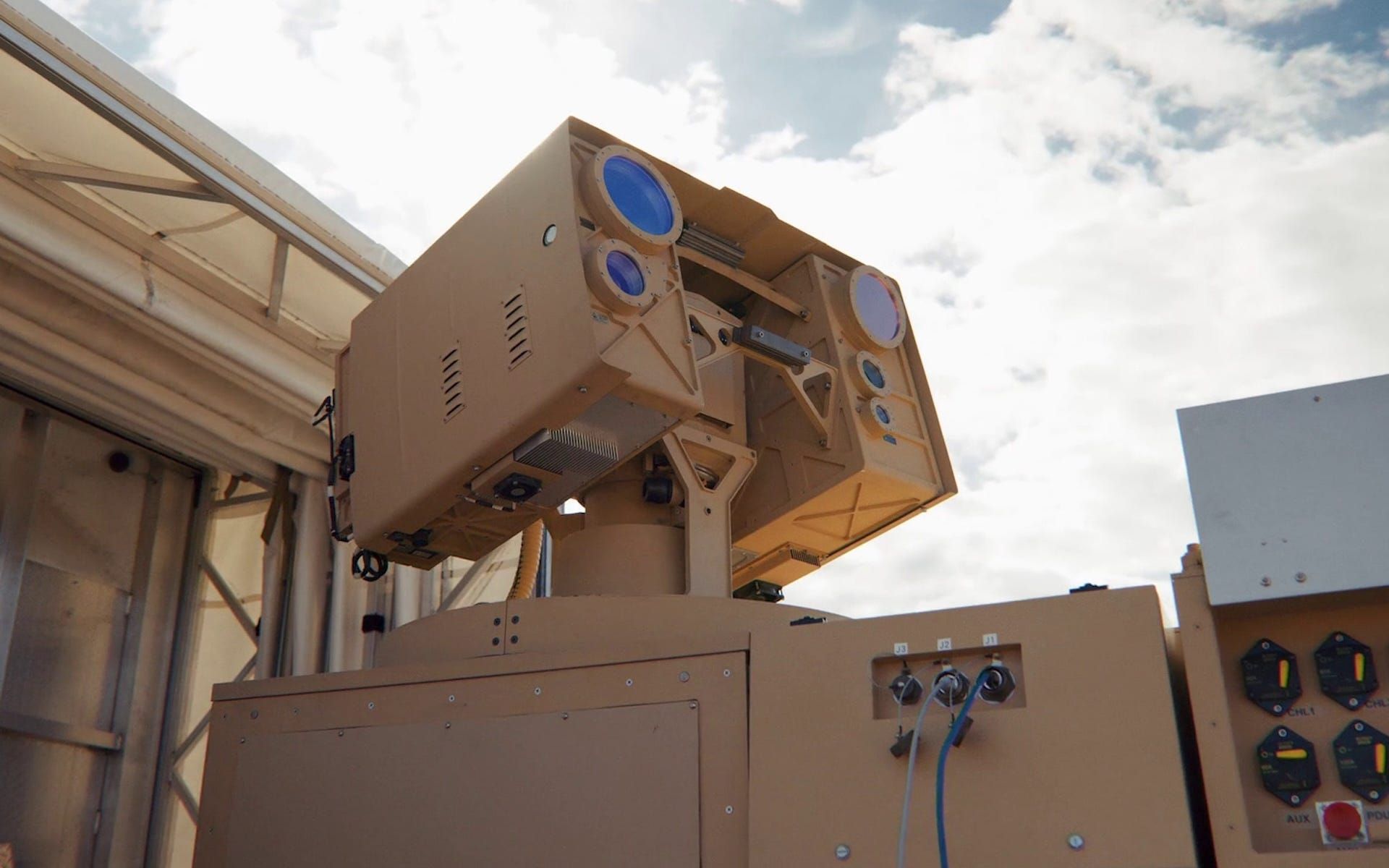
The Enduring High Energy Laser (E-HEL) is a planned U.S. Army directed-energy weapon for defense against unmanned aircraft. It is intended to provide a reusable hard-kill layer for military bases and other protected positions.
The program is designed to move Army high-energy lasers from limited experiments into an enduring acquisition and sustainment structure. If approved and fielded, E-HEL would become the Army's first directed-energy program of record.
E-HEL is intended to complement electronic warfare, guns, guided rockets, and surface-to-air missiles. Its principal advantage is the ability to conduct repeated engagements using generated electrical power instead of consuming an interceptor missile for every target.
The program follows decades of U.S. military research into tactical laser weapons. Earlier Army work included the Directed Energy Maneuver-Short Range Air Defense program, which placed a 50 kW-class laser on a Stryker armored vehicle. Testing demonstrated the potential of a mobile laser but also exposed difficulties involving electrical generation, cooling, beam control, maintenance, and continuous operation from an armored platform.
The Army publicly identified the Enduring High Energy Laser requirement in a special notice issued in July 2024. The requirement incorporated lessons from earlier directed-energy projects and emphasized a more modular and deployable system suitable for protecting semi-fixed sites and supporting maneuver forces.
During 2025, the Army deployed a vehicle carrying a LOCUST laser weapon system to the southern border. This deployment was separate from a confirmed E-HEL production configuration, but it contributed operational experience with counter-drone laser technology.
AeroVironment unveiled LOCUST X3 in March 2026 as the third generation of the LOCUST family. The company described it as a modular laser weapon with scalable output from approximately 20 kW to more than 35 kW and a target set covering Group 1 through Group 3 unmanned aircraft. Public reporting has connected LOCUST X3 with the E-HEL competition, but the Army and AeroVironment have not confirmed that it is the configuration proposed for production.
On 14 July 2026, Lt. Gen. Frank Lozano, the Army's portfolio acquisition executive for Fires, confirmed that negotiations with AeroVironment were underway following a demonstration at White Sands Missile Range in New Mexico. The demonstrated configuration was not publicly identified. The 2026 demonstration and negotiations represent the earliest supported physical milestone associated with the proposed E-HEL system.
In August 2026, reports indicated that the Department of Defense was preparing to award an E-HEL production contract. Published accounts differed on the potential quantity. The Army's draft solicitation was reported as covering as many as 24 systems, while other reporting cited an original requirement for up to 20. Neither a final quantity nor a reported contract value of hundreds of millions of dollars had been officially confirmed.
Design
E-HEL is conceived as a modular high-energy laser system for short-range point defense. Its primary mission is to damage or destroy unmanned aircraft by directing concentrated optical energy onto a vulnerable part of the target. A successful engagement requires accurate detection, target classification, precise tracking, stable beam control, and sufficient dwell time on one point to cause structural, propulsion, sensor, or electronic failure.
The planned target set includes Group 1 through Group 3 unmanned aircraft. These categories extend from small, lightweight drones to larger unmanned systems. A laser can physically engage autonomous or fiber-optic-controlled drones that may be resistant to conventional radio-frequency jamming.
System architecture
The requirement favors a deployable architecture that separates the directed-energy equipment from any single permanent vehicle installation. This approach is intended to support semi-fixed base defense while retaining the ability to reposition the weapon as operational needs change.
Reported design goals include modular components and line-replaceable units. This would allow selected optical, diode, cooling, or other components to be replaced in the field instead of requiring laboratory-level maintenance. The complete system also requires electrical generation, energy storage or conditioning, thermal management, sensors, tracking equipment, beam-control hardware, and command interfaces.
Engagement process
E-HEL may receive target information from its own sensors or from an external air-defense network. After a target is detected and classified, the fire-control system must track it accurately and direct the beam toward a vulnerable point. Machine vision, beam control, and adaptive optics are therefore important to practical effectiveness, in addition to the laser's nominal power.
The weapon is intended to operate within a layered short-range air-defense system. Electronic warfare can disrupt drones that depend on radio or satellite-navigation signals. Guns and guided rockets can engage targets under suitable conditions, while missiles remain available for threats beyond the laser's effective envelope.
Operational limitations
Atmospheric conditions can reduce laser effectiveness. Fog, rain, smoke, dust, and airborne sand can scatter or absorb part of the beam. Thermal management also limits the rate of repeated engagements because accumulated heat must be removed from the system.
A laser normally attacks targets sequentially and must maintain its beam on each target long enough to cause damage. It therefore does not provide an unlimited ability to defeat a dense swarm simultaneously, even when electrical power is available.
Safe operation requires control of the firing geometry and surrounding airspace. This is particularly important near bases used by helicopters, fixed-wing aircraft, and friendly unmanned systems. Pentagon and Federal Aviation Administration representatives reportedly attended an AeroVironment demonstration at White Sands while safety procedures for operation in congested airspace were being examined.
Program status
As of August 2026, E-HEL remained a proposed acquisition rather than a confirmed operational Army weapon. Negotiations with AeroVironment were reported to be in progress, but the final contract, production configuration, quantity, value, and delivery schedule had not been publicly announced.
The Army's objective is to establish a repeatable production and sustainment program instead of procuring only a few experimental systems. If the planned acquisition proceeds, E-HEL would provide a lower-cost engagement option against suitable drones while preserving finite missile inventories for more demanding targets or unfavorable weather conditions.
E-HEL is not intended to replace conventional air defenses. Its role is to add a directed-energy effector to a layered counter-unmanned-aircraft network. The system's operational value will depend on power availability, cooling capacity, atmospheric conditions, sensor integration, and its ability to maintain accurate beam placement against moving targets.
Specifications (E-HEL proposed system)
General characteristics
- Type: Modular high-energy laser weapon system
- Primary role: Short-range counter-drone and base defense
- Program authority: United States Army
- Development status: Proposed production program under negotiation as of August 2026
- Intended deployment: Semi-fixed positions and repositionable support for maneuver forces
Engagement characteristics
- Target set: Group 1 through Group 3 unmanned aircraft
- Effect: Concentrated optical energy applied to a vulnerable point until physical or electronic failure occurs
- Magazine: Limited principally by available electrical power, cooling capacity, maintenance needs, and engagement time
- Environmental constraints: Performance may decline in fog, rain, smoke, dust, and sand
- Integration: Intended for operation with sensors, fire control, and a layered short-range air-defense network
Related equipment
- LOCUST X3: AeroVironment's modular 20 kW to more than 35 kW laser system. It has been associated with E-HEL reporting, but its selection as the production configuration has not been confirmed.
- DE M-SHORAD: An experimental 50 kW-class laser mounted on a Stryker armored vehicle. Experience from this program informed the Army's later E-HEL requirement.
- P-HEL and earlier LOCUST systems: Palletized counter-drone laser systems used in U.S. military testing and deployments before the proposed E-HEL acquisition.
 Argentina
 Armenia
 Australia
 Austria
 Austria-Hungary
 Belgium
 Brazil
 United Kingdom
 Brunei
 Bulgaria
 Canada
 Chile
Chile China
China Colonial America
 Colombia
 Confederate States
 Croatia
 Czech
Czech Denmark
 Egypt
Egypt Finland
 France
 Georgia
 Germany
 German Imperial
 Greece
 Holland
 Hungary
 India
India Indonesia
 Iran
Iran Iraq
Iraq Ireland
 Israel
 Italy
Italy Japan
Japan Japan (1940)
 Jordan
 Kingdom of Italy
 Malaysia
 Mexico
 Myanmar
 Nazi Germany
 Netherlands
 New Zealand
 North Korea
 Norway
 Pakistan
 Peru
Peru Philippines
 Poland
 Portugal
 Prussia
 Romania
 Russia
 Saudi Arabia
 Serbia
 Singapore
 Slovakia
 Slovenia
 South Africa
 South Korea
 Soviet Union
 Spain
Spain Sweden
 Switzerland
 Syria
Syria Taiwan
 Thailand
 Turkey
 UAE
UAE Ukraine
 Vietnam
 Yugoslavia