
History
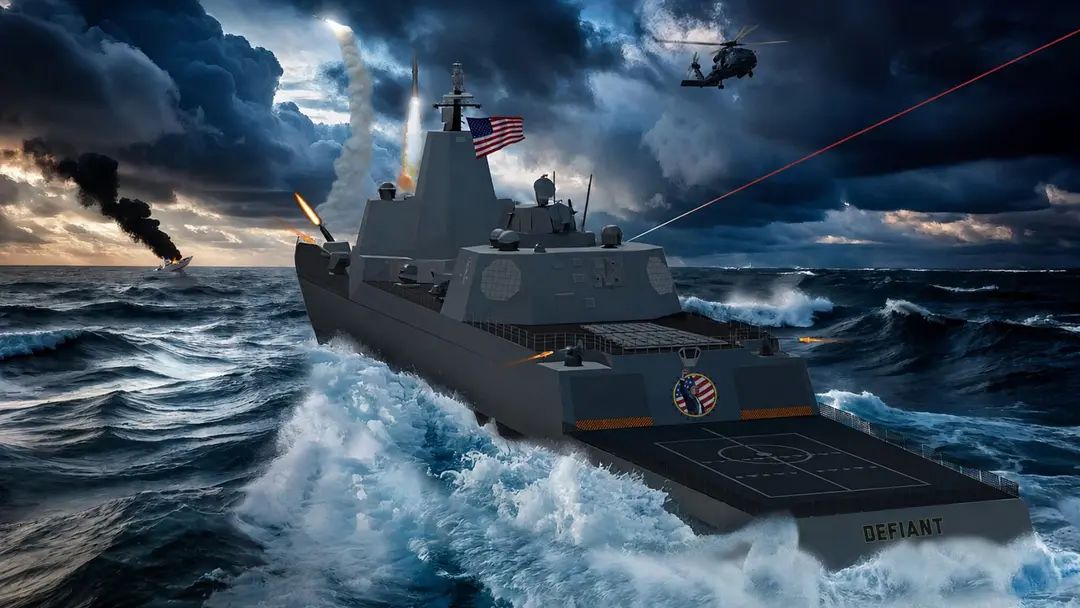
The Trump-class BBG(X) is a proposed nuclear-powered guided-missile battleship for the United States Navy. The concept combines a large missile magazine, hypersonic weapons, advanced sensors, directed-energy systems, aviation facilities, and a fleet command function.
The planned lead ship is USS Defiant, designated BBG-1 in published concept material. No ship of the class has been built, launched, or placed in service. The design, armament, cost, construction schedule, and planned fleet size remain subject to engineering work, funding, and congressional approval.
The class is part of the Golden Fleet initiative announced in 2025. Its proposed displacement of about 35,000 tonnes would make it substantially larger than current U.S. Navy cruisers and destroyers.
The U.S. Navy retired its last Iowa-class battleships in the early 1990s. Subsequent large surface-combatant studies eventually led to the DDG(X) program, whose program office was established in 2021. Navy officials later concluded that the DDG(X) hull could not accommodate all the desired missile cells, hypersonic weapons, power-generation capacity, and gun systems. The proposed battleship emerged as a much larger alternative incorporating work from DDG(X).
President Donald Trump first publicly discussed returning battleships to the fleet on 30 September 2025. On 22 December 2025, he announced the Trump class as part of the Golden Fleet shipbuilding initiative. The initial announcement described two ships within a program of ten, with a possible long-term fleet of 20 to 25 vessels. The first ship was named USS Defiant.
Early announcements used the developmental designation BBG(X), meaning a guided-missile battleship whose design was not yet finalized. The Navy later used BBGN to identify the planned nuclear-powered configuration. A compiled program overview records the changing designations and the evolution of the program from DDG(X).
In January 2026, congressional research identified Bath Iron Works, Ingalls Shipbuilding, and Newport News Shipbuilding as shipyards with relevant naval construction experience. Trump had previously named Hanwha Philly Shipyard as a prospective builder, but that yard had concentrated on commercial ships. Later reporting indicated that nuclear-propulsion requirements made Newport News a more likely construction site.
The Navy's fiscal year 2027 shipbuilding plan described the ship as a nuclear-powered surface combatant intended to provide high-volume, long-range offensive fire and forward command-and-control capability. It proposed acquiring three ships during fiscal years 2027–2031. A report on the shipbuilding plan also described expanded electrical generation, modular payload capacity, electronic warfare equipment, and growth margins for future systems.
In May 2026, Navy officials stated that the nuclear ships would carry the BBGN designation. Published planning called for the lead-ship contract and the start of construction in 2028, with delivery expected in 2036. This remains a planned schedule rather than a completed physical milestone.
In June 2026, the House Armed Services Committee voted to require a detailed acquisition report by March 2027. The report was to address the program and its possible effects on construction of Gerald R. Ford-class aircraft carriers. This reflected concern that a large nuclear surface combatant could compete with existing naval programs for industrial capacity.
In August 2026, the Congressional Budget Office estimated that developing and acquiring 15 ships through 2056 would cost approximately $275 billion. The lead ship was estimated at $23.4 billion, while each of the following 14 ships would average about $18 billion. These figures exceeded earlier Navy estimates. The reported CBO assessment also concluded that the Navy would need to construct approximately one battleship every two years while continuing production of two DDG-51 destroyers annually.
The CBO calculated that the shipbuilding industrial base would need to support a major increase in large-combatant tonnage. A separate cost and schedule report stated that increasing displacement from 35,000 to 41,000 tonnes could raise the cost of each hull by about 16 percent. A possible fleet of 25 ships was separately estimated at as much as $455 billion.
Design
Hull and mission
The Trump class is conceived as a large multi-mission surface combatant rather than a traditional armored gun battleship. Its principal offensive weapons would be missiles. The hull would also provide space, electrical power, cooling capacity, and weight margins for weapons that cannot be fitted easily to existing destroyers.
The planned missions include long-range conventional strike, air and missile defense, anti-ship warfare, fleet command and control, electronic warfare, and support for distributed naval operations. Nuclear propulsion is intended to provide long endurance and reduce dependence on conventional propulsion fuel. It would not remove the need for ammunition, aviation fuel, provisions, maintenance, or other logistical support.
The proposed ship has been compared with an arsenal ship or an enlarged stealth destroyer because missiles, sensors, and command facilities would provide its primary combat value. Its classification as a battleship is debated because the published concept lacks the heavy armor and large-caliber conventional main battery associated with twentieth-century battleships.
Propulsion and electrical power
The planned configuration uses nuclear propulsion. Published information identifies the A1B reactor type associated with the Gerald R. Ford class, although the detailed machinery arrangement has not been finalized publicly. The design emphasizes high electrical output for radar, electronic warfare systems, lasers, computing equipment, and a possible electromagnetic railgun.
Sensors and command facilities
Concept material shows the AN/SPY-6 air-search radar and advanced electronic warfare equipment. The ship is also intended to carry an extensive command-and-control suite capable of accommodating a fleet commander. These systems would support the proposed role as a forward command platform.
Missile armament
The published concept includes 12 launch cells for Conventional Prompt Strike hypersonic missiles and at least 128 Mk 41 vertical launch cells. Later public testimony referred to as many as 200 vertical launch cells, indicating that the missile capacity was still under study. Mk 41 cells can accommodate different weapons, but the final missile allocation has not been announced.
Planned missions require anti-air, anti-ship, and land-attack missiles. A nuclear-armed Surface Launch Cruise Missile-Nuclear, or SLCM-N, has also been presented as a possible weapon rather than a confirmed installation.
Guns and directed-energy weapons
Concept illustrations show one proposed 32-megajoule electromagnetic railgun, two 127 mm Mk 45 guns, four 30 mm Mk 38 systems, and two RIM-116 Rolling Airframe Missile launchers. The railgun would use electromagnetic energy to accelerate a projectile, but the U.S. Navy has not fielded such a weapon operationally.
The proposed directed-energy battery includes two large 300 or 600 kW laser weapons and four lower-power Optical Dazzling Interdictor, Navy systems. The high-power lasers, railgun, and some other weapons could be added after the base design rather than installed from the first ship. Their maturity and integration requirements are major sources of technical uncertainty.
Aviation facilities
The planned stern area includes a flight deck and two enclosed hangars. Published concepts describe support for helicopters, V-22 Osprey tiltrotor aircraft, and future crewed or uncrewed vertical-lift aircraft.
Program status
As of August 2026, the Trump class remained a proposed acquisition program. The Navy had issued concept material and included the program in its shipbuilding plan, but no completed design or physical ship existed. The intended 2028 construction start and 2036 lead-ship delivery were planning targets.
The CBO estimate assumed 15 ships constructed between 2028 and 2056. Earlier statements referred to initial groups of two or three ships, a ten-ship program, or an eventual force of 20 to 25. These numbers represent different planning stages and should not be treated as firm orders.
The program faces industrial, financial, and technological risks. U.S. shipyards are already building destroyers, submarines, amphibious ships, and nuclear aircraft carriers. The Trump-class schedule would require additional skilled labor, infrastructure, and sustained funding. Nuclear construction could also compete for facilities used by the Ford-class carrier program.
Independent analysts have questioned whether concentrating multiple missions and immature weapons in one very large ship would provide sufficient combat value. A technical critique of the concept identified design maturity, shipyard capacity, unproven railgun and laser technology, and opportunity costs as central concerns. Supporters argue that existing destroyers lack the payload volume and electrical growth capacity required for future weapons.
Specifications (Trump-class BBG(X) concept)
General characteristics
- Type: Proposed nuclear-powered guided-missile battleship
- Displacement: Approximately 35,000 tonnes planned
- Length: Approximately 260–270 m (840–880 ft)
- Beam: Approximately 32–35 m (105–115 ft)
- Draft: Approximately 7.3–9.1 m (24–30 ft)
- Propulsion: Nuclear propulsion; A1B reactor reported
- Crew: Approximately 650–800 planned
- Aircraft facilities: Flight deck and two hangars for vertical-lift aircraft
Performance
- Maximum speed: More than 30 knots (56 km/h)
Sensors and electronic systems
- Primary radar: AN/SPY-6 air-search radar planned
- Other systems: Advanced electronic warfare and fleet command-and-control equipment planned
Planned armament
- Hypersonic missiles: 12 Conventional Prompt Strike launch cells
- Vertical launch system: 128 Mk 41 cells shown in initial concept material; later statements referred to as many as 200 cells
- Nuclear cruise missile: SLCM-N proposed as a possible capability
- Close defense: Two RIM-116 Rolling Airframe Missile launchers
- Naval guns: Two 127 mm Mk 45 guns and four 30 mm Mk 38 systems planned
- Railgun: One 32-megajoule electromagnetic railgun proposed
- High-energy lasers: Two 300 or 600 kW weapons proposed
- Optical dazzlers: Four ODIN systems proposed
Related equipment
- DDG(X): Planned next-generation U.S. destroyer program whose technology and requirements were incorporated into the battleship concept.
- Iowa class: The last battleship class operated by the United States Navy and the historical reference for the Trump-class designation.
- Zumwalt class: The largest current U.S. surface combatant and an earlier attempt to combine stealth, advanced guns, and land-attack capability.
- Gerald R. Ford class: Nuclear-powered aircraft-carrier class relevant to the proposed reactor technology, construction infrastructure, and cost comparison.
 Argentina
 Armenia
 Australia
 Austria
 Austria-Hungary
 Belgium
 Brazil
 United Kingdom
 Brunei
 Bulgaria
 Canada
 Chile
Chile China
China Colonial America
 Colombia
 Confederate States
 Croatia
 Czech
Czech Denmark
 Egypt
Egypt Finland
 France
 Georgia
 Germany
 German Imperial
 Greece
 Holland
 Hungary
 India
India Indonesia
 Iran
Iran Iraq
Iraq Ireland
 Israel
 Italy
Italy Japan
Japan Japan (1940)
 Jordan
 Kingdom of Italy
 Malaysia
 Mexico
 Myanmar
 Nazi Germany
 Netherlands
 New Zealand
 North Korea
 Norway
 Pakistan
 Peru
Peru Philippines
 Poland
 Portugal
 Prussia
 Romania
 Russia
 Saudi Arabia
 Serbia
 Singapore
 Slovakia
 Slovenia
 South Africa
 South Korea
 Soviet Union
 Spain
Spain Sweden
 Switzerland
 Syria
Syria Taiwan
 Thailand
 Turkey
 UAE
UAE Ukraine
 Vietnam
 Yugoslavia