
History
The Rheinmetall mobile rescue station is a containerized medical-support system being procured for the Bundeswehr medical service. It forms part of the Modulare Sanitätseinrichtungen, or Modular Medical Facilities, system intended to provide soldiers with initial emergency medical treatment.
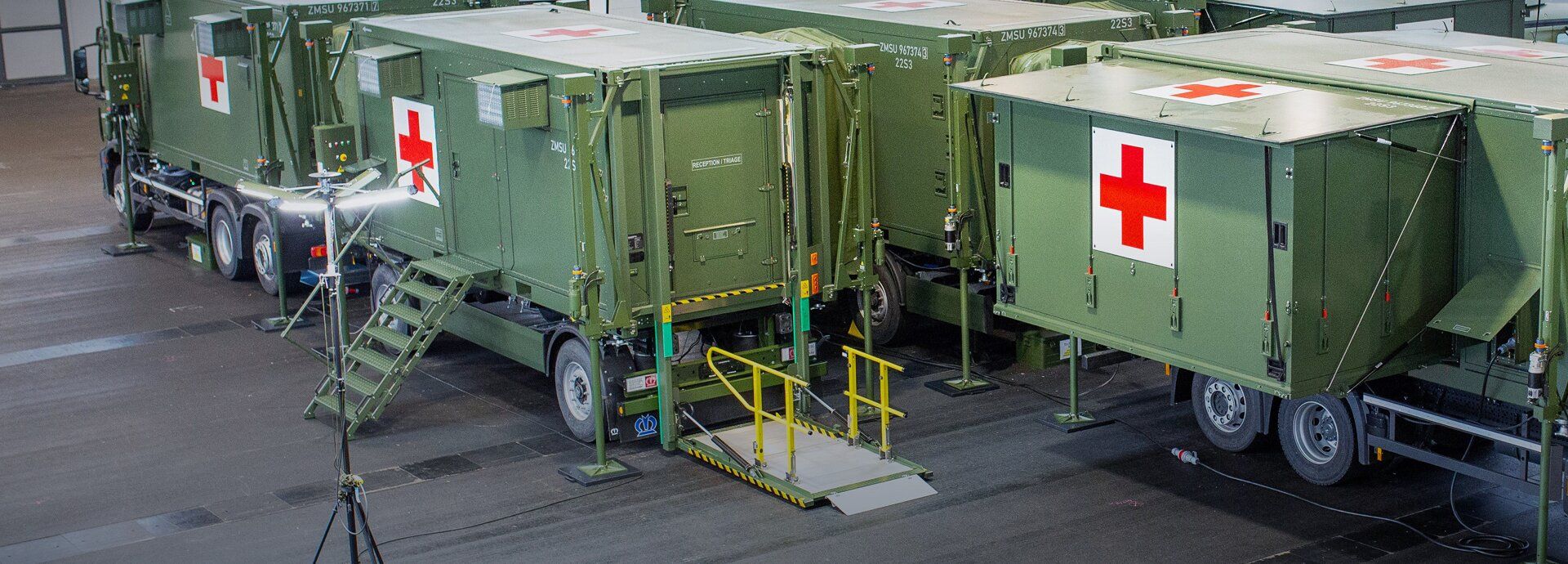
The system is designed for rapid relocation, setup and dismantling. A rescue station comprises two containers that can operate together or separately for several days, with integrated medical treatment areas, environmental control and independent electrical generation.
The Bundeswehr expanded its procurement substantially in 2026. Production of the systems covered by the latest order is planned to begin in the first quarter of 2027.
Procurement
In December 2024, the Bundesamt für Ausrüstung, Informationstechnik und Nutzung der Bundeswehr, Germany's Federal Office of Bundeswehr Equipment, Information Technology and In-Service Support, ordered 10 mobile rescue stations and six unprotected systems under a framework covering up to 137 systems.
A further order for 149 mobile rescue stations was booked in July 2026 and announced by Rheinmetall on 17 August 2026. The call-off was valued at more than EUR500 million. Together with the earlier procurement, it brought the reported total to 165 systems with a combined value of approximately EUR600 million.
The contract also includes personnel training and provides options for additional armoured and unarmoured systems. Rheinmetall Project Solutions is responsible for the contract. Production under the 2026 call-off is planned to start during the first quarter of 2027.
Design
The Bundeswehr rescue station consists of two container modules. The containers can be used as a combined treatment facility or operated separately for several days, allowing the medical installation to be adapted to operational requirements.
Each container is equipped with air conditioning and its own generator. The electrical arrangement provides redundancy because one generator can support both containers if the generator assigned to the other container fails.
The system contains one fully equipped emergency treatment station and four additional treatment stations. Medical equipment is mounted on airliner-style rails, allowing the internal arrangement to be configured according to user requirements.
Rheinmetall states that four soldiers can rapidly set up and dismantle the rescue station. The emphasis on mobility reflects a Bundeswehr requirement for medical facilities that can be displaced quickly rather than remaining at a fixed treatment site.
Program status
As of August 2026, the Bundeswehr was procuring 165 systems under the reported orders. The largest call-off, covering 149 additional mobile rescue stations, had been placed in July 2026, while production was scheduled to begin in the first quarter of 2027.
The procurement remains associated with the Bundeswehr's Modular Medical Facilities programme. The available contract information also provides for personnel training and possible future orders for additional protected and unprotected configurations.
Specifications (Bundeswehr mobile rescue station)
General characteristics
- Configuration: Two container modules per rescue station.
- Setup personnel: Four soldiers.
- Operating arrangement: Containers can operate together or separately for several days.
- Environmental control: Air conditioning installed in each container.
- Electrical power: Generator installed for each container, with the ability for one generator to support both containers if the other fails.
Medical facilities
- Emergency treatment: One fully equipped emergency treatment station.
- Additional treatment positions: Four treatment stations.
- Equipment installation: Medical equipment mounted on airliner rails and configurable according to user requirements.
Related equipment
Rheinmetall also produces other mobile medical facilities with different configurations. In July 2025, the company reported delivery of a fourth Role 2 mobile rescue station to Ukraine. That distinct system consists of three truck-trailers, each carrying two expandable container modules, and incorporates areas for triage, emergency care, X-ray, surgery and intensive care. Details of that system are available in the Rheinmetall delivery announcement.
 Argentina
 Armenia
 Australia
 Austria
 Austria-Hungary
 Belgium
 Brazil
 United Kingdom
 United States
 Brunei
 Bulgaria
 Canada
 Chile
Chile China
China Colonial America
 Colombia
 Confederate States
 Croatia
 Czech
Czech Denmark
 Egypt
Egypt Finland
 France
 Georgia
 German Imperial
 Greece
 Holland
 Hungary
 India
India Indonesia
 Iran
Iran Iraq
Iraq Ireland
 Israel
 Italy
Italy Japan
Japan Japan (1940)
 Jordan
 Kingdom of Italy
 Malaysia
 Mexico
 Myanmar
 Nazi Germany
 Netherlands
 New Zealand
 North Korea
 Norway
 Pakistan
 Peru
Peru Philippines
 Poland
 Portugal
 Prussia
 Romania
 Russia
 Saudi Arabia
 Serbia
 Singapore
 Slovakia
 Slovenia
 South Africa
 South Korea
 Soviet Union
 Spain
Spain Sweden
 Switzerland
 Syria
Syria Taiwan
 Thailand
 Turkey
 UAE
UAE Ukraine
 Vietnam
 Yugoslavia