
History
The Rheinmetall-MBDA German Navy Laser Weapon System is a high-energy directed-energy weapon under development for shipborne defense. It is intended primarily to counter drones and other agile targets at short and very short ranges.
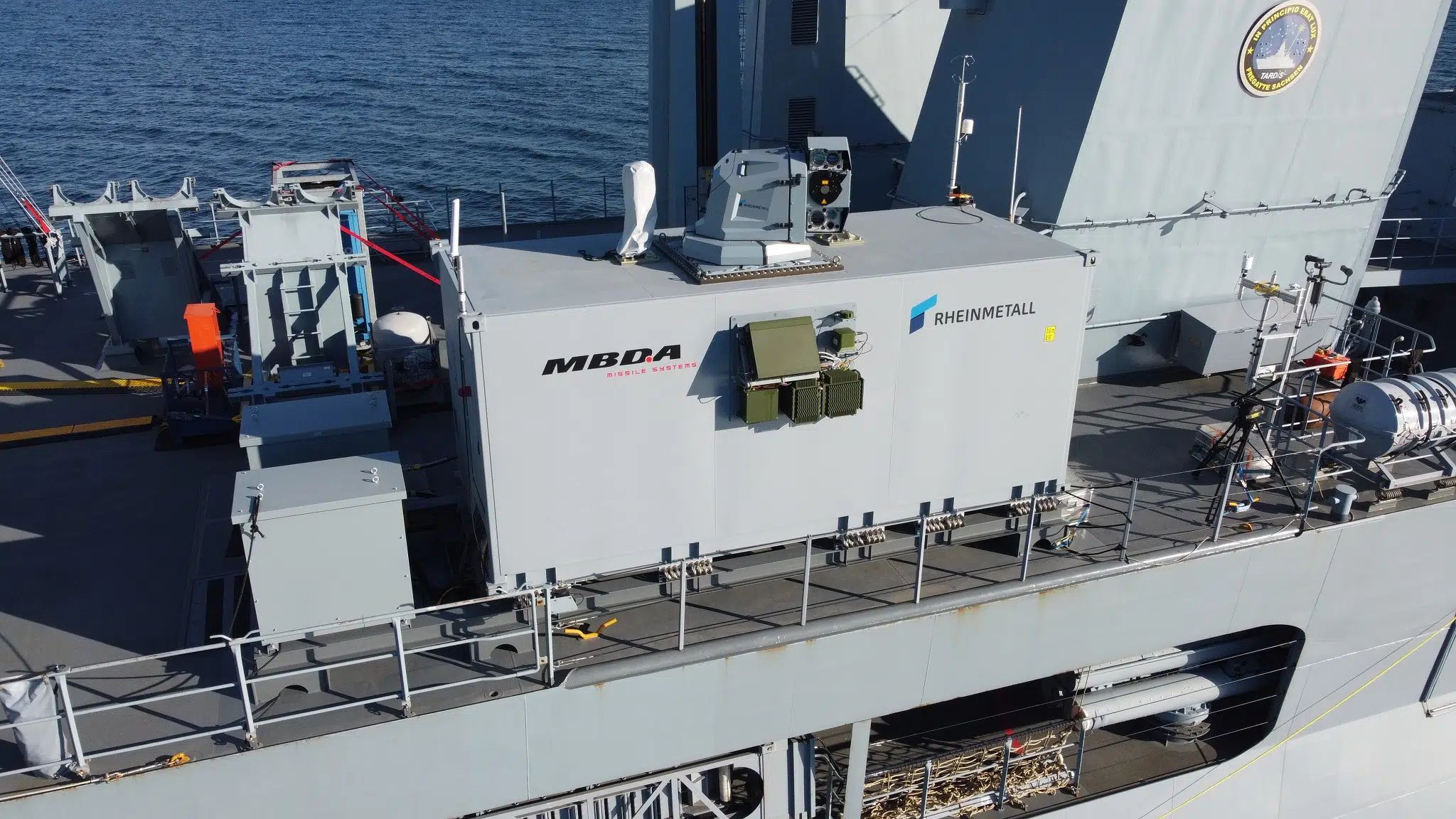
The system is being developed by Rheinmetall Waffe Munition and MBDA Deutschland for the German Navy. It builds on a naval Laser Weapon Demonstrator tested aboard the Sachsen-class frigate Sachsen and later at the Bundeswehr's WTD 91 test center in Meppen.
The planned operational system will cover the complete engagement sequence from target detection and tracking to laser engagement. Entry into operational service is scheduled for 2029.
Development
MBDA Deutschland has worked on high-energy laser technologies since at least 2008. Its research has included laser sources, precision tracking, beam-directing optics and modular demonstrators. Rheinmetall and MBDA began cooperating on the German naval laser program in 2019.
The companies produced the Laser Weapon Demonstrator for the Bundeswehr equipment office, known as BAAINBw. MBDA's documented responsibilities included the tracking system, laser operator station and connections to the ship's radar and combat management system. The companies integrated the demonstrator aboard the frigate Sachsen in June 2022.
Sea trials
Testing at sea continued until September 2023. The demonstrator completed more than 100 firing and tracking trials against airborne, maritime and land targets. Tests included engagements against the open sky, which examined accurate tracking and safe beam control without terrain behind the target.
During its wider deployment, the demonstrator travelled approximately 28,000 nautical miles in the North Sea, Baltic Sea and Mediterranean Sea. The trials examined its operation under maritime and adverse environmental conditions. The system was subsequently transferred to the Bundeswehr's Laser Competence Centre at WTD 91 in Meppen for additional testing, including land-based counter-drone work. The MBDA program history describes the demonstrator, its integration aboard Sachsen and the completed sea campaign.
Operational-system contract
Rheinmetall and MBDA signed a cooperation agreement in 2024 to develop a marketable maritime laser weapon, initially as a containerized product. In January 2026, they announced plans to establish a joint venture based on their earlier cooperation and the successful demonstrator program. The development sequence and the transfer of the demonstrator to WTD 91 were also reported by Janes.
On 9 June 2026, BAAINBw signed a contract with the ARGE HEL industrial partnership formed by MBDA Deutschland and Rheinmetall Waffe Munition. The contract covers development of the complete maritime system, including target detection, tracking and engagement. The companies described its value as several hundred million euros or a mid-three-digit million-euro amount. A separate trade report cited approximately €462 million, but this exact figure was not stated in the cited company material.
By March 2026, the demonstrator had conducted additional firings at WTD 91. Rheinmetall and MBDA reported more than 1,000 successful firings across the sea trials and subsequent testing against air, sea and land targets. This later total is broader than the more than 100 firings documented specifically for the earlier sea campaign.
Design
The weapon uses a high-energy laser to transfer energy directly to a precisely selected point on a target. The developers state that its beam quality and tracking system can concentrate the laser energy on an area only a few centimeters across, including when the target is moving. Maintaining the beam on this small area increases the energy density delivered to the target.
Tracking and engagement
MBDA's demonstrator technology uses active tracking with eye-safe illumination and high-performance image processing. The tracking equipment is intended to keep the directed beam aligned with small and agile targets despite target motion, movement of the ship and maritime environmental conditions.
The demonstrator employs a highly dynamic directing system with continuous multi-turn azimuth coverage. This arrangement supports rapid changes between targets approaching from different directions and is intended to contribute to defense against groups or swarms of drones.
The operational system is planned to integrate detection, target tracking and engagement in a single chain. Its interfaces with radar and the ship's combat management system allow sensor data and engagement commands to be transferred to the laser equipment.
Containerized installation
The demonstrated laser effector is housed in a 20-foot standard container. The containerized arrangement supports transport, testing and installation without requiring the entire system to be permanently built into a host platform. MBDA also developed a more compact and modular demonstrator intended to prepare the technology for future integrated ship installations.
Laser weapons do not require conventional projectiles or missiles for each engagement. Their practical firing endurance instead depends on available electrical power, cooling and equipment limitations. Ships provide useful space and access to power and thermal-management systems, although the published material does not disclose the operational weapon's power requirement or cooling capacity.
Program status
The Rheinmetall-MBDA weapon remains under development and is not yet an operational German Navy system. The June 2026 contract is intended to move the program from demonstration and qualification work toward a complete maritime weapon. Operational service is planned for 2029, while serial production is expected to take place largely in Germany.
The principal intended role is protection of naval vessels against drones. The developers also describe potential use against other airborne, maritime and land targets. MBDA has proposed the containerized effector as a possible cost-effective system for port protection and other fixed-site applications, but these applications do not represent confirmed operational deployments.
The development program emphasizes German supply chains and domestic system-integration expertise. This approach is intended to preserve national control over the technology and its future production. Contemporary reporting on the contract and planned 2029 service date is available from Defense News.
Specifications (Laser Weapon Demonstrator)
General characteristics
- Type: Naval high-energy laser weapon demonstrator
- Developers: Rheinmetall Waffe Munition and MBDA Deutschland
- Customer: German Federal Office of Bundeswehr Equipment, Information Technology and In-Service Support
- Installation: Containerized effector using a 20-foot standard container
- Test ship: German Navy frigate Sachsen
- Primary demonstrated functions: Target tracking, beam direction and engagement of moving targets
- Demonstrated target categories: Airborne, maritime and land targets
- Beam concentration: Area measuring only a few centimeters across
Trials
- Integration aboard Sachsen: June 2022
- Completion of sea campaign: September 2023
- Distance covered: Approximately 28,000 nautical miles
- Sea-campaign firings and tracking trials: More than 100
- Reported cumulative firings after later testing: More than 1,000
- Test environments: North Sea, Baltic Sea, Mediterranean Sea and WTD 91 in Meppen
 Argentina
 Armenia
 Australia
 Austria
 Austria-Hungary
 Belgium
 Brazil
 United Kingdom
 United States
 Brunei
 Bulgaria
 Canada
 Chile
Chile China
China Colonial America
 Colombia
 Confederate States
 Croatia
 Czech
Czech Denmark
 Egypt
Egypt Finland
 France
 Georgia
 German Imperial
 Greece
 Holland
 Hungary
 India
India Indonesia
 Iran
Iran Iraq
Iraq Ireland
 Israel
 Italy
Italy Japan
Japan Japan (1940)
 Jordan
 Kingdom of Italy
 Malaysia
 Mexico
 Myanmar
 Nazi Germany
 Netherlands
 New Zealand
 North Korea
 Norway
 Pakistan
 Peru
Peru Philippines
 Poland
 Portugal
 Prussia
 Romania
 Russia
 Saudi Arabia
 Serbia
 Singapore
 Slovakia
 Slovenia
 South Africa
 South Korea
 Soviet Union
 Spain
Spain Sweden
 Switzerland
 Syria
Syria Taiwan
 Thailand
 Turkey
 UAE
UAE Ukraine
 Vietnam
 Yugoslavia