
History
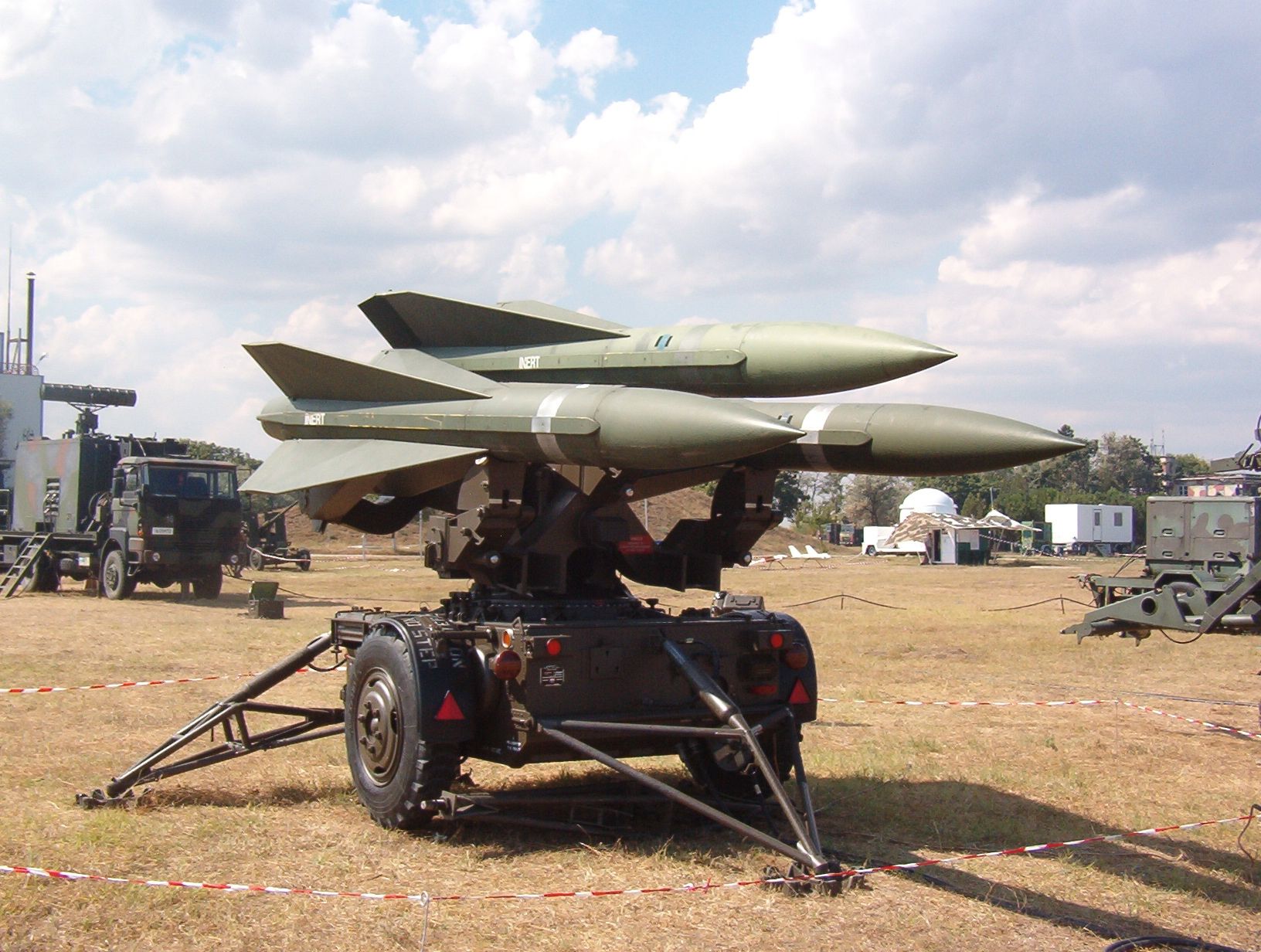
The MIM-23 HAWK is an American medium-range surface-to-air missile system developed for mobile air defense, with particular emphasis on engaging aircraft at low and medium altitudes. The missile uses semi-active radar homing and operates as part of a distributed system of acquisition radars, tracking and illumination radars, fire-control equipment, and multi-missile launchers.
Development began in 1952. Raytheon received responsibility for the missile in 1954, while Northrop developed the launcher, radars, and fire-control equipment. The first XSAM-A-18 test missile was launched in June 1956, and the system achieved initial operational capability with the U.S. Army in August 1959.
HAWK underwent repeated modernization during its long service life, evolving from the Basic HAWK into Improved HAWK and later Product Improvement Plan configurations. Although retired from U.S. military service, the system continued to serve foreign operators and gained renewed operational relevance after HAWK equipment was transferred to Ukraine from 2022 onward.
Development and initial deployment
The U.S. Army began studies for a medium-range semi-active radar homing surface-to-air missile in 1952 under the SAM-A-18 HAWK designation. Development contracts followed in July 1954. Raytheon developed the missile, while Northrop was responsible for the launcher, radar equipment, and fire-control system. The first XSAM-A-18 test launch took place in June 1956, and the initial development phase was completed in July 1957.
The system entered U.S. Army service in 1959 and was fielded by the U.S. Marine Corps in 1960. In June 1963, the missile family was redesignated under the MIM-23 series, with the operational M3 becoming MIM-23A. A detailed development chronology is available in the MIM-23 designation history.
Improved HAWK
The Army began the HAWK Improvement Program in 1964 to improve performance against low-altitude threats and reduce the effects of ground clutter. The program introduced a digital data-processing coordinator, upgraded ground radars, and the MIM-23B Improved HAWK missile. The new missile incorporated a larger blast-fragmentation warhead, a smaller and improved guidance package, and the Aerojet M112 dual-thrust rocket motor.
Improved HAWK became operational in 1971. By 1978, all U.S. HAWK units had converted to the improved configuration. The MIM-23B increased the high-altitude engagement envelope to approximately 40 km and reduced the minimum engagement range to about 1.5 km.
Product Improvement Plan
A multi-phase Product Improvement Plan subsequently concentrated on the system's ground equipment. Phase I introduced the AN/MPQ-55 Improved Continuous Wave Acquisition Radar and upgraded the AN/MPQ-50 Pulse Acquisition Radar with digital moving-target indication. The first Phase I systems were fielded in 1979.
Phase II, fielded between 1983 and 1986, upgraded the illuminator radar to AN/MPQ-57 standard, replaced additional vacuum-tube electronics with solid-state components, and introduced the OD-179/TVY Tracking Adjunct System. This electro-optical television tracker was intended to improve operation under electronic countermeasures.
Phase III development began in 1983 and was first fielded by U.S. forces in 1989. It introduced major computer hardware and software improvements, the AN/MPQ-62 continuous-wave acquisition radar, single-scan target detection, and the AN/MPQ-61 High Power Illuminator Radar with the Low-Altitude Simultaneous HAWK Engagement system. The Range Only Radar was eliminated from Phase III batteries.
Missile modernization
The missile family was modernized in parallel with the ground system. MIM-23C missiles introduced improved electronic counter-countermeasures around 1982. MIM-23E and MIM-23F versions entered use in 1990 with improved guidance for low-altitude engagements in cluttered and heavily jammed environments. MIM-23G and MIM-23H missiles added a new body section.
U.S. Marine Corps work during the early 1990s expanded HAWK toward theater ballistic missile defense. Tests combined the HAWK fire-control system with the AN/TPS-59(V)3 long-range radar. Enhanced-lethality MIM-23J and MIM-23K missiles received revised fuzing and a new fragmentation warhead intended for ballistic-missile targets. Successful intercepts of MGM-52 Lance targets were reported in 1994, and the MIM-23K configuration was operational with Marine Corps units from 1995.
Retirement from U.S. service and continued support
The last active U.S. Army HAWK unit was deactivated in 1994, and Army National Guard equipment was disposed of during the 1996-1997 period. The U.S. Marine Corps began phasing out HAWK in 1998-1999, and the system was no longer in Marine Corps service by 2002. More than 40,000 HAWK missiles of all variants were produced when foreign production is included.
Despite U.S. retirement, HAWK continued in foreign service. In August 2026, U.S. Army Contracting Command at Redstone Arsenal issued a Sources Sought notice for total system sustainment of HAWK equipment used through Foreign Military Sales and partner-support programs. The contemplated work covered logistics, engineering, material supply, testing, product assurance, configuration management, and technical documentation. The Army explicitly stated that the notice did not commit it to issue a solicitation or award a contract. The sustainment requirement was described in a 2026 HAWK sustainment report.
Design
HAWK is a semi-mobile air-defense system rather than a single launcher. A battery combines surveillance radars, target-tracking and illumination radars, fire-control equipment, power-generation equipment, missile transport and loading vehicles, and multiple launchers. Most major components of the original system were carried on wheeled trailers.
Launcher and missile
The standard M192 launcher carries three HAWK missiles. The missiles have slender cylindrical bodies with four large clipped-delta wings extending toward the rear of the airframe. Control surfaces on the wing trailing edges provide maneuvering control.
The MIM-23A uses an Aerojet M22E8 dual-thrust solid-propellant rocket motor. Improved missiles beginning with the MIM-23B use the more powerful M112 motor, which has separate boost and sustain phases. The propulsion arrangement provides rapid initial acceleration followed by sustained thrust during the engagement.
The missile uses semi-active radar homing. A ground-based High Power Illuminator Radar tracks and illuminates the target, while the missile's continuous-wave monopulse seeker follows energy reflected from that target. The system therefore depends on coordinated operation between the missile and the battery's radar and fire-control network.
Basic HAWK radar system
The original HAWK architecture distributed detection, ranging, tracking, and illumination functions across several radars. The AN/MPQ-35 Pulse Acquisition Radar searched for high- and medium-altitude targets. The AN/MPQ-34 Continuous Wave Acquisition Radar concentrated on low-altitude detection. The AN/MPQ-33 or AN/MPQ-39 High Power Illuminator Radar tracked designated targets and illuminated them for the missile seeker. The AN/MPQ-37 Range Only Radar supplied range data when other equipment was affected by jamming.
An Improved HAWK battery replaced these systems with the AN/MPQ-50 Pulse Acquisition Radar, AN/MPQ-48 Continuous Wave Acquisition Radar, AN/MPQ-46 High Power Illuminator Radar, and AN/MPQ-51 Range Only Radar. Later Product Improvement Plan phases progressively digitized the system and consolidated some functions.
Phase III architecture
Phase III HAWK used the AN/MPQ-62 Continuous Wave Acquisition Radar and AN/MPQ-61 High Power Illuminator Radar together with improved digital processing and a Fire Direction Center. The AN/MPQ-61 incorporated the Low-Altitude Simultaneous HAWK Engagement feature, allowing simultaneous engagements against multiple low-level targets. Phase III eliminated the dedicated Range Only Radar.
HAWK XXI represented a later compact modernization approach. It replaced the separate pulse and continuous-wave acquisition radars with the AN/MPQ-64 Sentinel three-dimensional radar and used a Kongsberg Fire Distribution Center derived from technology associated with NASAMS.
Operational history
HAWK was widely exported and saw combat with several operators even though the United States did not employ the system in combat before retiring it. Israel received HAWK during the 1960s. On 5 June 1967, an Israeli HAWK shot down a damaged Israeli Dassault Ouragan that was approaching the area of the Negev Nuclear Research Center, an engagement identified in the available sources as the system's first combat firing and first combat kill.
During the War of Attrition, Israeli HAWK batteries were credited with multiple aircraft kills. Iran used HAWK extensively during the Iran-Iraq War, with the available source reporting at least 40 Iraqi aircraft destroyed by Iranian HAWK missiles. Friendly-fire losses were also recorded.
On 7 September 1987, a French Army HAWK battery in Chad shot down a Libyan Tu-22B bomber. Kuwaiti HAWK batteries later engaged Iraqi aircraft during the August 1990 invasion of Kuwait. Source accounts claim as many as 14 Iraqi aircraft were shot down, although only two kills are described as verified.
Turkey deployed HAWK batteries in Syria and Libya during 2020. In Libya, air strikes against Al-Watiya Air Base damaged or destroyed Turkish-operated air-defense equipment, although the available accounts differ on the number of HAWK launchers and radars affected.
Ukraine began receiving HAWK systems in late 2022, initially from Spain, while the United States supplied refurbished missiles and additional partners later contributed components. Ukrainian forces subsequently used the system against cruise missiles and attack drones. A 2026 sustainment report for Ukraine described continued U.S. support for maintaining HAWK equipment in Ukrainian service. Open-source equipment summaries also continued to list HAWK as internationally active in 2026; one such reference is the MIM-23 HAWK equipment overview.
Variants
- MIM-23A Basic HAWK: Original operational missile, introduced with the initial HAWK system.
- MIM-23B Improved HAWK: Improved missile with a larger warhead, revised guidance package, and Aerojet M112 dual-thrust motor.
- MIM-23C and MIM-23D: Improved versions introduced around 1982 with enhanced electronic counter-countermeasure capability; available sources do not clearly define all differences between the C and D models.
- MIM-23E and MIM-23F: Versions introduced in 1990 with improved guidance for low-altitude engagements in cluttered and multi-jamming environments.
- MIM-23G and MIM-23H: Developments of the E and F missiles with a new body section assembly.
- MIM-23J and MIM-23K: Enhanced-lethality versions with revised fuzing and a new fragmentation warhead intended to improve effectiveness against tactical ballistic missiles.
- MIM-23L and MIM-23M: Versions retaining the earlier Improved HAWK warhead while incorporating the newer fuze.
- HAWK XXI: Modernized system configuration using the AN/MPQ-64 Sentinel three-dimensional radar, an updated Fire Distribution Center, and upgraded HAWK missiles.
Operators
HAWK was exported widely and was also license-produced outside the United States. Operator status has changed considerably as countries retired, modernized, transferred, or replaced their systems. The available source material lists continuing or recent HAWK operators including Bahrain, Egypt, Greece, Iran, Jordan, Kuwait, Morocco, Romania, Saudi Arabia, Singapore, Spain, Sweden, Turkey, Ukraine, and the United Arab Emirates. Some countries operate nationally modified or upgraded configurations.
Former operators include the United States, Belgium, Denmark, France, Germany, Italy, the Netherlands, Norway, South Korea, and Taiwan. Taiwan retired its HAWK systems after replacement by the Tien Kung 3 system, and reports cited in the available material state that retired Taiwanese missiles were subsequently transferred for Ukrainian use with U.S. approval. A broader historical operator listing is available in the MIM-23 HAWK overview.
Specifications (MIM-23B Improved HAWK)
General characteristics
- Length: 5.03 m (16 ft 6 in)
- Diameter: 0.37 m (14.5 in)
- Fin span: 1.19 m (3 ft 11 in)
- Launch weight: approximately 635 kg (1,400 lb)
- Propulsion: Aerojet M112 dual-thrust solid-propellant rocket motor
- Warhead: 74 kg (163 lb) high-explosive blast-fragmentation
- Guidance: X-band continuous-wave monopulse semi-active radar homing
- Fuzing: radar proximity and impact fuzes
Performance
- Maximum high-altitude engagement range: approximately 40 km (25 mi)
- Minimum engagement range: approximately 1.5 km (0.93 mi)
- Low-altitude engagement envelope: approximately 2.5-20 km (1.6-12.4 mi)
- Maximum engagement altitude: approximately 17,700 m (58,000 ft)
- Minimum engagement altitude: approximately 60 m (200 ft)
- Maximum speed: approximately Mach 2.5
Related equipment
- MIM-104 Patriot: U.S. medium- and long-range air-defense system that replaced HAWK in U.S. Army service.
- FIM-92 Stinger: Short-range surface-to-air missile that assumed part of the air-defense role after HAWK retirement from U.S. service.
- NASAMS: Ground-based air-defense system associated with technology used in the HAWK XXI Fire Distribution Center and with Norway's transition away from HAWK.
- Mersad: Iranian air-defense system derived from HAWK technology and employing Iranian-developed associated missiles.
 Argentina
 Armenia
 Australia
 Austria
 Austria-Hungary
 Belgium
 Brazil
 United Kingdom
 Brunei
 Bulgaria
 Canada
 Chile
Chile China
China Colonial America
 Colombia
 Confederate States
 Croatia
 Czech
Czech Denmark
 Egypt
Egypt Finland
 France
 Georgia
 Germany
 German Imperial
 Greece
 Holland
 Hungary
 India
India Indonesia
 Iran
Iran Iraq
Iraq Ireland
 Israel
 Italy
Italy Japan
Japan Japan (1940)
 Jordan
 Kingdom of Italy
 Malaysia
 Mexico
 Myanmar
 Nazi Germany
 Netherlands
 New Zealand
 North Korea
 Norway
 Pakistan
 Peru
Peru Philippines
 Poland
 Portugal
 Prussia
 Romania
 Russia
 Saudi Arabia
 Serbia
 Singapore
 Slovakia
 Slovenia
 South Africa
 South Korea
 Soviet Union
 Spain
Spain Sweden
 Switzerland
 Syria
Syria Taiwan
 Thailand
 Turkey
 UAE
UAE Ukraine
 Vietnam
 Yugoslavia