
History
Unitree Robotics quadruped robots, commonly described as robot dogs, are a family of electrically actuated walking robots developed by Unitree Robotics in China. The range includes consumer and research platforms such as Go1 and Go2 and larger industrial systems such as B2.
Unitree has focused on relatively compact electric actuation, agile locomotion, onboard sensing and programmable control. The Go2 combines 12 powered joints with 4D LiDAR, cameras and wireless connectivity, while the B2 was developed for industrial inspection, firefighting, rescue and disaster-response applications.
Unitree states that its products are intended for civilian use, but several of its quadrupeds have appeared in military experiments. Reuters reported in 2026 that researchers involved in U.S.-military-funded quadruped programs saw an important technical lineage between their work and successful Unitree designs, while also crediting Unitree with the engineering required to turn such concepts into mass-produced products.
Early development
Unitree founder Wang Xingxing worked on quadruped robots while studying at Shanghai University. Unitree's own retrospective on the Go1 product page places development of the XDog quadruped between 2013 and 2015. A company chronology summarized by Wikipedia identifies XDog as Wang's 2016 master's-thesis project, while Reuters also reported reviewing his 2016 thesis. Unitree Robotics was established in Hangzhou in 2016.
Wang's thesis cited work from the Massachusetts Institute of Technology and discussed principles consistent with research being conducted in U.S. laboratories. Reuters reported that the thesis also referenced an Army Research Laboratory-funded University of Pennsylvania paper. In the United States, the Robotics Collaborative Technology Alliance operated from 2010 to 2020 with Army funding and brought together government, university and industrial researchers.
In 2016, University of Pennsylvania researchers demonstrated an architecture that reduced dependence on heavy central gearboxes by placing motors in the robot's legs. This work built on research at MIT that had also received U.S. military funding. In 2019, MIT presented the Mini Cheetah, which combined compact electric actuators with highly dynamic quadruped movement.
Unitree subsequently developed a succession of commercial quadrupeds. Its retrospective states that Laikago was offered for pre-sale in 2017 and that Laikago Pro began shipping in 2018. The company later developed Aliengo and introduced the A1 concept before releasing Go1 in 2021.
Go series and industrial expansion
Go1 was promoted as a lightweight consumer-level quadruped. Unitree specified a mass of about 12 kg, a folded size of approximately 0.588 by 0.22 by 0.29 m and an adaptive load of roughly 3 to 5 kg. Depending on configuration, the platform incorporated multiple fisheye depth-sensing systems, intelligent person-following functions and programmable interfaces.
Unitree launched Go2 in 2023. The entry-level Go2 Air was listed at $1,600 before tax and freight. The manufacturer's Go2 specifications describe a family of Air, Pro, X and EDU configurations using a common approximately 15 kg chassis. The platform added Unitree's 4D LiDAR, updated intelligent following, wireless communications and expanded computing options.
The company also developed larger quadrupeds for industrial use. Unitree describes B2 as an industrial-grade platform for electrical-power inspection, firefighting, rescue and geological-disaster response. According to a Unitree technical overview, B2 can reach up to 6 m/s, uses joint motors with peak torque stated at 360 N.m, can negotiate approximately 40 cm steps and is rated to IP67 for dust and water protection.
Influence of U.S. research
Reuters reported in August 2026 that several researchers involved in U.S.-funded quadruped programs saw direct technical similarities between their work and later Unitree products. Former University of Pennsylvania researcher Gavin Kenneally said the Army-funded research led to technology that became closely associated with the first Unitree robot produced at meaningful scale.
Ben Katz, who worked in MIT's Biomimetic Robotics Lab and helped develop Mini Cheetah, told Reuters that the dimensions of Unitree's popular Go series were nearly identical to Mini Cheetah. Researcher Joao Ramos said Unitree adopted the Mini Cheetah shape, structure and design, but also credited the Chinese company with the engineering work necessary to refine and mass-produce the concept.
Unitree states that it independently developed components including motors, reducers, controllers and some sensors. The underlying U.S. research was published openly, and the researchers interviewed by Reuters did not allege that Unitree had obtained it improperly. U.S. Army Research Laboratory representatives said publication of the research was intended to advance the wider robotics ecosystem.
Design
Structure and actuation
Unitree's Go-series quadrupeds use four articulated legs driven by 12 electric joint motors. Go1 used lightweight powered joints with a stated maximum torque of 23.7 N.m at the body and thigh joints and 35.55 N.m at the knee through its transmission arrangement. A heat-pipe-assisted cooling system was incorporated near the knee motors.
Go2 retains a 12-motor arrangement but increases the maximum stated torque of its largest joint motor to approximately 45 N.m. The chassis combines aluminium alloy with high-strength engineering plastic. The common Go2 body measures about 70 cm long, 31 cm wide and 40 cm high when standing and approximately 76 cm by 31 cm by 20 cm when crouched.
The larger B2 uses substantially more powerful joints. Unitree states a peak joint torque of 360 N.m and says the machine can climb steps approximately 40 cm high. The manufacturer also claims a maximum speed of 6 m/s and the ability to cross obstacles approximately 1.6 m wide.
Sensing and control
Go1 introduced Unitree's Super-sensing System and Intelligent Concomitant System. Depending on configuration, it used fisheye binocular depth sensing, human-recognition functions and wireless vector positioning to follow a person while remaining within the operator's lateral field of view.
Go2 introduced a self-developed 4D LiDAR system providing broad hemispherical environmental coverage. Unitree specifies a field of recognition of up to 360 degrees horizontally and 96 degrees vertically for its L2 system, with a minimum detection distance as low as 0.05 m. Go2 configurations also include an HD wide-angle camera, Wi-Fi 6, Bluetooth and, on selected versions, 4G connectivity with GPS.
With LiDAR and the associated application, Go2 can create a local point-cloud map and follow a specified route autonomously. The platform also supports Unitree's ISS 2.0 side-follow system and software updates delivered through an authorised cloud-based over-the-air service.
Power and endurance
Go2 operates at approximately 28 to 33.6 V and has a stated maximum working power of about 3,000 W. Standard configurations use an 8,000 mAh battery, while the EDU configuration is offered with a 15,000 mAh long-endurance battery. Unitree lists approximately one to two hours of operation for standard batteries and approximately two to four hours for the long-endurance configuration.
B2 uses a 45,000 mAh battery with a stated energy capacity of 2,250 Wh. Unitree says it can operate for more than five hours without a load and can maintain extended operation while carrying a 20 kg load.
Operational history
Civil and industrial use
Unitree markets its Go-series robots for consumer, research and development applications. The company has demonstrated following, mapping, obstacle avoidance and entertainment functions. A Unitree quadruped also transported discus and javelin equipment during the 19th Asian Games in Hangzhou.
The B2 is marketed primarily for industrial inspection and emergency-response work. Unitree cites electrical infrastructure inspection, firefighting, rescue and geological-disaster response as principal applications. Its IP67 protection and larger payload capability are intended for operation in environments more demanding than those targeted by the smaller Go-series platforms.
Military testing and weaponization
Unitree has publicly stated that its products are intended for civilian use. In 2022, the company joined other robotics manufacturers in an open letter pledging not to weaponize general-purpose robots because of safety and ethical concerns.
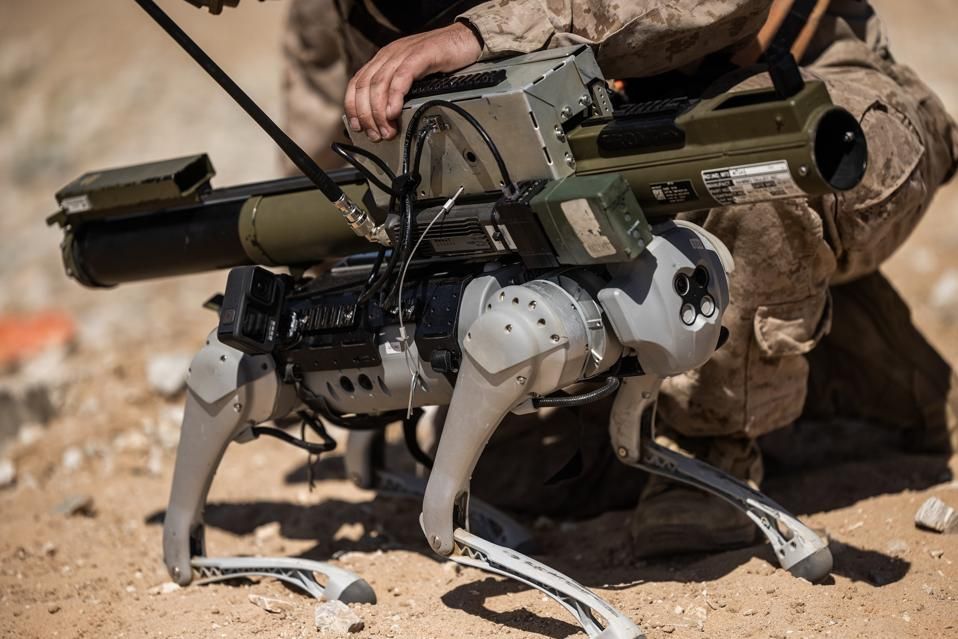
Despite that position, Unitree quadrupeds have been used in military experiments by third parties. In September 2023, U.S. Marines conducted an exercise in which an M72-series rocket launcher was attached to a Unitree Go1 for remote firing. In the same month, the U.S. Army obtained a federal procurement waiver permitting the proposed purchase of two Go2 robots because procurement records stated that sufficient U.S.-made alternatives of satisfactory quality were not commercially available. Reuters could not establish whether the purchase was completed.
Chinese state television has shown Go2 robots operating alongside People's Liberation Army personnel and has also shown a modified B1-series robot firing a mounted assault rifle. Reporting cited in the supplied material also described a Go2 appearing during Chinese military exercises with Cambodia.
In June 2026, the U.S. Department of Defense added Unitree to a list of Chinese military-linked companies, describing it as a contributor to China's defense industrial base. The designation was not itself a sanction but restricted future U.S. military use of the company's technology. In July 2026, the U.S. Federal Communications Commission also prohibited imports of future models of certain foreign-made humanoid and quadruped robots, including Unitree products.
Variants
- XDog: Early quadruped developed by Wang Xingxing during his postgraduate work and associated with his 2016 master's thesis.
- Laikago: Early commercial Unitree quadruped offered for global pre-sale in 2017.
- Laikago Pro: Updated Laikago version that Unitree states began shipping in 2018.
- Aliengo: Commercial quadruped developed after Laikago and before the later Go-series platforms.
- A1: Quadruped associated with Unitree's 2020 development of person-following and running concepts.
- Go1: Consumer-level quadruped released in 2021 with a mass of about 12 kg, multiple sensing options and intelligent following functions.
- Go2: New-generation consumer and research quadruped launched in 2023. Configurations include Air, Pro, X and EDU.
- Go2-W: Wheeled-leg derivative of Go2 shown by Unitree at CES in 2025.
- B1: Larger Unitree quadruped series. A modified B1 has appeared in Chinese state television footage firing a mounted rifle.
- B2: Industrial-grade quadruped introduced in the company's 2023 product generation, designed for inspection, rescue and other demanding applications.
- B2-W: Wheeled-leg industrial derivative displayed by Unitree at CES in 2025.
Specifications (Unitree Go2 EDU)
General characteristics
- Configuration: Electrically actuated quadruped robot
- Standing dimensions: approximately 70 x 31 x 40 cm
- Crouching dimensions: approximately 76 x 31 x 20 cm
- Weight with battery: approximately 15 kg
- Construction: aluminium alloy and high-strength engineering plastic
- Joint motors: 12
- Maximum joint torque: approximately 45 N.m for the largest joint motor
- Payload: approximately 8 kg, with a stated maximum of approximately 12 kg
- Electrical voltage: 28 to 33.6 V
- Maximum working power: approximately 3,000 W
- Battery: 15,000 mAh long-endurance battery
- Charger: 33.6 V, 9 A fast charger
Performance
- Normal speed range: 0 to approximately 3.7 m/s
- Maximum stated speed: approximately 5 m/s under specified conditions
- Maximum climb angle: approximately 40 degrees
- Maximum climb or drop height: approximately 16 cm
- Battery endurance: approximately 2 to 4 hours with the long-endurance battery
Sensors and communications
- Primary ranging sensor: ultra-wide-angle 4D LiDAR
- Camera: HD wide-angle camera
- Foot sensing: foot-end force sensors
- Wireless connectivity: Wi-Fi 6, Bluetooth and 4G with GPS
- Following system: ISS 2.0 intelligent side-follow system
- Development support: secondary-development interfaces and support for optional high-performance computing modules
Related equipment
- MIT Mini Cheetah: Research quadruped presented in 2019. Researchers interviewed by Reuters identified close dimensional and architectural similarities between Mini Cheetah and later Unitree Go-series robots.
- Ghost Robotics Vision 60: U.S.-developed rugged quadruped used mainly by military and government customers for surveillance and search tasks in difficult environments.
- Boston Dynamics Spot: U.S. quadruped robot introduced with a different technical lineage and used for industrial inspection, research and other applications.
 Argentina
 Armenia
 Australia
 Austria
 Austria-Hungary
 Belgium
 Brazil
 United Kingdom
 United States
 Brunei
 Bulgaria
 Canada
 Chile
Chile Colonial America
 Colombia
 Confederate States
 Croatia
 Czech
Czech Denmark
 Egypt
Egypt Finland
 France
 Georgia
 Germany
 German Imperial
 Greece
 Holland
 Hungary
 India
India Indonesia
 Iran
Iran Iraq
Iraq Ireland
 Israel
 Italy
Italy Japan
Japan Japan (1940)
 Jordan
 Kingdom of Italy
 Malaysia
 Mexico
 Myanmar
 Nazi Germany
 Netherlands
 New Zealand
 North Korea
 Norway
 Pakistan
 Peru
Peru Philippines
 Poland
 Portugal
 Prussia
 Romania
 Russia
 Saudi Arabia
 Serbia
 Singapore
 Slovakia
 Slovenia
 South Africa
 South Korea
 Soviet Union
 Spain
Spain Sweden
 Switzerland
 Syria
Syria Taiwan
 Thailand
 Turkey
 UAE
UAE Ukraine
 Vietnam
 Yugoslavia