
History
The Hanwha K9MH Mobile Howitzer is a South Korean 8×8 wheeled 155 mm self-propelled howitzer developed by Hanwha Aerospace as a new branch of the K9 artillery family. It combines K9-series gun technology and K9A2-derived ammunition automation with a heavy wheeled chassis intended to provide greater road mobility and rapid displacement.
The demonstrated configuration uses a CN98 155 mm/52-caliber cannon, an uncrewed rear artillery module, automated projectile and propellant handling, and an armored forward cab for a crew of three. The first complete prototype appeared publicly in spring 2026, and the system remained in pre-production development as of August 2026.
On August 18, 2026, the U.S. Army selected Hanwha Defense USA to provide K9MH prototypes for the Mobile Tactical Cannon program. The agreement covers six initial systems with an option for 12 more, but it is an experimentation contract and does not represent a decision to adopt the K9MH for operational service.
Development
The K9MH development program began in December 2024 and was planned as a 30-month effort ending in June 2027. According to EDR Magazine, a model of the wheeled system was unveiled at AUSA 2025 in Washington, D.C., and was subsequently displayed at ADEX 2025 in Seoul. The project was conceived around a lightweight automated artillery module with modular mechanical and electrical interfaces that could be adapted to suitable heavy 8×8 truck platforms.
The first images of the complete vehicle appeared in March 2026. Defense Express reported that the prototype combined the CN98 155 mm/52-caliber weapon with an automated loading system, 40 projectiles, 192 propellant charges, and a Tatra 8×8 chassis. Hanwha Defense USA formally positioned the K9MH for the U.S. Army Mobile Tactical Cannon competition at the end of March 2026.
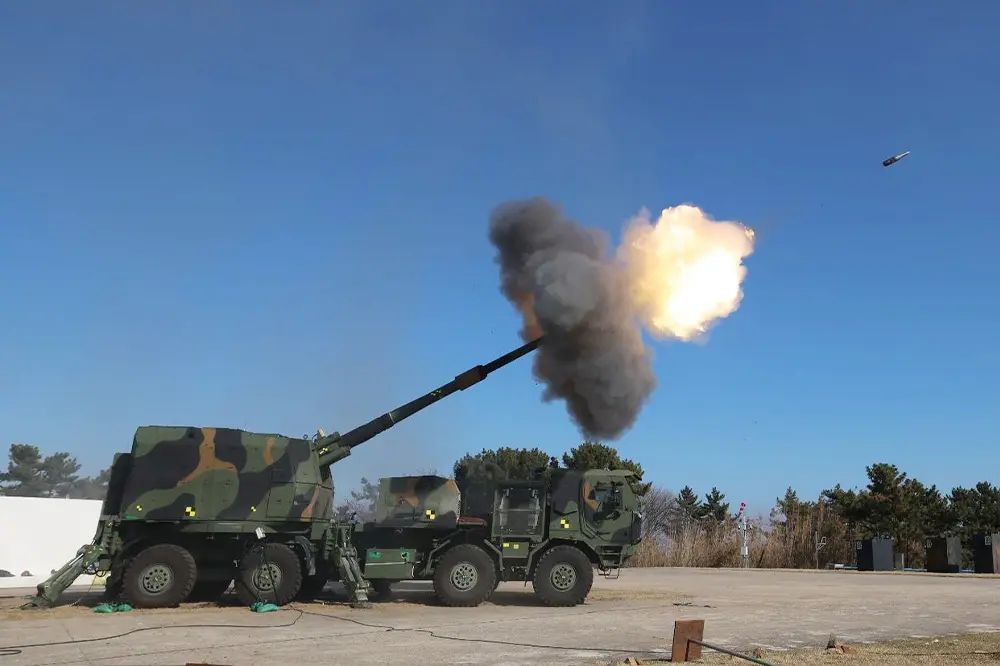
A firing demonstration in South Korea during 2026 showed the automated artillery system firing nine rounds in 59 seconds. Reporting on the demonstration also placed preparation for firing at less than 30 seconds, with the first round available about 20 seconds after the vehicle stopped.
U.S. Mobile Tactical Cannon program
On August 18, 2026, the U.S. Army awarded Hanwha Defense USA an agreement for K9MH prototypes under the Mobile Tactical Cannon program. Asian Military Review reported that six prototype 8×8 vehicles were to be delivered on an accelerated schedule, with an option for another 12. The initial action was valued at $100,302,961, while the agreement had a cumulative ceiling of $262,903,274 and an estimated four-year period for experimentation.
The U.S. Army intends to use the prototypes for operational experiments covering performance, reliability and supportability. The War Zone reported that the program is focused on a wheeled 155 mm system that could replace M777 towed howitzers in selected formations. The Army has emphasized that prototype selection does not guarantee later fielding of the K9MH.
The supplied program information places competitive evaluation and Soldier experimentation before a later production decision. A senior-leader downselect was planned for the fourth quarter of fiscal year 2027, followed by further integration, qualification and industrial preparation, with First Unit Equipped planned for the fourth quarter of fiscal year 2030 if the program proceeds.
Design
Layout and crew
The K9MH is not simply a tracked K9A2 with its running gear replaced by wheels. Hanwha separated the artillery functions of the K9 family from the tracked hull and redesigned the crew arrangement, recoil management, ammunition installation and automotive architecture around a heavy wheeled carrier.
The demonstrated prototype uses a third-generation Tatra Force 8×8 chassis. The armored crew cab is located at the front, while the gun, ammunition magazines, loading mechanisms and gun-laying equipment are installed in an uncrewed module over the rear axles. All three crew members remain in the forward cab during normal firing operations. No specific ballistic, mine or STANAG 4569 protection rating for the K9MH has been confirmed in the supplied material.
Four stabilizers are fitted around the rear artillery installation. They are deployed before firing to create a stable firing base and transfer recoil forces into the ground rather than requiring the truck suspension, tires and frame to absorb the entire impulse of the 155 mm cannon.
Hanwha designed the artillery module with interfaces intended to permit integration with other sufficiently capable heavy trucks. A Mack Defense chassis has also been represented in model form, but no alternative chassis has been confirmed as a production configuration. Any substitute carrier would require adequate axle capacity, structural rigidity, braking, hydraulic and electrical capacity, and appropriate interfaces for the stabilizers and recoil loads.
Armament and automation
The demonstrated K9MH is armed with the Hyundai WIA CN98 155 mm/52-caliber cannon. The weapon follows the NATO Joint Ballistics Memorandum of Understanding standard for 155 mm artillery. The 52-caliber designation corresponds to a nominal barrel length of approximately 8.06 m.
The rear module uses K9A2-derived automation for projectile selection, projectile transfer, propellant selection, charge handling, loading and gun laying. Projectiles and modular propellant charges follow separate handling paths because NATO 155 mm ammunition is loaded as separate components. This arrangement removes the need for personnel to manually handle ammunition at the breech during a normal fire mission.
Army Recognition reports a capacity of 40 projectiles and 192 modular propellant charges for the demonstrated prototype. The same source reports a maximum rate of approximately eight to nine rounds per minute, consistent with the 2026 demonstration in which nine rounds were fired in 59 seconds. EDR Magazine separately reported a maximum rate of eight rounds per minute for three minutes.
Reported range figures depend on the ammunition used. The supplied sources support a conventional-ammunition range of about 40 km and ranges beyond 60 km with suitable extended-range or rocket-assisted ammunition. The War Zone reported a Hanwha-stated maximum of just over 60 km. Higher figures approaching 70 km appear in some reporting but are not consistently confirmed for the baseline K9MH, so they are not treated here as a standard performance figure.
A 155 mm/58-caliber cannon has been considered as a future growth option for the K9 family and K9MH concept. It is not part of the demonstrated baseline K9MH configuration and should not be treated as operational armament.
Mobility and firing deployment
The Tatra-based prototype is reported to reach 100 km/h on roads and have a road range of about 700 km. A climbing capability of up to a 50 percent gradient has also been reported. The specific engine installed in the K9MH prototype has not been identified in the supplied material.
Development reporting places the complete vehicle close to or below 40 tonnes. Estimated dimensions published for the prototype are close to 12 m in length, 3.4 m in width and 2.73 m in height. These figures remain development estimates rather than confirmed final production dimensions.
The system is designed for rapid emplacement and displacement. Multiple supplied sources report that the weapon can prepare to fire in less than 30 seconds and that the first round can be fired about 20 seconds after stopping. Reporting differs on post-mission displacement: EDR Magazine gave approximately 50 seconds to get moving after a fire mission, while Army Recognition reported less than 30 seconds. The supplied sources do not resolve this difference.
Program status
As of August 2026, the K9MH remained a pre-production system. The United States was the first confirmed prototype customer, but the U.S. Army agreement covers experimentation rather than serial production or operational adoption. No armed force was identified in the supplied material as operating the K9MH in regular service.
Hanwha Defense USA is establishing an integration and testing capability in Opelika, Alabama, as an initial U.S. industrial base for the prototype program. The supplied material reports an initial investment of more than $2 million at the site. Any larger U.S. production network would depend on the outcome of Mobile Tactical Cannon testing and a later procurement decision.
Hanwha's original engineering program is scheduled for completion in June 2027. U.S. prototype testing is expected to continue in parallel, with performance, reliability, supportability, ammunition integration and Soldier operation forming part of the evaluation before any production decision.
Variants
- K9MH 155 mm/52-caliber: Demonstrated development configuration using the CN98 155 mm/52-caliber cannon, K9A2-derived automated ammunition handling, an uncrewed rear artillery module, a three-person crew and a Tatra Force 8×8 chassis. This is the basis of the U.S. Mobile Tactical Cannon prototype effort.
- Alternative chassis concept: The artillery module is designed for adaptation to other sufficiently capable heavy 8×8 carriers. A Mack Defense chassis has been shown in model form, but no separately designated production version has been confirmed.
- 155 mm/58-caliber growth option: A longer 58-caliber weapon has been studied as a possible future development. It is not part of the baseline K9MH demonstrated in 2026 and is not a confirmed production variant.
Specifications (K9MH 155 mm/52-caliber prototype)
General characteristics
- Type: Wheeled self-propelled howitzer
- Developer: Hanwha Aerospace
- Chassis: Third-generation Tatra Force 8×8 on the demonstrated prototype
- Crew: 3
- Combat mass: Close to or below 40 tonnes, reported development figure
- Length: Close to 12 m, estimated
- Width: Approximately 3.4 m, estimated
- Height: Approximately 2.73 m, estimated
- Firing support: Four deployable stabilizers
Performance
- Maximum road speed: 100 km/h
- Road range: Approximately 700 km
- Gradient: Up to 50 percent
- First round after stopping: About 20 seconds, reported
- Firing preparation: Less than 30 seconds, reported
- Demonstrated firing sequence: 9 rounds in 59 seconds
- Reported maximum rate of fire: Approximately 8–9 rounds per minute
Armament
- Main weapon: 1 × Hyundai WIA CN98 155 mm/52-caliber howitzer
- Projectile capacity: 40
- Modular propellant charges: 192
- Conventional-ammunition range: About 40 km
- Extended-range capability: More than 60 km with suitable extended-range or rocket-assisted ammunition
- Loading system: Fully automated projectile and propellant handling derived from K9A2 technology
Related equipment
- K9 Thunder: Tracked 155 mm self-propelled howitzer family from which the K9MH derives its gun and artillery-system heritage.
- K9A2: Development of the tracked K9 family whose automation technology influenced the K9MH ammunition-handling and reduced-crew architecture.
- K10 Ammunition Resupply Vehicle: Tracked K9-family resupply system whose automated ammunition-transfer concept has been adapted toward a wheeled support vehicle for the K9MH.
- Mobile Tactical Cannon competitors: The supplied sources identify SIGMA, Archer, RCH 155 and CAESAR proposals among the systems evaluated in the wider U.S. Army modernization effort.
As of August 2026, the K9MH remained a pre-production system undergoing continued development and U.S. prototype evaluation.
 Argentina
 Armenia
 Australia
 Austria
 Austria-Hungary
 Belgium
 Brazil
 United Kingdom
 United States
 Brunei
 Bulgaria
 Canada
 Chile
Chile China
China Colonial America
 Colombia
 Confederate States
 Croatia
 Czech
Czech Denmark
 Egypt
Egypt Finland
 France
 Georgia
 Germany
 German Imperial
 Greece
 Holland
 Hungary
 India
India Indonesia
 Iran
Iran Iraq
Iraq Ireland
 Israel
 Italy
Italy Japan
Japan Japan (1940)
 Jordan
 Kingdom of Italy
 Malaysia
 Mexico
 Myanmar
 Nazi Germany
 Netherlands
 New Zealand
 North Korea
 Norway
 Pakistan
 Peru
Peru Philippines
 Poland
 Portugal
 Prussia
 Romania
 Russia
 Saudi Arabia
 Serbia
 Singapore
 Slovakia
 Slovenia
 South Africa
 Soviet Union
 Spain
Spain Sweden
 Switzerland
 Syria
Syria Taiwan
 Thailand
 Turkey
 UAE
UAE Ukraine
 Vietnam
 Yugoslavia