
History
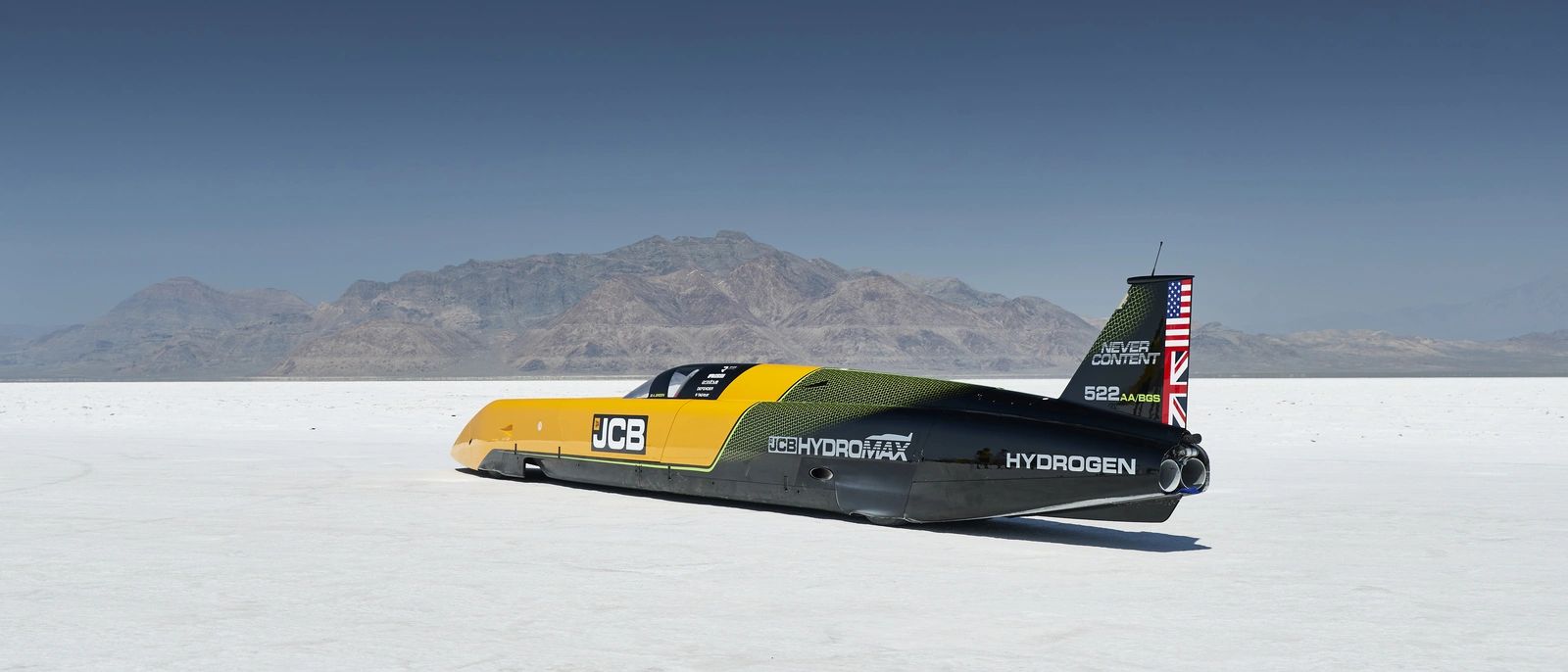
The JCB Hydromax is a British hydrogen-powered land-speed streamliner developed for JCB to demonstrate the performance potential of the company's hydrogen internal combustion engine technology. The purpose-built vehicle uses two heavily modified production-based JCB hydrogen engines and four-wheel drive.
In August 2026, Hydromax completed two record runs at the Bonneville Salt Flats in Utah at 644.740 km/h (400.623 mph) and 663.267 km/h (412.135 mph). Their average was 653.909 km/h (406.320 mph), establishing the hydrogen-powered vehicle land-speed record reported by JCB and other sources.
The project followed JCB's Dieselmax program, which had set a diesel land-speed record of 563.418 km/h (350.092 mph) in 2006. Hydromax returned JCB and driver Andy Green to Bonneville 20 years later, this time using hydrogen combustion engines.
Development
JCB developed Hydromax as a high-speed demonstration of technology derived from its construction-equipment hydrogen engines. According to JCB, the project used two production-based engines, while specialist companies contributed to the vehicle program. Prodrive supported the car build, Ricardo worked on the engine tune, and Xtrac supplied transmission expertise.
The record-car program began approximately 18 months before the 2026 Bonneville campaign, while detailed construction and development were concentrated in roughly the final 12 months. The resulting streamliner was approximately 9.8 m (32 ft) long. Testing and simulation covered the suspension, traction-control settings, aerodynamics and other systems before the Bonneville attempt.
The aerodynamic body was developed using computational fluid dynamics rather than conventional wind-tunnel shaping. The Hydromax design was intended to improve both aerodynamic efficiency and high-speed stability compared with the earlier Dieselmax. A technical account published by The Autopian described the vehicle as a steel-framed structure with a carbon-fibre tub permanently bonded to it.
Testing
Hydromax began runway testing in the United Kingdom in June 2026. Early testing at RAF Wittering reached approximately 335 km/h (208 mph). The team then transported the vehicle to the Bonneville Salt Flats for progressive shakedown and licensing runs before attempting competitive records.
At Bonneville Speed Week, Hydromax competed in the Southern California Timing Association's AA/BGS Blown Gas Streamliner class. After progressively increasing speed, the car recorded runs of 590.865 km/h (367.141 mph) and 594.729 km/h (369.554 mph), producing a two-run average of 592.797 km/h (368.347 mph). This established an SCTA record before the separate FIA world-record attempt.
The Bonneville campaign also exposed mechanical problems that required rapid repairs. During one run, the front engine's control system reported low oil pressure. The team replaced the engine with a spare and subsequently realigned and retested the vehicle before continuing the program.
World-record attempt
For the FIA record attempt on 11 August 2026, Hydromax had to complete two runs in opposite directions within one hour. The first run reached 644.740 km/h (400.623 mph), while the return run reached 663.267 km/h (412.135 mph). The resulting average was 653.909 km/h (406.320 mph).
The record exceeded both the previous hydrogen internal combustion benchmark associated with the BMW H2R and the 303 mph benchmark cited for a hydrogen fuel-cell vehicle. Contemporary coverage by PistonHeads reported that FIA officials were present for the attempt. JCB subsequently described Hydromax as the fastest hydrogen-powered vehicle of any kind.
Andy Green drove Hydromax during the 2026 campaign. Green had previously driven JCB Dieselmax to its diesel record in 2006 and ThrustSSC to the absolute land-speed record of 1,227.985 km/h (763.035 mph) in 1997.
Design
Structure and aerodynamics
Hydromax is a long, narrow streamliner designed specifically for straight-line high-speed running. Its structure combines a steel frame with a bonded carbon-fibre tub. Removable body sections provide access for repair and transport, while the main structure remains rigid.
The aerodynamic form was developed through computer simulation. JCB stated that lessons learned since the Dieselmax program were applied to reduce drag and improve stability. The vehicle uses custom high-speed Goodyear tyres developed for the demands of Bonneville running.
The fully laden mass, including fuel, lubricants, cooling fluids, ice and the driver, was reported as slightly less than 2,700 kg (6,000 lb). The hydrogen fuel tank is positioned behind the carbon-fibre cockpit.
Powertrain
Hydromax is powered by two JCB 4.8-litre four-cylinder hydrogen internal combustion engines. The production version of the engine normally produces about 55 kW (74 hp), but each Hydromax engine was modified to produce approximately 597 kW (800 hp). Combined output is approximately 1.19 MW (1,600 hp).
The race engines retained their relationship to JCB's production hydrogen power unit but received extensive modifications for sustained high-speed operation. Engine speed was increased from the production limit of about 2,200 rpm to more than 4,000 rpm. Port fuel injection was replaced with direct injection, and injection pressure was increased from about 1 MPa to approximately 5 MPa. The race engines also received double overhead camshafts in place of the production pushrod arrangement and a dry-sump lubrication system.
The engines use turbocharging. Rather than relying on a conventional radiator and fan arrangement for the record runs, Hydromax carried ice-based cooling systems. Approximately 250 kg (551 lb) of ice could be carried in two cooling containers, one serving the front engine and another serving the rear installation. The system was used to reduce the temperature of the turbocharged intake air.
Transmission and four-wheel drive
Each engine powers one axle, giving Hydromax four-wheel drive. The front and rear powertrains operate independently, with each engine connected to its own six-speed racing transmission. Xtrac was involved in the transmission system, while the clutch technology was derived from components used in JCB production machinery.
An electronic control system monitors both engines, synchronizes the transmissions and coordinates throttle output. Driver Andy Green retained manual control of gear selection through paddle controls rather than relying on fully automatic shifting.
The transmissions do not engage from rest. During Bonneville operation, a Land Rover Defender OCTA push vehicle accelerated Hydromax to approximately 100 km/h (62 mph), after which the racing transmissions engaged and the streamliner accelerated under its own power.
Cockpit and control
Hydromax has a single-seat cockpit. Its narrow canopy provides forward visibility while tightly restraining the driver for high-speed operation. The vehicle was designed around conventional accelerator and paddle-shift inputs despite the complexity of its twin-engine drivetrain.
High-speed stopping relied on a parachute after the measured section of the course. During the FIA attempt, the measured flying mile was positioned within a run of about 16 km (10 mi), after which Green deployed the parachute to decelerate the vehicle.
Testing and record attempts
Hydromax was developed as a dedicated test and record vehicle rather than a production road car. Its 2026 program progressed from runway testing in Britain to staged runs at Bonneville, an SCTA class record and finally the FIA hydrogen-powered vehicle record attempt.
During the FIA procedure, the team had less than one hour to complete the two required runs in opposite directions. Between runs, the vehicle had to be turned around, its tyres serviced or changed as required, and its hydrogen supply replenished. Contemporary reporting stated that the turnaround was completed in approximately 50 minutes.
A JCB dealer report from Gunn JCB described the result as a 406.320 mph world land-speed record and identified the category as FIA Category A, Group XIV, Class 7. The project served primarily as a demonstration of JCB's production-based hydrogen internal combustion technology rather than as the basis for a road-going vehicle.
Specifications (JCB Hydromax)
General characteristics
- Type: Hydrogen-powered land-speed streamliner
- Crew: 1
- Length: approximately 9.8 m (32 ft)
- Fully laden mass: slightly less than 2,700 kg (6,000 lb)
- Structure: Steel frame with bonded carbon-fibre tub
- Fuel: Compressed gaseous hydrogen
- Drive: Four-wheel drive, with one engine driving each axle
- Engines: 2 × JCB 4.8-litre four-cylinder hydrogen internal combustion engines
- Power: approximately 597 kW (800 hp) per engine; approximately 1.19 MW (1,600 hp) combined
- Transmission: 2 × six-speed racing transmissions, one for each engine
- Cooling: Ice-based charge-air cooling system carrying approximately 250 kg (551 lb) of ice
Performance
- FIA record average: 653.909 km/h (406.320 mph)
- First FIA run: 644.740 km/h (400.623 mph)
- Second FIA run: 663.267 km/h (412.135 mph)
- Bonneville Speed Week SCTA average: 592.797 km/h (368.347 mph)
Related equipment
- JCB Dieselmax: JCB's earlier twin-engine land-speed streamliner, driven by Andy Green to a diesel record of 563.418 km/h (350.092 mph) in 2006.
 Argentina
 Armenia
 Australia
 Austria
 Austria-Hungary
 Belgium
 Brazil
 United States
 Brunei
 Bulgaria
 Canada
 Chile
Chile China
China Colonial America
 Colombia
 Confederate States
 Croatia
 Czech
Czech Denmark
 Egypt
Egypt Finland
 France
 Georgia
 Germany
 German Imperial
 Greece
 Holland
 Hungary
 India
India Indonesia
 Iran
Iran Iraq
Iraq Ireland
 Israel
 Italy
Italy Japan
Japan Japan (1940)
 Jordan
 Kingdom of Italy
 Malaysia
 Mexico
 Myanmar
 Nazi Germany
 Netherlands
 New Zealand
 North Korea
 Norway
 Pakistan
 Peru
Peru Philippines
 Poland
 Portugal
 Prussia
 Romania
 Russia
 Saudi Arabia
 Serbia
 Singapore
 Slovakia
 Slovenia
 South Africa
 South Korea
 Soviet Union
 Spain
Spain Sweden
 Switzerland
 Syria
Syria Taiwan
 Thailand
 Turkey
 UAE
UAE Ukraine
 Vietnam
 Yugoslavia