
History
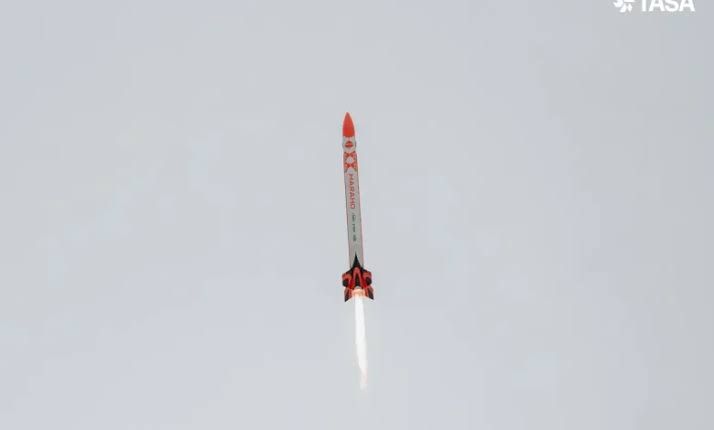
The TASA MARAHO is a sounding rocket developed by the Taiwan Space Agency as a flight-test platform for technologies intended to support Taiwan's indigenous orbital launch vehicle program. Its first test flight was completed on August 22, 2026, from the Syuhai research rocket launch site in Pingtung County.
MARAHO uses a hybrid propulsion system based on 90 percent hydrogen peroxide and polypropylene. During its maiden flight, the rocket reached about Mach 1.2 and a maximum altitude of 8.1 km while transmitting flight data to the ground.
The rocket is not an orbital launch vehicle. TASA uses the MARAHO flight-test series to validate propulsion, structural, avionics, communications, tracking, ground-support and recovery technologies before moving to larger suborbital and orbital test vehicles.
Development
TASA began its orbital launch vehicle program in 2023 with the goal of establishing an indigenous capability to place satellites into low Earth orbit. The program targets delivery of a 200 kg payload to low Earth orbit and uses MARAHO as an early system-level flight-test step.
TASA Director Wu Jong-shinn said the agency's research team carried out MARAHO's design, manufacturing, assembly, integration testing and flight test. The agency planned multiple MARAHO flights to verify critical technologies repeatedly, rehearse mission procedures and reduce development risk before testing larger vehicles.
The name MARAHO comes from Papilio maraho, the broad-tailed swallowtail butterfly endemic to Taiwan. TASA said the butterfly's broad red tails resemble the flame trailing behind a rocket during liftoff.
First flight test
MARAHO lifted off at 07:10 local time on August 22, 2026, from the Syuhai research rocket launch site in Pingtung County. The hybrid propulsion system operated for 18 seconds and produced 1,500 kgf of liftoff thrust. The rocket reached a maximum speed of about Mach 1.2, climbed to 8.1 km, and reached its peak altitude 49 seconds after launch. Total flight time was 432 seconds.
The test was intended to verify operation of the complete rocket system in a real flight environment. A central objective was end-to-end communication between the rocket and the ground so flight data could be received in real time. TASA also used the flight to evaluate independently developed propulsion, structure, avionics, communications, tracking, ground support and recovery subsystems. The Taipei Times report said the planned flight sequence, including ignition, flight and parachute deployment, was completed and the required verification data were obtained.
MARAHO deployed its parachute before descending into the sea. Recovery personnel attempted to retrieve the rocket, but high waves and continued drift prevented recovery. TASA stated that the needed data had already been transmitted during flight, so the loss of the vehicle did not prevent completion of the main test objectives.
Design
Structure and systems
MARAHO is 7.2 m long and 0.4 m in diameter. TASA developed the rocket as an integrated test platform rather than as an operational orbital launcher. Its test program covers the rocket's structure, avionics, communications, tracking and recovery functions together with propulsion and ground-support systems.
The first flight emphasized continuous communication with the ground. The rocket successfully returned useful data throughout the mission, allowing TASA to obtain flight measurements even though the vehicle itself was not recovered after splashdown.
Propulsion
MARAHO uses a hybrid propulsion system with 90 percent hydrogen peroxide and polypropylene. During the first test flight, the propulsion system burned for 18 seconds and generated 1,500 kgf of liftoff thrust. The filling process for concentrated hydrogen peroxide was identified as one of the technically demanding parts of operating the propulsion system.
Recovery
The rocket is equipped with a parachute recovery system. The parachute deployed successfully during the first flight, and the rocket descended into the sea. Recovery was planned but was not completed because sea conditions caused strong waves and vehicle drift.
Program status
MARAHO remains part of TASA's development and flight-test effort for an indigenous orbital launch capability. Data from the 2026 maiden flight are intended to support design improvements and later flight tests, and TASA has stated that multiple MARAHO flights are planned.
The broader launch vehicle program calls for a first suborbital test vehicle flight in 2029. A second suborbital test vehicle is planned around 2030–2031; reporting based on TASA's schedule gives 2031 for that second flight. The first orbital rocket test is planned for 2034.
The program's initial orbital objective is to place a payload of up to 200 kg into low Earth orbit. The source material describes a planned two-stage liquid-propellant launch vehicle for this mission and also notes that TASA has considered a later three-stage hybrid configuration with payload capacity increased to as much as 600 kg. These are future launch-vehicle concepts and are not specifications of MARAHO itself.
Specifications (MARAHO)
General characteristics
- Type: Sounding rocket and flight-test vehicle
- Length: 7.2 m
- Diameter: 0.4 m
- Propulsion: Hybrid propulsion system using 90 percent hydrogen peroxide and polypropylene
- Propulsion duration during first test: 18 seconds
- Liftoff thrust during first test: 1,500 kgf
- Recovery: Parachute system with sea recovery planned
Performance during first test flight
- Maximum speed: About Mach 1.2
- Maximum altitude: 8.1 km
- Time to maximum altitude: 49 seconds
- Total flight time: 432 seconds
Related equipment
MARAHO is an early test platform within TASA's orbital launch vehicle development program. The next planned steps are suborbital test vehicles beginning in 2029, followed by an orbital rocket flight test planned for 2034. These later vehicles are separate development stages rather than MARAHO variants.
 Argentina
 Armenia
 Australia
 Austria
 Austria-Hungary
 Belgium
 Brazil
 United Kingdom
 United States
 Brunei
 Bulgaria
 Canada
 Chile
Chile China
China Colonial America
 Colombia
 Confederate States
 Croatia
 Czech
Czech Denmark
 Egypt
Egypt Finland
 France
 Georgia
 Germany
 German Imperial
 Greece
 Holland
 Hungary
 India
India Indonesia
 Iran
Iran Iraq
Iraq Ireland
 Israel
 Italy
Italy Japan
Japan Japan (1940)
 Jordan
 Kingdom of Italy
 Malaysia
 Mexico
 Myanmar
 Nazi Germany
 Netherlands
 New Zealand
 North Korea
 Norway
 Pakistan
 Peru
Peru Philippines
 Poland
 Portugal
 Prussia
 Romania
 Russia
 Saudi Arabia
 Serbia
 Singapore
 Slovakia
 Slovenia
 South Africa
 South Korea
 Soviet Union
 Spain
Spain Sweden
 Switzerland
 Syria
Syria Thailand
 Turkey
 UAE
UAE Ukraine
 Vietnam
 Yugoslavia