
History
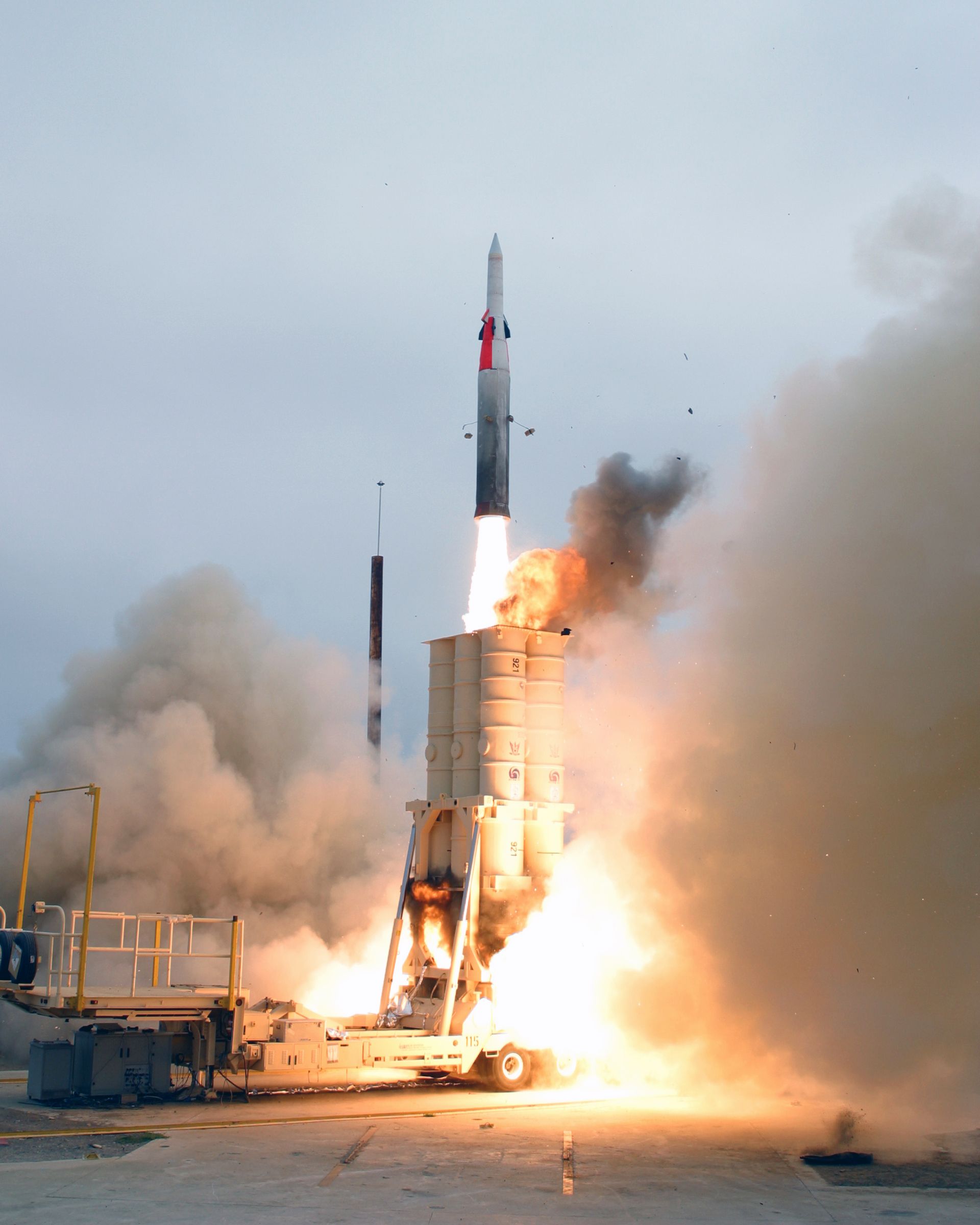
The Israel Aerospace Industries Arrow Weapon System is an Israeli ballistic missile defense system developed with United States participation. It was created to detect, track, and intercept ballistic missiles and forms the upper layer of Israel's multi-tiered air and missile defense network.
The system combines Arrow interceptors with long-range radar, battle management, and launch-control elements. Arrow 2 provides high-altitude interception within and near the atmosphere, while Arrow 3 extends the system to exo-atmospheric interception during the space-flight portion of a ballistic missile's trajectory.
Development began under a United States-Israeli agreement signed in 1986. The first Arrow 1 test vehicle was launched in 1990, and the program subsequently evolved through Arrow 2, Arrow 3, and continuing system upgrades.
Development and early testing
Israel and the United States signed a memorandum of understanding for joint development of Arrow in May 1986. The program addressed the growing threat from long-range surface-to-surface missiles and sought a purpose-built ballistic missile defense capability more suitable for that mission than existing air-defense systems.
The first Arrow 1 launch took place on 9 August 1990. Early tests encountered guidance and tracking problems, but the test program progressively demonstrated the interceptor's flight and interception functions. On 12 June 1994, Arrow 1 successfully intercepted a target missile during the Arrow Demonstration Test program. Development then shifted toward the smaller and more capable Arrow 2 interceptor. A detailed chronology of the early program is available in the Arrow missile family history.
Arrow 2 flight testing began in the mid-1990s. Israel Aerospace Industries delivered the first operational Arrow 2 interceptor to the Israeli Ministry of Defense in November 1998. The first complete battery was rolled out at Palmachim Airbase in March 2000, and the battery was declared operational in October 2000. A second battery became operational in 2002.
The Arrow 2 system underwent repeated Israeli and joint United States-Israeli tests against representative ballistic targets. A notable test at Naval Air Station Point Mugu in California on 29 July 2004 successfully intercepted a Scud-B missile. Later upgrades improved discrimination, communications, guidance, and interoperability with other missile-defense assets.
Arrow 3 and upper-tier defense
Development of Arrow 3 began as Israel and the United States sought a higher-tier interceptor capable of engaging ballistic missiles outside the atmosphere. Arrow 3 uses a two-stage solid-propellant configuration and a kinetic hit-to-kill vehicle. Israel declared Arrow 3 operational on 18 January 2017.
Israel Aerospace Industries describes Arrow 3 as an integral part of the Arrow Weapon System and states that it complements Arrow 2 by providing upper-tier interception and additional engagement opportunities. The manufacturer's Arrow 3 overview identifies a two-stage interceptor, hit-to-kill engagement method, long-range electro-optical acquisition sensor, and high maneuverability.
Continued modernization
The Arrow system has continued to evolve through successive interceptor and system upgrades. Work on Arrow 4 has been presented as a further development intended to address more advanced future threats while remaining part of the wider Arrow architecture.
On 5 August 2026, the Israel Missile Defense Organization, the United States Missile Defense Agency, the Israel Defense Forces, and Israel Aerospace Industries completed a planned test of the Arrow Weapon System at a test site in central Israel. The Israeli Ministry of Defense said the event formed part of a multi-year program to develop and upgrade the system. Its official test announcement stated that the system continues to be upgraded in response to evolving regional threats and lessons from operational use.
The accompanying source report stated that the 2026 test incorporated technologies including elements of artificial intelligence and automated control. The Israeli Ministry of Defense announcement described new developments and continuing upgrades but did not publicly identify the specific test scenario, interceptor variant, or all technologies evaluated. A separate test report likewise noted that these details were not disclosed.
Design
The Arrow Weapon System is a distributed ballistic missile defense architecture rather than a single missile. Its principal elements include Arrow 2 and Arrow 3 interceptors, Green Pine and Super Green Pine long-range radars, a battle-management and command system, a launch-control system, and transportable launcher units.
Radar and target tracking
The Green Pine family provides long-range detection, classification, and tracking of ballistic targets. The original Green Pine is an active electronically scanned array radar with a reported detection range of about 500 km. Later Super Green Pine versions extend reported detection range to approximately 800 to 900 km. The Israeli Ministry of Defense identifies Green Pine and Super Green Pine as the threat-detection and classification radars of the current system.
Command and control
The Arrow architecture uses a battle-management system to process radar tracks, develop engagement solutions, assign targets, and coordinate interceptor launches. The Golden Citron command center has been associated with engagement management, while the Brown Hazelnut launch-control element provides communications and control at the launcher site. The system has also been tested for interoperability with other missile-defense networks.
Launchers
Arrow 2 launchers are trailer-mounted and use sealed canisters. Published descriptions indicate six ready-to-fire interceptor canisters per launcher. The launch method is vertical, providing all-azimuth engagement capability. System elements are transportable or semi-mobile and can be relocated between prepared positions.
Arrow 2 interceptor
Arrow 2 is a two-stage solid-propellant interceptor intended for high-altitude engagement of ballistic missiles. It uses thrust-vector control during powered flight and a terminal kill vehicle fitted with aerodynamic control surfaces. Guidance combines mid-course updates with terminal sensing. Unlike purely kinetic interceptors, Arrow 2 uses a directed high-explosive fragmentation warhead and proximity fuzing while also being designed to achieve very close terminal engagement.
Published system descriptions give Arrow 2 a range of about 90 to 100 km and an interception altitude of approximately 50 km. Maximum speed is reported at about Mach 9. An independent Arrow system overview similarly describes Arrow 2 as a two-stage solid-propellant interceptor with a 90 km range and 50 km altitude ceiling.
Arrow 3 interceptor
Arrow 3 extends interception into the exo-atmospheric region. It uses two solid-propellant stages and destroys targets through kinetic hit-to-kill impact rather than a fragmentation warhead. The interceptor is designed for longer-range ballistic threats and provides an additional engagement layer above Arrow 2.
The supplied source reports exo-atmospheric engagements at distances up to 2,400 km and altitudes above 100 km. Israel Aerospace Industries publicly emphasizes the interceptor's very large defended area and battle space but does not provide the same numerical engagement range on its product page.
Operational history
The Arrow system achieved its first operational intercept on 17 March 2017, when an Arrow interceptor destroyed a Syrian S-200 missile that presented a ballistic-type trajectory toward Israel.
On 31 October 2023, Arrow 2 intercepted a long-range ballistic missile launched toward Israel from Yemen. On 9 November 2023, Arrow 3 achieved its first operational interception of a ballistic missile.
During Iran's large missile and drone attack on Israel on 13 April 2024, the Arrow system participated in the interception of long-range ballistic missiles as part of a broader layered defense involving Israeli and allied systems.
The Israeli Ministry of Defense stated in August 2026 that Arrow 2 and Arrow 3 had intercepted numerous ballistic threats launched from Iran and Yemen during the preceding three years, including exo-atmospheric interceptions. The ministry said lessons from this combat experience were being incorporated into continuing development. Israel was also accelerating interceptor production to expand its stockpile.
Variants
- Arrow 1: Technology-demonstration interceptor used during the early development program. Its first launch occurred in 1990, and development later shifted to Arrow 2.
- Arrow 2: Operational high-altitude ballistic missile interceptor using a fragmentation warhead. It became the basis of the first operational Arrow batteries in 2000.
- Arrow 3: Operational exo-atmospheric interceptor using kinetic hit-to-kill technology. It was declared operational in 2017 and forms the higher engagement tier of the Arrow Weapon System.
- Arrow 4: Next-generation interceptor under development to address more advanced future ballistic and hypersonic threats. It is not described in the supplied material as operational.
Operators
- Israel: The Israeli Air Force Air Defense Command operates the complete Arrow Weapon System, including Arrow 2 and Arrow 3 interceptors.
- Germany: Germany purchased Arrow 3 as part of its ballistic missile defense program. The supplied research states that the first portion of the German system entered service in December 2025.
Specifications (Arrow 2)
General characteristics
- Type: Two-stage ballistic missile defense interceptor
- Propulsion: Two solid-propellant rocket stages
- Launch method: Vertical hot launch from a sealed canister
- Launcher capacity: Six interceptor canisters per trailer-mounted launcher
- Guidance: Mid-course guidance with terminal infrared and radar sensing
- Warhead: Directed high-explosive fragmentation warhead
Performance
- Operational range: Approximately 90 to 100 km
- Interception altitude: Approximately 50 km
- Maximum speed: Approximately Mach 9
Specifications (Arrow 3)
General characteristics
- Type: Exo-atmospheric ballistic missile defense interceptor
- Propulsion: Two solid-propellant stages
- Kill mechanism: Kinetic hit-to-kill vehicle
- Role: Upper-tier interception of longer-range ballistic missiles during the space-flight portion of their trajectory
Performance
- Interception environment: Exo-atmospheric space
- Reported engagement distance: Up to 2,400 km in the supplied source
- Reported interception altitude: Above 100 km in the supplied source
Related equipment
- David's Sling: Israeli missile-defense system forming a lower layer of the national multi-tiered defense architecture.
- Iron Dome: Shorter-range Israeli air and missile defense system operating as another layer of the national defense network.
- Iron Beam: Directed-energy defense system identified by the Israeli Ministry of Defense as part of Israel's multi-layered air and missile defense array.
 Argentina
 Armenia
 Australia
 Austria
 Austria-Hungary
 Belgium
 Brazil
 United Kingdom
 United States
 Brunei
 Bulgaria
 Canada
 Chile
Chile China
China Colonial America
 Colombia
 Confederate States
 Croatia
 Czech
Czech Denmark
 Egypt
Egypt Finland
 France
 Georgia
 Germany
 German Imperial
 Greece
 Holland
 Hungary
 India
India Indonesia
 Iran
Iran Iraq
Iraq Ireland
 Italy
Italy Japan
Japan Japan (1940)
 Jordan
 Kingdom of Italy
 Malaysia
 Mexico
 Myanmar
 Nazi Germany
 Netherlands
 New Zealand
 North Korea
 Norway
 Pakistan
 Peru
Peru Philippines
 Poland
 Portugal
 Prussia
 Romania
 Russia
 Saudi Arabia
 Serbia
 Singapore
 Slovakia
 Slovenia
 South Africa
 South Korea
 Soviet Union
 Spain
Spain Sweden
 Switzerland
 Syria
Syria Taiwan
 Thailand
 Turkey
 UAE
UAE Ukraine
 Vietnam
 Yugoslavia