
History
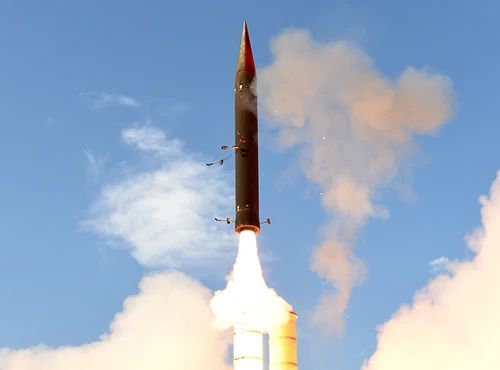
Arrow 3 is an Israeli-American exo-atmospheric ballistic-missile-defense system developed to intercept long-range ballistic threats during the space-flight portion of their trajectory. Israel Aerospace Industries is the principal industrial contractor, while the program has been developed with support from the United States Missile Defense Agency and industrial participation from Boeing.
The system forms the upper layer of Israel's multi-tier missile-defense architecture. It combines the Arrow 3 interceptor with long-range radar, battle-management and fire-control equipment, launch-control facilities and mobile launchers.
Arrow 3 became operational in Israel in 2017 and achieved its first operational interception in November 2023. Germany subsequently became the first foreign customer to introduce the system, receiving its first operational Arrow 3 capability in December 2025.
Development
Development of the Arrow 3 upper-tier interceptor began after Israeli and United States authorities identified a requirement for an exo-atmospheric layer above the existing Arrow 2 system. Development work was under way by 2008, with Israel Aerospace Industries responsible for the interceptor program and Boeing becoming a major production partner.
IAI conducted preliminary Arrow 3 testing in 2011. In January 2012, a model interceptor was launched to evaluate the launch and propulsion systems and associated tracking functions. Boeing and IAI also announced an agreement in 2012 covering joint work on Arrow 3, with Boeing assigned a substantial share of production content, including structural, power, navigation and actuator components. A detailed chronology of the early program is available from the Arrow 3 program summary.
The first successful Arrow 3 flight test was conducted from Palmachim Airbase in February 2013. The interceptor reached hypersonic speed and climbed to approximately 100 km during the test. Another flight in January 2014 demonstrated exo-atmospheric flight and maneuvering. A planned interception test in December 2014 did not proceed to interceptor launch because test conditions were unsuitable.
On 10 December 2015, Arrow 3 completed its first successful interception test against a target released by an improved Silver Sparrow target missile. Further testing followed in Israel in 2018 and 2019.
Alaska test campaign
In July 2019, the Israel Missile Defense Organization and the U.S. Missile Defense Agency conducted a series of Arrow 3 tests at the Pacific Spaceport Complex in Kodiak, Alaska. Arrow 3 successfully completed multiple exo-atmospheric hit-to-kill engagements. The campaign also demonstrated interoperability with the U.S. AN/TPY-2 radar. Additional information on the test program and system configuration is provided by Airforce Technology.
Full production was reported to have begun in 2019 under the Israeli-American co-production arrangement. Another successful Arrow weapon-system and Arrow 3 interceptor flight test was conducted in January 2022.
German procurement
Germany selected Arrow 3 to provide a high-altitude layer against long-range ballistic missiles. The United States approved the Israeli-German export agreement in August 2023, and the procurement agreement was concluded later that year. The initial contract was valued at more than €3.6 billion according to German reporting.
The first operational Arrow 3 system for Germany was formally handed over on 3 December 2025 at a German Air Force facility near Berlin. The delivery made Germany the first country outside Israel to integrate Arrow 3 into its national missile-defense structure. The delivery and industrial responsibilities were reported by Breaking Defense.
Germany's first site is associated with the Holzdorf military airfield near Schönewalde. Additional sites are planned in Bavaria and Schleswig-Holstein as Germany expands national coverage. German plans envisage a broader Arrow 3 protection capability by around 2030. An overview of the German deployment concept is available from Deutsche Welle.
In Bavaria, a future Bundeswehr facility in the Friesenried and Kaufbeuren area is planned to include a radar station associated with Arrow 3. Construction of the site is planned for completion in 2028. Local politicians and residents have sought federal compensation for possible effects on drinking-water infrastructure and regional roads, while residents have also raised concerns about the proximity of the radar installation to homes.
Design
Arrow 3 is designed primarily for exo-atmospheric interception of ballistic missiles. The interceptor uses hit-to-kill technology rather than an explosive fragmentation warhead. It destroys a target through direct collision at very high relative velocity.
Interceptor
The Arrow 3 interceptor uses two solid-propellant stages. After vertical launch, the missile is directed toward a predicted interception region. Once the hostile re-entry vehicle or warhead has been identified, the kill vehicle performs terminal guidance and maneuvering to achieve direct impact.
The kill vehicle uses an electro-optical seeker and a maneuvering system that allows substantial changes in direction outside the atmosphere. The design is intended to provide a larger defended area and longer engagement distances than the earlier Arrow 2 interceptor.
Radar and fire control
The Arrow weapon system can use the ELTA Super Green Pine early-warning and fire-control radar. The L-band radar provides long-range detection, acquisition and tracking of ballistic targets and supports simultaneous tracking of multiple objects. The system is also designed to work with other sensors, as demonstrated by testing with the AN/TPY-2 radar.
Radar information is processed by the Citron Tree battle-management and command-and-control system. It evaluates detected threats, estimates launch and impact points and supports selection and assignment of interceptors. The battle-management system can operate in manual and automatic modes and is designed to manage multiple ballistic threats.
Launch control and launcher
The Hazelnut Tree launch-control centre connects the fire-control system with the missile launchers. It controls launch operations, provides system redundancy and incorporates safeguards intended to prevent accidental launch. It also supports diagnosis and maintenance of interceptor equipment.
The mobile launcher uses sealed missile canisters and vertical hot launch. Each launcher can carry six interceptor canisters. Published descriptions state that the launcher can accommodate both Arrow 3 and Arrow 2 interceptors.
Industrial organization
Israel Aerospace Industries is the principal contractor for Arrow and is responsible for major interceptor, radar and system elements. Boeing contributes a substantial portion of Arrow 3 production in the United States. Elbit Systems developed the command-and-control element, while Tomer and Rafael Advanced Defense Systems participate as major subcontractors in interceptor and propulsion-related work.
Operational history
Arrow 3 was declared operational with Israel in January 2017. It remained part of the country's highest-tier defense against long-range ballistic missiles alongside Arrow 2, with David's Sling and Iron Dome covering lower layers of the defensive architecture.
On 9 November 2023, Arrow 3 achieved its first confirmed operational interception when it engaged a ballistic missile launched by Houthi forces in Yemen toward southern Israel. The engagement demonstrated the system's intended exo-atmospheric combat role.
Arrow 3 was subsequently employed during the large Iranian missile and drone attack against Israel in April 2024 as part of a broader Israeli and allied defensive effort. The system was also used against later ballistic-missile attacks during 2024.
Arrow interceptors continued to be used against ballistic missiles during the 12-day Israel-Iran conflict in 2025. Public reporting describes extensive use of the Arrow family during the campaign, although available sources do not provide a complete independently verified breakdown of Arrow 2 and Arrow 3 engagements.
Operators
- Israel: Arrow 3 entered operational service in 2017 and has been used in combat against ballistic missiles since November 2023.
- Germany: The first operational Arrow 3 capability was delivered to the Bundeswehr on 3 December 2025. Additional sites are planned as part of a wider German long-range missile-defense network.
Specifications (Arrow 3)
General characteristics
- Type: Exo-atmospheric anti-ballistic missile interceptor and integrated missile-defense system
- Guidance and terminal engagement: Electro-optical seeker with hit-to-kill interception
- Propulsion: Two solid-propellant stages
- Launch method: Vertical hot launch from sealed canister
- Launcher capacity: Six interceptor canisters per launcher
Performance
- Reported flyout range: Up to approximately 2,400 km
- Interception regime: Exo-atmospheric, at approximately 100 km altitude and above depending on engagement conditions
- Speed: Hypersonic
System components
- Radar: Super Green Pine L-band early-warning and fire-control radar
- Battle management: Citron Tree command, control, communication and intelligence/fire-control system
- Launch control: Hazelnut Tree launch-control centre
- Interceptor: Arrow 3 hit-to-kill missile
Related equipment
- Arrow 2: Earlier Arrow interceptor used for ballistic-missile defense and sharing elements of the wider Arrow weapon-system architecture.
- David's Sling: Israeli missile-defense system forming a lower defensive layer beneath Arrow against shorter-range threats.
- Iron Dome: Short-range Israeli air- and missile-defense system forming the lowest layer of Israel's commonly described multi-tier active-defense architecture.
 Argentina
 Armenia
 Australia
 Austria
 Austria-Hungary
 Belgium
 Brazil
 United Kingdom
 United States
 Brunei
 Bulgaria
 Canada
 Chile
Chile China
China Colonial America
 Colombia
 Confederate States
 Croatia
 Czech
Czech Denmark
 Egypt
Egypt Finland
 France
 Georgia
 Germany
 German Imperial
 Greece
 Holland
 Hungary
 India
India Indonesia
 Iran
Iran Iraq
Iraq Ireland
 Italy
Italy Japan
Japan Japan (1940)
 Jordan
 Kingdom of Italy
 Malaysia
 Mexico
 Myanmar
 Nazi Germany
 Netherlands
 New Zealand
 North Korea
 Norway
 Pakistan
 Peru
Peru Philippines
 Poland
 Portugal
 Prussia
 Romania
 Russia
 Saudi Arabia
 Serbia
 Singapore
 Slovakia
 Slovenia
 South Africa
 South Korea
 Soviet Union
 Spain
Spain Sweden
 Switzerland
 Syria
Syria Taiwan
 Thailand
 Turkey
 UAE
UAE Ukraine
 Vietnam
 Yugoslavia