
History
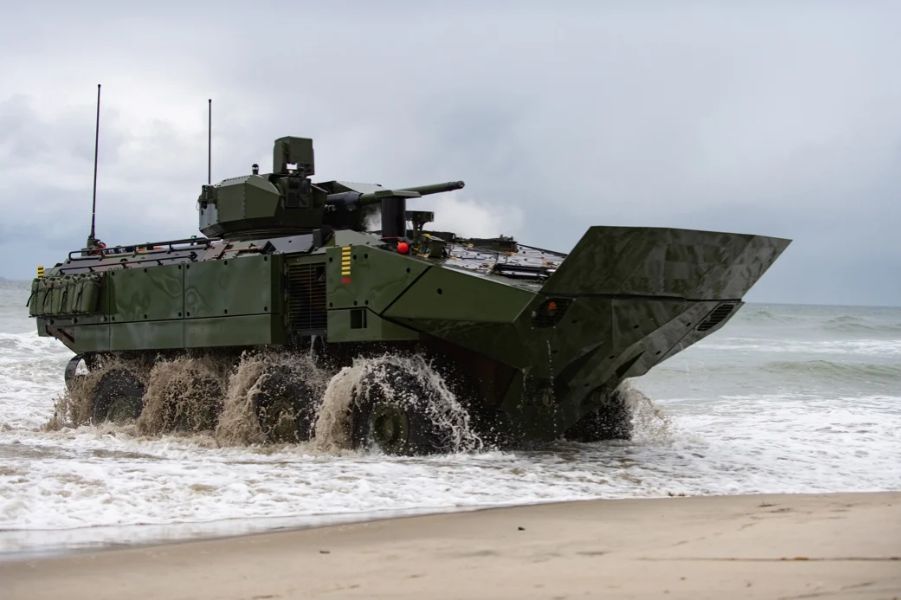
The Kongsberg PROTECTOR RT20 is a stabilized, remotely operated medium-caliber turret developed by Kongsberg Defence & Aerospace of Norway. It is used to provide protected direct-fire capability while allowing operators to remain inside the armored vehicle hull.
The RT20 became closely associated with the U.S. Marine Corps Amphibious Combat Vehicle 30, or ACV-30, where it carries a 30 mm cannon. Kongsberg has also received an order for RT20 turrets for the Marine Corps Advanced Reconnaissance Vehicle program, although the reconnaissance configuration is described as lighter and tailored for a different vehicle integration.
The turret combines remote operation, digital fire control and stabilized sensing with an architecture intended to preserve internal vehicle space and support later integration of additional sensors or effectors. Optional capabilities described for the wider RT20 architecture should not be assumed to be installed on every Marine Corps configuration.
Development and ACV-30 integration
By May 2022, the RT20 had been publicly shown on an ACV-30 configuration. Contemporary commentary described it as using the same basic architecture as the larger RT40 and RT60 turrets while being lighter and more compact. The configuration combined a 30×173 mm Bushmaster cannon with a coaxial 7.62 mm machine gun. A contemporary description is available from Nicholas Drummond.
Kongsberg subsequently moved into larger-scale production for the ACV-30 program. Published figures for the August 2025 production award differ. The Defense Post reported a $118 million contract associated with full-rate production of 101 PROTECTOR 20 systems, with a potential value of $271.5 million if all options were exercised. A later Army Recognition account described the August 2025 full-rate-production agreement as valued at up to approximately $330 million. The sources therefore appear to use different contract scopes or option accounting, and the available evidence does not establish a single directly comparable total.
In December 2025, an additional contract modification funded 52 full-rate-production RT20 turrets. The wider ACV-30 industrial program was also expanding. By February 2026, BAE Systems reported that another ACV production award had increased the number of ACV-30 vehicles ordered under that contract to more than 150.
Advanced Reconnaissance Vehicle order
On January 27, 2026, Kongsberg received a $22,412,881 firm-fixed-price contract modification for 16 PROTECTOR RT20 remote weapon stations for the U.S. Marine Corps Advanced Reconnaissance Vehicle program. According to Army Recognition, deliveries were expected to begin in the third quarter of fiscal year 2026 and continue into early fiscal year 2027.
The ARV installation is derived from the same RT20 family used on the ACV-30, but the two configurations are not identical. The reconnaissance-oriented version was described as lighter and more modular, with greater accommodation for sensors, command-and-control equipment and unmanned-system connectivity. The 16 ordered turrets were intended for early production or test vehicles while the ARV program continued evaluation.
Sustainment contract
On August 24, 2026, the United States announced a $44,267,020 firm-fixed-price contract modification for Kongsberg Defence & Aerospace supporting the Marine Corps Amphibious Combat Vehicle Medium Caliber Cannon program and the PROTECTOR Remote Turret 20. The modification covered additional initial provisioning spares, engineering changes, repair activities, sustainment processes and support for future engineering changes. The award increased the contract's potential value to $335.90 million if all options were exercised.
Work under the sustainment modification was scheduled to continue through August 27, 2030. Sixty-two percent of the work was assigned to Johnstown, Pennsylvania, and 38 percent to Kongsberg, Norway. Kongsberg had expanded its Johnstown facility in February 2026 with more than 36,000 square feet of additional manufacturing space supporting ACV-30 production. The 2026 award marked a transition from primarily acquiring turrets toward establishing the spare-parts, repair and engineering infrastructure needed to sustain a growing fleet.
Design
Remote turret architecture
The PROTECTOR RT20 is a remotely operated medium-caliber turret. Its crew controls the weapon and sensors from protected positions inside the host vehicle rather than occupying the turret itself. This arrangement reduces the internal volume required by a traditional manned turret and helps preserve space for troops and mission equipment.
The turret is stabilized for firing and observation while the vehicle is moving. Its architecture is digital and modular, providing a basis for integrating different sensors, weapons and other effectors. Kongsberg's RT20 architecture has been described with linkless ammunition handling and under-armor reloading, allowing ammunition servicing without requiring the crew to leave the protected hull.
Sensors and fire control
Reported RT20 equipment includes stabilized electro-optical sights, thermal imaging, a laser rangefinder and target-tracking functions. The system has also been described as supporting single- or dual-user operation, hunter-killer targeting and target sharing. These capabilities belong to the broader RT20 architecture and may vary according to customer and vehicle configuration.
Additional features described for configurable RT20 installations include programmable airburst ammunition, auxiliary weapons, anti-tank guided missiles and active protection systems. These are integration options rather than confirmation that every U.S. Marine Corps RT20 carries all of them.
ACV-30 armament
The confirmed principal weapon of the Marine Corps ACV-30 configuration is the Northrop Grumman Mk44S Stretch Bushmaster Chain Gun. It fires NATO-standard 30×173 mm ammunition and entered full-rate production for the ACV-30 program in December 2025.
The Mk44S weapon provides a future path to 40 mm ammunition through replacement of the barrel and several other components. This conversion potential concerns the weapon architecture and does not mean that the Marine Corps currently operates its ACV-30 vehicles with a 40 mm cannon.
Program status
The RT20 is in full-rate production for the U.S. Marine Corps ACV-30 program, with production, spare-parts, repair and engineering-support contracts extending into the second half of the 2020s. The August 2026 sustainment modification is scheduled to support the program through August 2030.
A separate batch of 16 RT20 turrets has been ordered for the Advanced Reconnaissance Vehicle program. Those systems are associated with early production or test vehicles and should not be treated as evidence that the ARV has entered full-rate production.
Variants
- PROTECTOR RT20 for ACV-30: Remote medium-caliber turret integrated with the U.S. Marine Corps Amphibious Combat Vehicle 30 and equipped with the Mk44S Stretch Bushmaster 30 mm cannon.
- PROTECTOR RT20 for ARV: Lighter, more modular configuration ordered for the U.S. Marine Corps Advanced Reconnaissance Vehicle program, with emphasis on sensor and digital-system integration.
Operators
- United States Marine Corps: RT20 turrets are being produced and sustained for the ACV-30 fleet. The service has also ordered 16 RT20 systems for the Advanced Reconnaissance Vehicle program.
Specifications (PROTECTOR RT20, ACV-30 configuration)
General characteristics
- Type: Stabilized remotely operated medium-caliber turret
- Manufacturer: Kongsberg Defence & Aerospace
- Operating arrangement: Remote operation from protected positions inside the vehicle hull
- Host vehicle: U.S. Marine Corps ACV-30
Armament
- Primary weapon: Northrop Grumman Mk44S Stretch Bushmaster Chain Gun
- Caliber: 30×173 mm
- Future weapon conversion: Mk44S can be converted to 40 mm by replacing the barrel and several components; this is not the current Marine Corps ACV-30 configuration
Fire control and sensors
- Stabilization: Stabilized weapon and observation system
- Reported sensor types: Electro-optical sights, thermal imaging and laser rangefinding
- Reported functions: Target tracking, hunter-killer operation and target sharing, depending on configuration
Related equipment
- PROTECTOR RT40 and RT60: Larger Kongsberg remote turret designs described as sharing the same basic architectural family as the lighter and more compact RT20.
 Argentina
 Armenia
 Australia
 Austria
 Austria-Hungary
 Belgium
 Brazil
 United Kingdom
 United States
 Brunei
 Bulgaria
 Canada
 Chile
Chile China
China Colonial America
 Colombia
 Confederate States
 Croatia
 Czech
Czech Denmark
 Egypt
Egypt Finland
 France
 Georgia
 Germany
 German Imperial
 Greece
 Holland
 Hungary
 India
India Indonesia
 Iran
Iran Iraq
Iraq Ireland
 Israel
 Italy
Italy Japan
Japan Japan (1940)
 Jordan
 Kingdom of Italy
 Malaysia
 Mexico
 Myanmar
 Nazi Germany
 Netherlands
 New Zealand
 North Korea
 Pakistan
 Peru
Peru Philippines
 Poland
 Portugal
 Prussia
 Romania
 Russia
 Saudi Arabia
 Serbia
 Singapore
 Slovakia
 Slovenia
 South Africa
 South Korea
 Soviet Union
 Spain
Spain Sweden
 Switzerland
 Syria
Syria Taiwan
 Thailand
 Turkey
 UAE
UAE Ukraine
 Vietnam
 Yugoslavia