
History
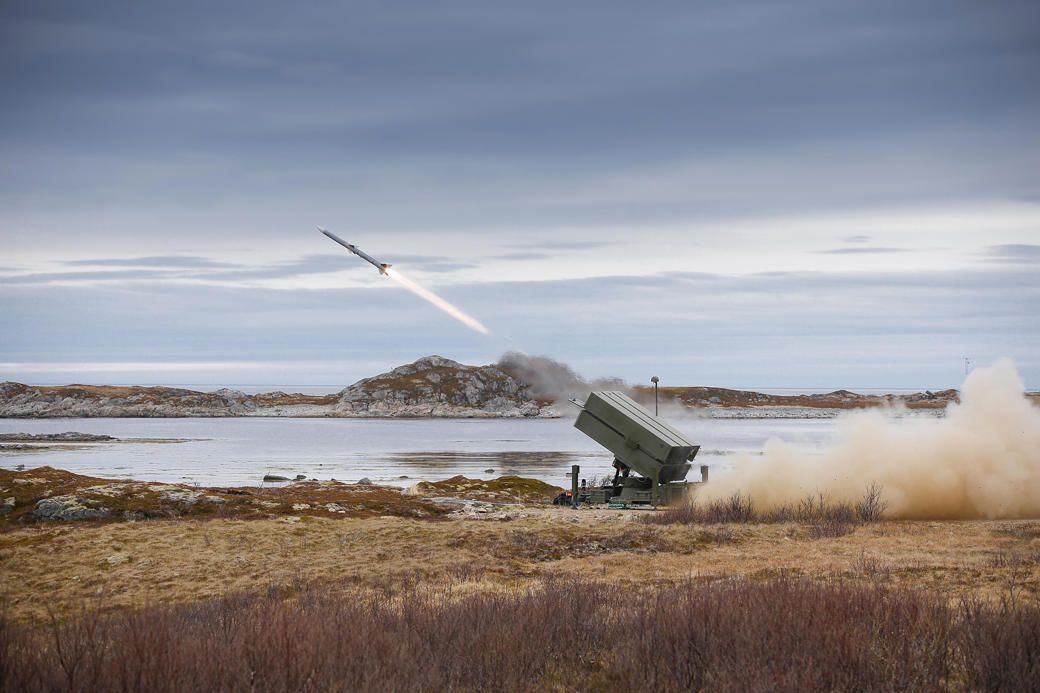
NASAMS, the National Advanced Surface-to-Air Missile System, is a networked ground-based air-defense system developed by Kongsberg Defence & Aerospace and Raytheon. It is designed to defend military forces, populated areas, air bases, ports, and other high-value assets against aircraft, helicopters, unmanned aerial vehicles, and cruise missiles.
The system combines distributed sensors, command-and-control equipment, launchers, and several compatible missile types. Its modular architecture allows individual elements to be dispersed over a wide area while remaining connected through the Fire Distribution Center.
NASAMS entered development for the Royal Norwegian Air Force as a replacement for older air-defense capabilities protecting southern Norwegian air bases. The design evolved into a short- to medium-range system centered on surface-launched versions of air-to-air missiles, particularly the AIM-120 AMRAAM.
Development
Development began during the 1980s as a cooperative effort involving Kongsberg and the American companies associated with the missile and ground-system elements. The program drew on Norwegian work with the Norwegian Adapted Hawk air-defense system, including command-and-control technology and radar integration.
The new system replaced the semi-active radar-guided Hawk missile concept with the active radar-homing AIM-120 AMRAAM. The surveillance element evolved toward the AN/MPQ-64 Sentinel radar configuration, while the distributed architecture allowed several launchers and sensors to operate as part of one network.
NASAMS test launches were conducted in June 1993. Initial operational capability followed during 1994-1995, and the system was fully fielded in Norway in 1998.
Evolution
NASAMS has undergone continuous development since its introduction. An enhanced NASAMS 2 configuration became operational during the 2000s and incorporated improved networking capabilities, including Link 16 integration. NASAMS 3 was subsequently developed and fielded in 2019, expanding the range of compatible weapons and system components.
The current architecture supports the AIM-120 AMRAAM as its baseline weapon and can also employ AMRAAM-ER and AIM-9X-2 missiles. Kongsberg describes AMRAAM-ER as an option that significantly increases the system's engagement volume, while AIM-9X-2 is optimized for shorter-range engagements.
Design
NASAMS uses a modular, distributed architecture in which sensors, launchers, and command elements can be separated geographically while operating as one coordinated air-defense network. Kongsberg describes the system as network-centric and capable of multiple simultaneous engagements and beyond-visual-range operations.
Fire control and sensors
A standard NASAMS unit includes a Kongsberg Fire Distribution Center, an active three-dimensional Raytheon AN/MPQ-64F1 Sentinel radar, a passive electro-optical and infrared sensor, and missile canister launchers. Several fire units can be linked through a low-latency communications network.
The Fire Distribution Center is the central command-and-control element. Its open architecture allows NASAMS to exchange information with higher-echelon command structures and to integrate additional sensors and effectors. Kongsberg states that the system has demonstrated interoperability with longer-range air-defense systems such as Patriot.
Radar and launcher elements may be deployed more than 20 km from the Fire Distribution Center. This distributed arrangement increases the area that can be covered and reduces the need to concentrate all components at one location.
Launchers and missiles
NASAMS uses canister launchers carrying surface-launched guided missiles. The baseline weapon is the Raytheon AIM-120 AMRAAM, the same basic missile family used by fighter aircraft. Using an existing air-to-air missile family provides commonality between airborne and ground-based inventories.
Later NASAMS configurations can also employ AMRAAM-ER and AIM-9X missiles. The ability to integrate several missile types allows a NASAMS unit to use different effectors for different engagement requirements.
Mobility and deployment
The system is designed for flexible deployment around static or mobile assets. Its individual components can be distributed over a comparatively large area rather than operating as a tightly grouped battery. Kongsberg states that NASAMS can be configured for the protection of air bases, seaports, populated areas, high-value assets, and army forces.
The architecture is intended to permit mission-specific combinations of sensors, launchers, communications equipment, and command posts. Kongsberg also describes the system as suitable for operations in Arctic, subtropical, and desert environments.
Operational history
NASAMS has been incorporated into the air defense of the United States National Capital Region since 2005. Raytheon states that the system continues to form part of the defensive network protecting the Washington, D.C. area.
NASAMS has subsequently entered service with a growing group of countries. Raytheon's 2026 material lists Norway, the United States, Finland, Spain, the Netherlands, Oman, Lithuania, Indonesia, Australia, Qatar, Hungary, Ukraine, Taiwan, Denmark, Kuwait, and Chile among countries operating the system. Kongsberg separately describes a customer base of thirteen countries, indicating that the two manufacturers use different counting methods for customers and operators.
Ukraine began receiving NASAMS systems in 2022 during the Russia-Ukraine war. Norwegian military reporting cited in the supplied research stated in 2025 that NASAMS units in Ukrainian service had engaged approximately 900 missiles and drones with a reported 94 percent hit rate, with almost 60 percent of the destroyed threats described as cruise missiles. These figures are operational claims attributed to the Norwegian Armed Forces rather than independently verified system specifications.
Lithuania has also expanded its NASAMS force. In August 2026, Lithuanian military officials stated that NASAMS had been deployed on the approaches to Vilnius, replacing the shorter-range RBS-70 in that role. Lithuania had two NASAMS batteries at that time and expected a third battery in 2028.
The Lithuanian deployment was described as part of an effort to improve protection against aerial threats, including unmanned aircraft. Lithuanian officials noted that NASAMS missiles are related to weapons used by fighter aircraft participating in Baltic Air Policing and emphasized the system's greater range and engagement flexibility compared with the RBS-70 units previously assigned to the capital area.
Variants
- NASAMS: Original operational configuration developed for Norway around the AIM-120 AMRAAM, distributed sensors, launchers, and networked command-and-control equipment.
- NASAMS 2: Enhanced generation developed during the 2000s with improved networking and Link 16 capability.
- NASAMS 3: Later generation fielded in 2019 with expanded integration of missiles and other system capabilities, including AIM-9X and AMRAAM-ER.
Operators
- Norway: Original NASAMS customer and operator.
- United States: NASAMS has formed part of the National Capital Region air-defense system since 2005.
- Finland: Listed by Raytheon as an operator.
- Spain: Listed by Raytheon as an operator.
- Netherlands: Listed by Raytheon as an operator.
- Oman: Listed by Raytheon as an operator.
- Lithuania: Operates two batteries as of August 2026, with a third battery expected in 2028. NASAMS is deployed for the protection of approaches to Vilnius.
- Indonesia: Listed by Raytheon as an operator.
- Australia: Listed by Raytheon as an operator.
- Qatar: Listed by Raytheon as an operator.
- Hungary: Listed by Raytheon as an operator.
- Ukraine: NASAMS has been used operationally against missiles and unmanned aircraft since systems began arriving in 2022.
- Taiwan: Listed by Raytheon as an operator.
- Denmark: Listed by Raytheon as an operator.
- Kuwait: Listed by Raytheon as an operator.
- Chile: Listed by Raytheon as an operator.
Specifications (standard NASAMS unit)
General characteristics
- Type: Networked short- to medium-range ground-based air-defense system
- Developers: Kongsberg Defence & Aerospace and Raytheon
- Command element: Kongsberg Fire Distribution Center
- Primary radar: Raytheon AN/MPQ-64F1 Sentinel active three-dimensional radar
- Additional sensor: Passive electro-optical and infrared sensor
- Launcher type: Missile canister launcher
- Baseline missile: AIM-120 AMRAAM
- Additional supported missiles: AMRAAM-ER and AIM-9X family weapons in later configurations
- Distributed deployment: Radar and launcher elements can be positioned more than 20 km from the Fire Distribution Center
Engagement capability
- Target classes: Fixed-wing aircraft, rotary-wing aircraft, unmanned aerial vehicles, and cruise missiles
- Engagement architecture: Networked operation with multiple simultaneous engagements and beyond-visual-range capability
- Integration: Designed for connection with national integrated air and missile-defense networks and higher-echelon command systems
Related equipment
- RBS-70: Short-range air-defense system replaced by NASAMS in the air-defense role around Vilnius in 2026.
- Patriot: Longer-range air-defense system with which Kongsberg states NASAMS has demonstrated interoperability.
Technical descriptions of the current system are published by Kongsberg and Raytheon. The 2026 Lithuanian deployment around Vilnius was also reported by Mezha.
 Argentina
 Armenia
 Australia
 Austria
 Austria-Hungary
 Belgium
 Brazil
 United Kingdom
 United States
 Brunei
 Bulgaria
 Canada
 Chile
Chile China
China Colonial America
 Colombia
 Confederate States
 Croatia
 Czech
Czech Denmark
 Egypt
Egypt Finland
 France
 Georgia
 Germany
 German Imperial
 Greece
 Holland
 Hungary
 India
India Indonesia
 Iran
Iran Iraq
Iraq Ireland
 Israel
 Italy
Italy Japan
Japan Japan (1940)
 Jordan
 Kingdom of Italy
 Malaysia
 Mexico
 Myanmar
 Nazi Germany
 Netherlands
 New Zealand
 North Korea
 Pakistan
 Peru
Peru Philippines
 Poland
 Portugal
 Prussia
 Romania
 Russia
 Saudi Arabia
 Serbia
 Singapore
 Slovakia
 Slovenia
 South Africa
 South Korea
 Soviet Union
 Spain
Spain Sweden
 Switzerland
 Syria
Syria Taiwan
 Thailand
 Turkey
 UAE
UAE Ukraine
 Vietnam
 Yugoslavia