
History
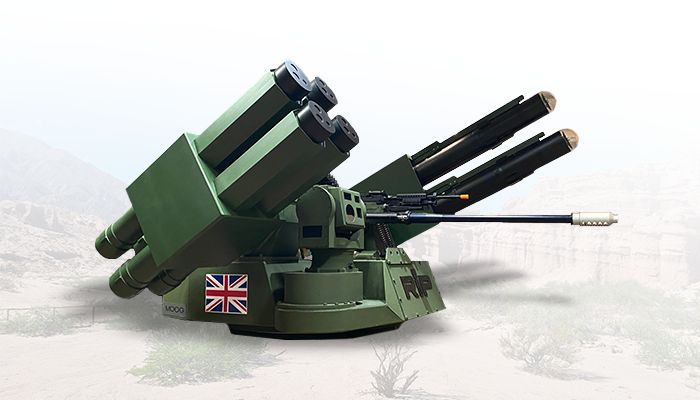
The Moog Reconfigurable Integrated-weapons Platform, or RIwP, is a modular remote weapon turret developed to accept different weapons and sensors on a common turret architecture. Moog designed the system to be independent of a specific host vehicle, weapon, or mission.
RIwP has been applied primarily to air-defense and counter-uncrewed-aircraft missions, while its modular architecture also supports direct-fire and anti-armour configurations. The turret has been integrated with crewed ground vehicles, robotic vehicles, and, during 2026 trials, an uncrewed surface vessel.
The system combines Moog technologies in precision motion control, stabilization, fire control, and power and data transfer. Its open physical and digital architectures are intended to simplify changes to weapons and sensors as mission requirements evolve.
Development
Moog entered the 2000s with established experience supplying turret components, including two-axis motion-control systems and slip rings for military vehicles. In 2010, the company acquired Advanced Integrated Systems in Santa Barbara, California. AIS brought experience in weapon systems, fire control, armoured structures, ammunition handling, and ground-vehicle integration, supporting Moog's transition from component supplier to complete turret-system provider.
During the early 2010s, Moog and Raytheon developed a turret solution for modernization of the U.S. Marine Corps Light Armoured Vehicle-Anti-Tank fleet. That project combined the TOW anti-armour missile and Modified Improved Target Acquisition System sensor with Moog components including the armoured structure, slip ring, actuation system, motor controller, gyro assemblies, encoders, and interconnect cabling.
Building on this experience, the Moog Santa Barbara team conceived, designed, and prototyped RIwP as a weapon-agnostic, vehicle-agnostic, and mission-agnostic turret. Moog demonstrated the new RIwP turret, including its fire-control system, to the U.S. Department of Defense in 2015 as the U.S. Army pursued an urgent counter-drone requirement. More background on the development program is provided by Moog's RIwP history.
U.S. Army programs
RIwP participated in a competitive live-fire exercise in November 2017 and was subsequently selected for the U.S. Army Mobile Low, slow, small, unmanned aircraft Integrated Defeat System, or MLIDS. The counter-drone system combines sensors with multiple weapon effectors.
In 2018, Moog was selected to provide RIwP as the turret for the U.S. Army Maneuver Short-Range Air Defense program on the Stryker 8x8 vehicle. The resulting M-SHORAD system is now known as SGT Stout. The configuration uses RIwP as a common platform for integrating air-defense sensors and effectors against threats that include helicopters and larger uncrewed aircraft.
International and maritime integrations
Moog has promoted RIwP for British ground-based air-defense and counter-small-aerial-target requirements. A RIwP turret was integrated on a British Army Ridgback 4x4 for a 2024 demonstration. At the International Armoured Vehicles event in January 2025, Moog displayed RIwP installations on a Supacat HMT Armoured Closed Cab and a KNDS Dingo 3. The company described the HMT installation as using a production RIwP turret representative of the technology deployed by the U.S. Army. Details of these demonstrations were reported by EDR Magazine.
The 2025 UK display configurations used Thales HVM/LMM missiles. One of the demonstrated turrets was additionally fitted with a 30x113 mm Bushmaster cannon and a 7.62 mm machine gun, illustrating the ability to combine different effectors on the common turret architecture. These British integrations were demonstrations associated with prospective requirements and did not establish the British Army as an RIwP operator.
In 2026, Voltaic Marine completed live trials pairing its AEU39 uncrewed surface vessel with a Moog Space and Defense RIwP remote weapon turret. During the trials, the turret received power directly from the vessel's 300 kWh battery bank through standard interfaces while the AEU39 maintained position on the water. The trial demonstrated that RIwP could be electrically integrated with the battery-powered vessel without a separate turret power source being identified in the available information.
Design
RIwP is designed around a modular turret architecture rather than a fixed weapon combination. Moog describes the system as a weapons hub that can accept different sensors and effectors according to the host platform and mission. The company states that a turret can be reconfigured within hours while retaining common components across configurations.
Motion control and stabilization
The turret draws on Moog's experience with two-axis turret motion control. Stabilized azimuth and elevation movement allows the turret and its installed effectors to remain pointed at a target while the host platform, turret, target, or a combination of them is moving. Moog also applies its slip-ring technology to turret systems to transfer electrical power, data, and communications signals between a stationary host structure and a rotating turret.
Fire control and sensors
RIwP incorporates a fire-control system that processes sensor information to produce pointing and firing solutions for the installed weapon effector. Because the turret is designed for different missions, its sensor and weapon installation is configuration-dependent rather than permanently fixed.
Moog describes RIwP as having open physical and digital architectures intended to support later sensor and effector upgrades. The company is also investing in artificial-intelligence technologies intended to augment RIwP targeting and tracking. These AI functions are described as continuing development and investment rather than as a universal specification of every fielded RIwP turret.
Weapons integration
RIwP can host guns, missiles, sensors, or combinations selected for a particular role. Demonstrated configurations include Thales HVM/LMM missiles, a 30x113 mm Bushmaster cannon, and a 7.62 mm machine gun. The platform has also been applied to counter-UAS, short-range air-defense, and direct-fire anti-armour missions. The precise armament therefore depends on the selected RIwP configuration.
Platform integration
RIwP was developed to avoid dependence on a single vehicle type. Confirmed integrations or demonstrations include the U.S. Army Stryker, robotic ground vehicles, the British Army Ridgback 4x4, Supacat HMT Armoured Closed Cab, KNDS Dingo 3, and the Voltaic Marine AEU39 uncrewed surface vessel.
The AEU39 trial also demonstrated integration with a battery-powered maritime platform. RIwP drew power from the vessel's 300 kWh battery bank through standard interfaces while the vessel held position. No separate electrical consumption figure for the turret was provided in the available source material.
Operational history
The U.S. Army selected RIwP for MLIDS after the November 2017 competitive live-fire exercise. The system was subsequently selected in 2018 as the turret for the Army's Stryker-based M-SHORAD program. The M-SHORAD system, now designated SGT Stout, represents RIwP's confirmed production and operational U.S. Army application.
Outside the United States, Moog has continued demonstrations and integration work intended to support potential allied requirements. The 2024 and 2025 British vehicle installations were presented in connection with UK ground-based air-defense requirements, while the 2026 AEU39 trial extended demonstrated integration to an uncrewed maritime platform.
Operators
- United States Army: RIwP is used as the turret of the Stryker-based M-SHORAD system, now known as SGT Stout.
Specifications (RIwP modular turret)
General characteristics
- Type: Reconfigurable remote weapon turret.
- Architecture: Modular, weapon-agnostic, vehicle-agnostic, and mission-agnostic design with open physical and digital interfaces.
- Movement: Stabilized two-axis azimuth and elevation motion control.
- Fire control: Integrated fire-control capability for processing sensor data and generating weapon pointing and firing solutions.
- Reconfiguration: Moog states that weapons and sensors can be changed within hours according to mission requirements.
Supported roles and effectors
- Roles: Short-range air defense, counter-UAS, counter-small aerial targets, and direct-fire anti-armour applications.
- Demonstrated missile integration: Thales HVM/LMM.
- Demonstrated cannon integration: 30x113 mm Bushmaster.
- Demonstrated machine-gun integration: 7.62 mm machine gun.
Maritime trial integration
- Host platform: Voltaic Marine AEU39 uncrewed surface vessel.
- Power source during trials: AEU39 300 kWh battery bank through standard interfaces.
- Trial status: Live integration trials completed in 2026.
 Argentina
 Armenia
 Australia
 Austria
 Austria-Hungary
 Belgium
 Brazil
 United Kingdom
 Brunei
 Bulgaria
 Canada
 Chile
Chile China
China Colonial America
 Colombia
 Confederate States
 Croatia
 Czech
Czech Denmark
 Egypt
Egypt Finland
 France
 Georgia
 Germany
 German Imperial
 Greece
 Holland
 Hungary
 India
India Indonesia
 Iran
Iran Iraq
Iraq Ireland
 Israel
 Italy
Italy Japan
Japan Japan (1940)
 Jordan
 Kingdom of Italy
 Malaysia
 Mexico
 Myanmar
 Nazi Germany
 Netherlands
 New Zealand
 North Korea
 Norway
 Pakistan
 Peru
Peru Philippines
 Poland
 Portugal
 Prussia
 Romania
 Russia
 Saudi Arabia
 Serbia
 Singapore
 Slovakia
 Slovenia
 South Africa
 South Korea
 Soviet Union
 Spain
Spain Sweden
 Switzerland
 Syria
Syria Taiwan
 Thailand
 Turkey
 UAE
UAE Ukraine
 Vietnam
 Yugoslavia