
History
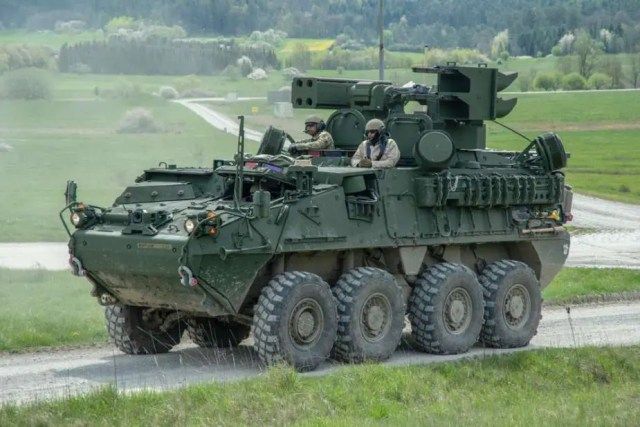
The Leonardo DRS SGT STOUT M-SHORAD is a U.S. Army maneuver short-range air-defense system built around a mission equipment package installed on the M-1265A1 Stryker Double V Hull combat vehicle. It combines radar and electro-optical sensing with FIM-92 Stinger missiles, an XM914 30 mm automatic cannon and an M240 7.62 mm machine gun so air-defense crews can move with maneuver formations while detecting, tracking and engaging low-altitude threats.
The system emerged from the Army's effort to rebuild short-range air-defense capacity after force-structure reductions in the early 2000s. The expanding threat from unmanned aircraft, helicopters and fixed-wing aircraft drove the requirement for an air-defense vehicle able to accompany Brigade Combat Teams rather than remain primarily in static defense positions.
Increment 1 entered Army fielding in 2021. The Army formally named M-SHORAD the SGT Stout in 2024, and Leonardo DRS announced in August 2026 that a U.S. Government test had extended the fielded mission equipment package to Group 1 and Group 2 small unmanned aircraft through detection and fire-control software changes without adding new hardware.
Development and initial fielding
According to the Congressional Research Service, the Army reduced much of its short-range air-defense force after 2005, retaining a limited number of active and Army National Guard Avenger battalions and Counter-Rocket, Artillery and Mortar batteries. The subsequent growth of air and missile threats, especially unmanned aircraft, led the Army to improve air defense for maneuver forces.
M-SHORAD Increment 1 was developed using an Other Transaction Authority contracting process. Its chassis is the M-1265A1 Stryker Double V Hull. Leonardo DRS configures the weapons and radar package, after which General Dynamics Land Systems, the Stryker's original manufacturer, installs it on the vehicle. The Army originally planned to field 144 Increment 1 systems to four battalions. The first four vehicles were received by 5th Battalion, 4th Air Defense Artillery Regiment in April 2021, and that battalion was fully equipped in late 2022.
On 14 June 2024, the Army designated M-SHORAD as SGT Stout in honor of Sergeant Mitchell William Stout, an Air Defense Artillery soldier and Medal of Honor recipient from the Vietnam War. The designation applies to the Army's M-SHORAD system rather than representing a separate vehicle configuration.
Fielding and sustainment
By March 2026, CRS reported that SGT Stout battalions were organized around 36 vehicles each. It listed 5-4th Air Defense Artillery in Germany, 4-60th Air Defense Artillery at Fort Sill, Oklahoma, and 6-56th Air Defense Artillery at Fort Hood, Texas, as fielded units. It also reported that 3-4th Air Defense Artillery at Fort Bragg, North Carolina, was about two-thirds fielded and was expected to complete fielding by the end of fiscal year 2026. Future fielding was identified for the Florida Army National Guard in fiscal year 2028 and the Ohio Army National Guard in fiscal year 2029; these planned formations are not current operators in this article.
Separate industry reporting in 2026 quoted Leonardo DRS as saying that several hundred SGT STOUT systems were already fielded. This manufacturer statement is broader than the specific battalion inventory described by CRS, so the two figures should not be treated as directly interchangeable. Sustainment activity is confirmed by Moog, the original equipment manufacturer for the Reconfigurable Integrated-weapons Platform turret, which announced a second-year spares contract with Leonardo DRS supporting fielded Army SGT Stout systems through June 2026.
Expansion against small unmanned aircraft
Small Group 1 and Group 2 unmanned aircraft became an increasingly important part of the SGT Stout mission. A June 2026 article in the U.S. Army's Air Defense Artillery Journal argued that SGT Stout battalions needed tactics and additional equipment specifically suited to small drones. The article described the vehicle as a three-person platform with a driver, gunner and vehicle commander, and discussed using both mounted weapons and dismounted counter-UAS teams to create a layered defense. Those recommendations represent operational proposals from the journal article and should not be read as a description of a standardized four-person crew or universally fielded dismounted equipment.
On 11 August 2026, Leonardo DRS announced that the fielded SGT STOUT M-SHORAD Mission Equipment Package had defeated Group 1 and Group 2 small unmanned aircraft during a U.S. Government test. According to the company's announcement, the expanded capability came from changes to detection and fire-control software and did not require new mission-equipment hardware. The test broadened a system originally intended for Group 3-and-above unmanned aircraft, fixed-wing aircraft and rotary-wing threats.
The software-only change demonstrated one purpose of the mission equipment package's modular, open architecture. Leonardo DRS describes the design as capable of accepting further sensors, computing functions and effectors without redesigning the entire package. The company has identified passive detection options, AI-enabled decision aids, edge computing and additional effectors as possible future integrations. These are growth paths rather than capabilities that should automatically be assumed to be present on every fielded vehicle.
Design
SGT Stout Increment 1 is a mobile air-defense vehicle intended to operate with maneuver formations. The M-1265A1 Stryker Double V Hull provides the automotive platform, while the mission equipment package adds the sensors, fire-control equipment and weapons needed for short-range air defense. This arrangement allows air-defense crews to move with supported formations instead of relying only on fixed-site protection.
Mission equipment and sensors
The Leonardo DRS mission equipment package uses a modular architecture and platform interfaces intended to support modernization. Source material describes onboard sensors that provide 360-degree aerial surveillance and a combination of radar and electro-optical equipment for detection, identification and engagement. The configuration includes multi-mission radar sensors, MX-GCS electro-optical/infrared equipment and an identification-friend-or-foe antenna. It is designed to integrate with Army networks and to operate interoperably with Sentinel radar, allowing the vehicle to use both its own sensing and wider air-defense information.
The system's open architecture is important to the 2026 counter-small-UAS update because Leonardo DRS says the new Group 1 and Group 2 engagement capability was obtained through software changes to detection and fire control. The same architecture is described as a basis for future integration of passive sensing, edge computing, decision aids and new effectors. No source in the package establishes that all of those future technologies are installed on the standard fielded Increment 1 configuration.
Turret and armament
The weapons are carried in the Reconfigurable Integrated-weapons Platform, or RIwP, turret. The Increment 1 armament described by CRS consists of eight FIM-92 Stinger missiles for aerial targets in a dual-launcher arrangement, one XM914 30 mm automatic cannon and one M240 7.62 mm machine gun. The cannon and machine gun also give the crew direct-fire options against ground threats. Leonardo DRS states that direct fire can be used against smaller Group 1 and Group 2 unmanned aircraft at closer ranges when required.
The June 2026 Air Defense Artillery Journal article discussed proximity-fuzed 30 mm ammunition as a way to improve engagement of small drones without using a Stinger missile. CRS separately identifies the XM1223 Multi-Mode Proximity Airburst munition as a planned Increment 3 enhancement, with fielding scheduled for late fiscal year 2028. Because these sources describe different contexts, the XM1223 should be treated as a planned future capability rather than as standard armament on every 2026 Increment 1 vehicle.
Crew and tactical employment
The Army journal describes the current SGT Stout crew as three soldiers: driver, gunner and vehicle commander. It recommended adding an assistant gunner to create a four-person crew, partly to reduce workload, help reload mounted weapons and support dismounted counter-UAS activity. That proposal had not been established in the supplied sources as an Army-wide crew change.
The vehicle is intended to support formation-based air defense. Its sensors, network links and weapons are meant to protect maneuver forces while they move, rather than limiting the system to the point defense of one fixed site. Army training observations published in 2026 noted that some SGT Stout units were still being used in a largely static role during exercises and argued for tactics better suited to large-scale combat operations and small-UAS threats.
Operational history
The first operational fielding began with 5-4th Air Defense Artillery in Germany, which received its first four systems in April 2021 and became fully equipped in late 2022. Additional battalions were subsequently fielded in the United States. By March 2026, CRS listed 4-60th Air Defense Artillery at Fort Sill and 6-56th Air Defense Artillery at Fort Hood as fielded, while 3-4th Air Defense Artillery at Fort Bragg was still completing its allocation.
Army reporting from Europe in 2026 described SGT Stout participating in U.S. Army Europe and Africa exercises and battery-level field training. The published observations emphasized the need to adapt employment against Group 1 and Group 2 drones, including low-flying threats that may be difficult for radar to detect. Suggested measures included beyond-line-of-sight communications, improved data sharing and dismounted observers, but these recommendations are not evidence that the entire fielded fleet had received those changes.
The August 2026 U.S. Government test marked a confirmed expansion of the system's demonstrated target set. Leonardo DRS reported successful defeat of Group 1 and Group 2 small unmanned aircraft using the existing mission equipment hardware with updated detection and fire-control software. The source package does not state that every fielded vehicle had already received the new software, so the test should be understood as a demonstrated upgrade path rather than proof of fleet-wide implementation.
Variants
- M-SHORAD Increment 1 / SGT Stout: Stryker-based fielded configuration using the Leonardo DRS mission equipment package with Stinger missiles, an XM914 30 mm cannon, an M240 7.62 mm machine gun and multi-mission radar. This is the principal fielded SGT Stout configuration described in the supplied sources.
- M-SHORAD Increment 2 / DE M-SHORAD: Directed-energy development variant using a 50 kW laser as its primary armament. Four Stryker-mounted prototypes were deployed to the Middle East in February 2024 for soldier testing. CRS reports that, after the fiscal year 2023-2024 user assessment, the Army decided not to pursue further procurement and not to field the system to operational units.
- M-SHORAD Increment 3: Planned evolution of Increment 1 intended to integrate the Next Generation Short Range Interceptor as a replacement for Stinger and to add the XM1223 Multi-Mode Proximity Airburst 30 mm munition. The NGSRI achieved its first successful test flight in late 2025, with developmental testing planned through 2026-2027 and a single-vendor selection planned for fiscal year 2028. XM1223 fielding is planned for late fiscal year 2028.
- M-SHORAD Increment 4: Planned, vehicle-agnostic and self-contained capability focused on supporting dismounted maneuver. The Army has sought an air-transportable system capable of C-130 transport, airdrop and sling-load operations, with possible integration on platforms such as the Joint Light Tactical Vehicle, Infantry Squad Vehicle or a robotic vehicle. Initial operational capability is planned for late fiscal year 2029. It is part of the wider M-SHORAD program but is not defined in the supplied sources as a Stryker-based SGT Stout configuration.
Operators
- United States Army: Sole confirmed operator in the supplied material. CRS reports fielded 36-vehicle SGT Stout battalions at 5-4th Air Defense Artillery in Germany, 4-60th Air Defense Artillery at Fort Sill, Oklahoma, and 6-56th Air Defense Artillery at Fort Hood, Texas. The 3-4th Air Defense Artillery battalion at Fort Bragg, North Carolina, was about two-thirds fielded in March 2026, with completion planned by the end of fiscal year 2026.
Specifications (M-SHORAD Increment 1 / SGT Stout)
General characteristics
- Chassis: M-1265A1 Stryker Double V Hull combat vehicle.
- Mission equipment integrator: Leonardo DRS.
- Vehicle installation: General Dynamics Land Systems.
- Crew: Three: driver, gunner and vehicle commander.
- Primary role: Maneuver short-range air defense for ground formations.
- Surveillance: Onboard 360-degree aerial surveillance using multi-mission radar and electro-optical/infrared sensing.
- Network integration: Designed for integration with U.S. Army networks and interoperability with Sentinel radar.
Armament
- Surface-to-air missiles: Eight FIM-92 Stinger missiles in a dual-launcher arrangement.
- Automatic cannon: One XM914 30 mm automatic cannon.
- Machine gun: One M240 7.62 mm machine gun.
- Turret: Moog Reconfigurable Integrated-weapons Platform (RIwP).
Supported threat set
- Original mission: Group 3-and-above unmanned aircraft, fixed-wing aircraft and rotary-wing threats.
- Demonstrated 2026 expansion: Group 1 and Group 2 small unmanned aircraft defeated in a U.S. Government test through detection and fire-control software updates without new mission-equipment hardware.
 Argentina
 Armenia
 Australia
 Austria
 Austria-Hungary
 Belgium
 Brazil
 United Kingdom
 Brunei
 Bulgaria
 Canada
 Chile
Chile China
China Colonial America
 Colombia
 Confederate States
 Croatia
 Czech
Czech Denmark
 Egypt
Egypt Finland
 France
 Georgia
 Germany
 German Imperial
 Greece
 Holland
 Hungary
 India
India Indonesia
 Iran
Iran Iraq
Iraq Ireland
 Israel
 Italy
Italy Japan
Japan Japan (1940)
 Jordan
 Kingdom of Italy
 Malaysia
 Mexico
 Myanmar
 Nazi Germany
 Netherlands
 New Zealand
 North Korea
 Norway
 Pakistan
 Peru
Peru Philippines
 Poland
 Portugal
 Prussia
 Romania
 Russia
 Saudi Arabia
 Serbia
 Singapore
 Slovakia
 Slovenia
 South Africa
 South Korea
 Soviet Union
 Spain
Spain Sweden
 Switzerland
 Syria
Syria Taiwan
 Thailand
 Turkey
 UAE
UAE Ukraine
 Vietnam
 Yugoslavia