
History
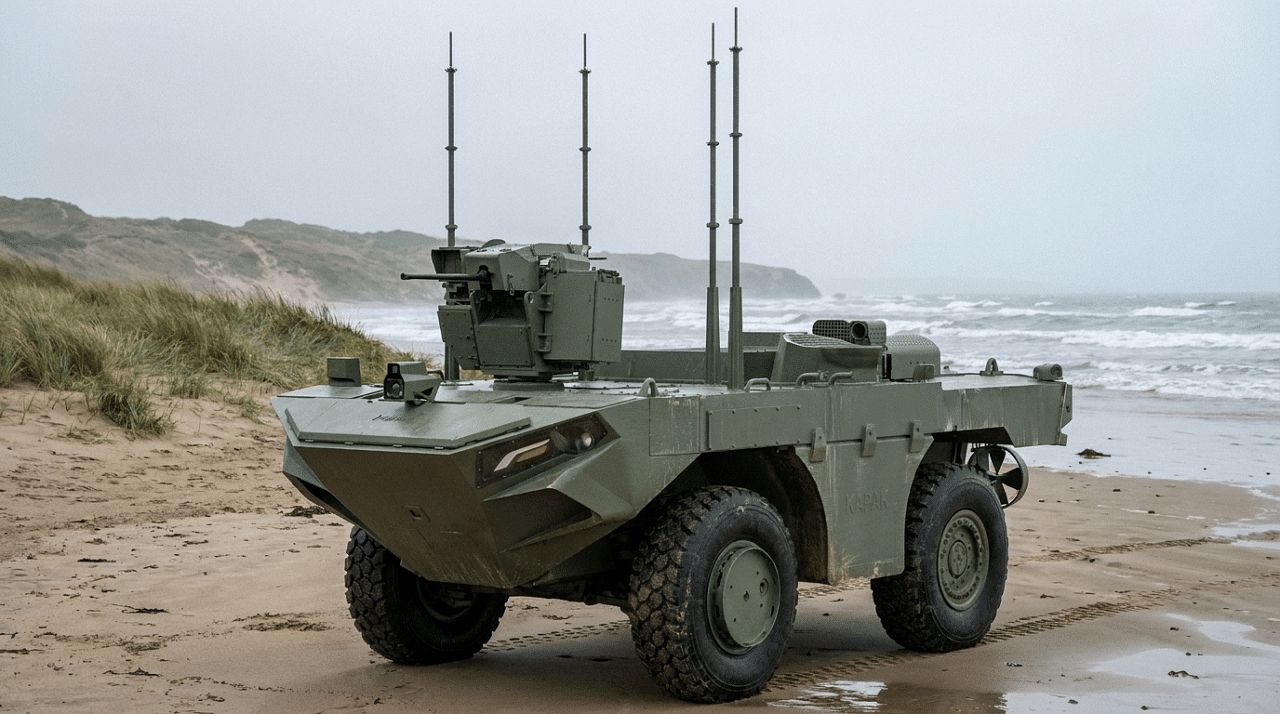
The FNSS U-MAV, or Multi-Purpose Modular Unmanned Amphibious Vehicle, is an 8-ton Turkish unmanned vehicle developed for amphibious assault operations. It is intended to move ahead of crewed Marine Assault Vehicles, engage coastal defences and perform beach-preparation tasks while keeping operators away from the forward platform.
U-MAV uses a modular architecture that allows one common vehicle to carry mission systems for fire support, mine clearance, engineering, reconnaissance, electronic warfare, counter-drone operations, logistics and other roles. FNSS states that mission modules can be exchanged in the field in approximately 40 minutes.
The vehicle can operate autonomously, under remote control or in a hybrid mode. Its amphibious mobility, digital command-and-control systems and modular payload concept are intended to support manned-unmanned operations with the Turkish Naval Forces Command's MAV/ZAHA amphibious assault vehicles.
Development and unveiling
FNSS developed U-MAV as an unmanned manoeuvre element for the first stages of an amphibious landing. Its concept places unmanned vehicles ahead of the crewed assault wave to identify or engage defensive positions, clear mines and obstacles, and prepare routes from the waterline toward the beachhead.
FNSS publicly unveiled U-MAV on 20 August 2026 at TEKNOFEST Mavi Vatan 2026, held at the Gölcük Naval Shipyard Command in Kocaeli, Turkey, from 20 to 23 August. The manufacturer described the platform in its U-MAV unveiling announcement and subsequently published detailed mission and technical information on the U-MAV product page. The unveiling was also reported by ASDNews.
Design
Modular mission architecture
U-MAV is built around a common unmanned amphibious base vehicle with interchangeable mission modules. FNSS states that a module change takes approximately 40 minutes under field conditions. Different configurations can operate together during the same amphibious operation, while use of a common chassis and support infrastructure is intended to reduce the logistics burden.
The mission concept covers the initial approach, beach preparation, support of the landing force and subsequent operations around the beachhead. Depending on configuration, U-MAV can perform fire support, reconnaissance, mine clearance, obstacle removal, electronic warfare, deception, navigation and marking, counter-drone, logistics or casualty-evacuation tasks.
Mobility and propulsion
The vehicle has an amphibious combat weight of 8 tonnes and uses a combined 300 hp powerpack, giving a stated power-to-weight ratio of 37.5 hp per tonne. Maximum road speed is 70 km/h and swimming speed is 7 knots. An independent suspension system is fitted, and FNSS states that different tyre options can be selected for different ground conditions.
The published road and water speeds are the same as the maximum figures listed by FNSS for the crewed MAV Marine Assault Vehicle, although the available material does not state that the two vehicles use the same propulsion or suspension systems.
Control, navigation and communications
U-MAV is designed for autonomous, remote-controlled and hybrid operation. Its command-and-control architecture includes an encrypted mesh network, a combined GNSS/INS navigation system and an identification friend-or-foe module. The inertial navigation unit can continue estimating the vehicle's position when satellite navigation signals are degraded or unavailable.
The stated line-of-sight communications range is 3 km. FNSS says this can be extended through a UAV communications relay. If the datalink is interrupted, the vehicle first enters a safe hold condition and can then return to base along a programmed route or continue its assigned navigation task, depending on configuration.
Sensors and artificial intelligence
The vehicle uses onboard image processing to analyse camera feeds locally. Instead of continuously sending high-bandwidth video, the system can transmit processed detection information over the radio link. Detected objects can be assigned a type, status and threat score, while automatic target detection presents prioritised information to the operator. Detected targets are tracked and recorded with timestamps.
FNSS also describes U-MAV as the first unmanned vehicle to integrate Nurol Teknoloji's Armor Integrity structural monitoring system. Sensors are intended to determine the location, direction and severity of impacts, estimate remaining structural capacity in the affected area and monitor accumulated damage. Information can be sent to operators and command elements, while data produced during a communications outage can be stored locally and transmitted after the link is restored.
Deployment
FNSS states that U-MAV can be transported by road, rail and sea. The manufacturer also lists compatibility with heavy-lift helicopters and transport aircraft including the CH-47F Chinook, Mil Mi-26, C-130 Hercules, A400M, C-17 Globemaster, C-5 Galaxy, An-124 and Il-76.
Program status
U-MAV was publicly presented as a physical platform in August 2026. FNSS describes it as a next-generation heavy-class unmanned amphibious vehicle intended to work with MAV/ZAHA-equipped Marine units. The available source material documents the vehicle's unveiling, design and planned mission configurations but does not state a production order, delivery quantity or operational service-entry date for U-MAV.
Variants
- Fire Support: Mission configuration intended to provide direct combat support during amphibious operations.
- Mine Clearance: Configuration for detecting and clearing mines during beach preparation.
- Combat Engineering: Configuration intended to remove or breach obstacles using engineering equipment.
- Electronic Warfare: Configuration intended for electronic-warfare tasks, including disruption of hostile communications and guidance frequencies.
- Reconnaissance: Configuration using electro-optical and thermal sensors and supporting mini-UAVs to identify defensive positions, obstacles and minefields.
- Deception: Mission configuration intended for deception tasks during amphibious operations.
- Counter-Drone: Configuration intended for operations against hostile unmanned aerial systems.
- Navigation and Obstacle Marking: Configuration intended to mark routes, navigation points and obstacles for following forces.
- Logistics Support: Configuration for transporting supplies and supporting forces after the initial landing.
- Casualty Evacuation: CASEVAC configuration that uses the platform's internal payload volume to evacuate casualties without placing a vehicle crew in the forward area.
Specifications (FNSS U-MAV)
General characteristics
- Type: Multi-purpose modular unmanned amphibious vehicle
- Amphibious combat weight: 8 tonnes
- Powerpack output: 300 hp
- Power-to-weight ratio: 37.5 hp/tonne
- Suspension: Independent suspension
- Control modes: Autonomous, remote-controlled or hybrid
- Line-of-sight communications range: 3 km, extendable through UAV relay support
- Mission-module change time: Approximately 40 minutes
Performance
- Maximum road speed: 70 km/h
- Maximum swimming speed: 7 knots
Navigation and mission systems
- Navigation: GNSS/INS with inertial navigation capability
- Communications: Encrypted mesh network
- Identification: IFF identification module
- Image processing: AI-enabled onboard processing with automatic target detection and tracking
- Structural monitoring: Nurol Teknoloji Armor Integrity system
Related equipment
- FNSS MAV/ZAHA: Crewed amphibious assault vehicle already associated with Turkish Naval Forces Command Marine units. U-MAV is designed to operate ahead of and in coordination with these vehicles during amphibious operations.
 Argentina
 Armenia
 Australia
 Austria
 Austria-Hungary
 Belgium
 Brazil
 United Kingdom
 United States
 Brunei
 Bulgaria
 Canada
 Chile
Chile China
China Colonial America
 Colombia
 Confederate States
 Croatia
 Czech
Czech Denmark
 Egypt
Egypt Finland
 France
 Georgia
 Germany
 German Imperial
 Greece
 Holland
 Hungary
 India
India Indonesia
 Iran
Iran Iraq
Iraq Ireland
 Israel
 Italy
Italy Japan
Japan Japan (1940)
 Jordan
 Kingdom of Italy
 Malaysia
 Mexico
 Myanmar
 Nazi Germany
 Netherlands
 New Zealand
 North Korea
 Norway
 Pakistan
 Peru
Peru Philippines
 Poland
 Portugal
 Prussia
 Romania
 Russia
 Saudi Arabia
 Serbia
 Singapore
 Slovakia
 Slovenia
 South Africa
 South Korea
 Soviet Union
 Spain
Spain Sweden
 Switzerland
 Syria
Syria Taiwan
 Thailand
 UAE
UAE Ukraine
 Vietnam
 Yugoslavia