
History
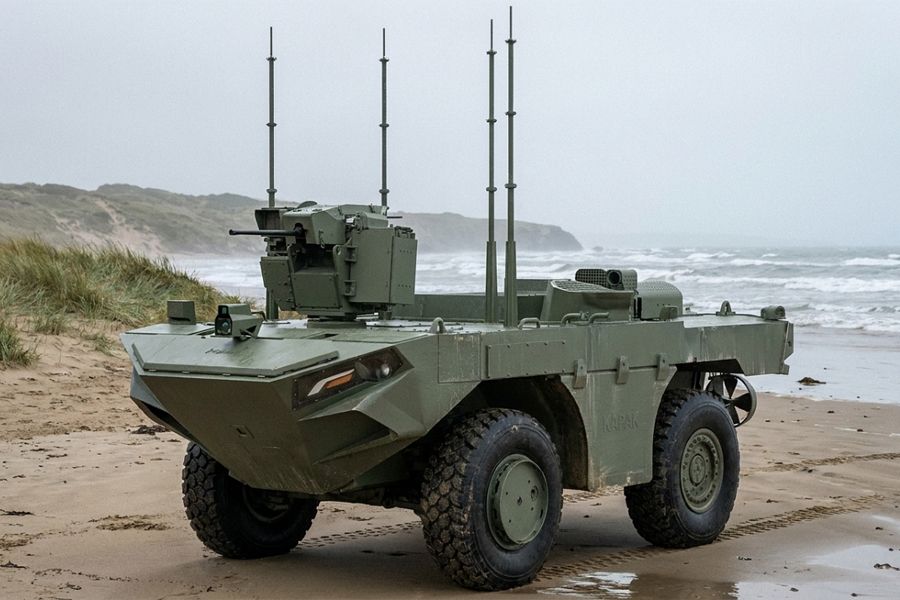
The FNSS İ-ZAHA is a multi-purpose modular unmanned amphibious vehicle developed in Turkey for sea-to-shore operations. FNSS also identifies the platform by the English designation U-MAV, or Multi-Purpose Modular Unmanned Amphibious Vehicle.
The vehicle is intended to operate ahead of crewed Marine Assault Vehicle, or ZAHA, formations during the highest-risk stages of an amphibious landing. Its concept combines unmanned reconnaissance, obstacle reduction, fire support and other mission packages on a common amphibious platform.
FNSS publicly unveiled İ-ZAHA at TEKNOFEST Blue Homeland 2026. The vehicle was exhibited at Kocaeli Gölcük Shipyard Command during the event held from 20 to 23 August 2026, establishing 2026 as the first supported year for the physical platform.
Development concept
FNSS developed U-MAV as an unmanned manoeuvre element intended to work in close coordination with Turkish Marine units equipped with the crewed ZAHA amphibious assault vehicle. The main purpose is to place an unmanned vehicle at the front of an assault force during initial contact with defended shorelines, reducing exposure of personnel while preparing routes for following vehicles.
The manned ZAHA provides the operational context for the program. According to Janes, FNSS developed ZAHA for Turkish Navy amphibious requirements under a 2017 agreement, delivered the first 27 vehicles by 2022, and received a contract for another 27 in May 2026. İ-ZAHA is designed to complement rather than replace these crewed vehicles.
Public unveiling
İ-ZAHA was shown publicly for the first time during TEKNOFEST Blue Homeland in August 2026. The presentation described it as a vanguard vehicle that could precede manned ZAHA vehicles, make initial contact with coastal defenses, neutralize mines and obstacles according to the installed mission package, and support subsequent phases of the landing.
The official FNSS U-MAV page describes the platform as capable of autonomous, remote-controlled and hybrid operation. FNSS also emphasizes a modular architecture intended to allow different mission payloads to use the same base vehicle.
Design
Platform and mobility
İ-ZAHA is a four-wheeled amphibious vehicle with an amphibious combat weight of 8 tonnes. A 300 hp powerpack gives the platform a stated power-to-weight ratio of 37.5 hp per tonne. Maximum stated speed is 7 knots in the water and 70 km/h on land.
The vehicle uses independent suspension, while selectable tyre options are intended to adapt it to different ground conditions. FNSS describes the platform as having a low visual, thermal and acoustic signature. Its hull and payload volume are designed to support different mission equipment as well as logistics and casualty evacuation roles.
Modular mission architecture
The vehicle uses interchangeable mission modules fitted to a common base platform. FNSS states that a module can be exchanged in the field in approximately 40 minutes. Ten mission configurations are identified: Fire Support, Mine Clearance, Combat Engineering, Electronic Warfare, Reconnaissance, Deception, Counter-Drone, Navigation and Obstacle Marking, Logistics Support, and Casualty Evacuation.
The common-platform approach allows several differently configured İ-ZAHA vehicles to operate together in the same amphibious operation while sharing the same basic mobility and support architecture.
Control, communications and navigation
İ-ZAHA is designed for autonomous, remote-controlled or hybrid control. Its command-and-control system combines an encrypted mesh network with GNSS/INS navigation and an IFF identification module. The inertial navigation unit is intended to maintain an estimate of vehicle position when satellite navigation signals are unavailable, degraded or jammed.
The stated direct line-of-sight communications range is 3 km. FNSS says this range can be extended through UAV relay support. If the datalink is interrupted, the vehicle is designed first to enter a safe hold state. Depending on mission configuration, it can then automatically return using a pre-programmed route or continue a navigation task.
Artificial intelligence and sensors
The platform incorporates AI-enabled image processing. Camera feeds are analyzed by the onboard mission computer, which can transmit detection information instead of continuously sending high-bandwidth video. Detected objects can be categorized by type, condition and threat level.
FNSS states that automatic target detection and fire-control functions can present prioritized targets to the operator and record detected targets with timestamps. The system is designed so that newly defined target types or engagement rules can be applied to live imagery in the field.
Armor Integrity system
U-MAV integrates the Armor Integrity structural monitoring system developed by Nurol Teknoloji. FNSS describes it as the first unmanned vehicle fitted with this system. Sensors are intended to determine the location, direction and severity of an impact, estimate the remaining structural capacity of the affected area and monitor damage that accumulates over time.
The resulting information can be transmitted to the operator and command chain to support decisions about manoeuvring, taking cover, continuing a mission or moving the vehicle into a passive role. If communications are lost, the system can store data locally for transmission after the connection is restored.
Transportability
FNSS states that İ-ZAHA can be transported by road, rail and sea. The company also lists compatibility with CH-47F Chinook and Mil Mi-26 heavy-lift helicopters and with C-130 Hercules, A400M, C-17 Globemaster, C-5 Galaxy, An-124 and Il-76 transport aircraft.
Mission concept
Beach preparation
The FNSS concept of operations places U-MAV vehicles ahead of the manned assault wave. A reconnaissance-configured vehicle can use thermal and electro-optical sensors and mini-UAVs to map defensive positions, obstacles and minefields, with the resulting information distributed through the command-and-control network.
Combat Engineering and Mine Clearance configurations are intended to clear beach obstacles and mines. FNSS describes equipment including an excavator arm, dozer blade, ground-penetrating radar, mine plough and line charge. An Electronic Warfare configuration is intended to interfere with hostile command-and-control communications and anti-tank guided missile guidance frequencies.
Support to ZAHA landing operations
During the approach of the main assault force, Fire Support vehicles are intended to engage designated targets and provide screening support. FNSS identifies heavy machine guns, autocannons and loitering munitions among the possible fire-support payloads.
The Navigation and Obstacle Marking configuration is intended to identify cleared lanes and hazardous areas for following ZAHA crews. Listed equipment includes infrared beacons, laser spot markers and floating buoy systems, while route information can also be transmitted to the command-and-control network.
The Counter-Drone configuration is intended to detect first-person-view and one-way attack UAV threats through electro-optical and radar sensor fusion. FNSS describes both electronic jamming and hard-kill effectors as possible counter-UAS responses.
Beachhead support
After the initial landing, reconnaissance and counter-drone vehicles are intended to continue supporting the force. The Logistics Support configuration can carry supplies in waterproof containers with an approximate capacity of 400 kg per vehicle. A Casualty Evacuation configuration is also included among the planned mission packages.
Program status
İ-ZAHA was publicly unveiled as a physical vehicle in August 2026. The available sources describe its design, mission configurations and intended cooperation with ZAHA vehicles, but do not establish that İ-ZAHA has entered operational service with the Turkish Naval Forces.
The platform therefore represents an FNSS unmanned amphibious vehicle program demonstrated in 2026, with its operational concept centered on manned-unmanned teaming with ZAHA vehicles already serving in the Turkish naval amphibious force. Additional technical and program information is available from the TEKNOFEST report and FNSS product material.
Variants
- Fire Support: Mission configuration intended to provide direct combat support using payloads that can include a heavy machine gun, autocannon and loitering munitions.
- Mine Clearance: Configuration intended to detect and neutralize mines during beach preparation.
- Combat Engineering: Configuration intended to remove physical obstacles using engineering equipment such as an excavator arm and dozer blade.
- Electronic Warfare: Configuration intended to disrupt hostile communications and selected guidance frequencies.
- Reconnaissance: Configuration using electro-optical, thermal and other sensors to identify defensive positions, obstacles and minefields.
- Deception: Mission configuration intended for tactical deception tasks.
- Counter-Drone: Configuration intended to detect and counter UAV threats using sensor fusion, electronic jamming and possible hard-kill effectors.
- Navigation and Obstacle Marking: Configuration intended to mark safe routes, hazards and cleared lanes for following forces.
- Logistics Support: Configuration intended to move supplies, including waterproof containers with an approximate capacity of 400 kg per vehicle.
- Casualty Evacuation: Configuration using the available internal payload volume for evacuation tasks.
Specifications (FNSS İ-ZAHA / U-MAV)
General characteristics
- Type: Multi-purpose modular unmanned amphibious vehicle
- Configuration: Four-wheeled amphibious vehicle
- Amphibious combat weight: 8 tonnes
- Powerplant output: 300 hp
- Power-to-weight ratio: 37.5 hp per tonne
- Control modes: Autonomous, remote-controlled and hybrid
- Navigation: GNSS/INS with inertial navigation capability
- Communications: Encrypted mesh network
- Identification: IFF identification module
- Direct line-of-sight communications range: 3 km, extendable through UAV relay support
- Mission module replacement time: Approximately 40 minutes in the field
Performance
- Maximum land speed: 70 km/h
- Maximum water speed: 7 knots
Mission equipment
- Mission configurations: Fire Support, Mine Clearance, Combat Engineering, Electronic Warfare, Reconnaissance, Deception, Counter-Drone, Navigation and Obstacle Marking, Logistics Support, and Casualty Evacuation
- Image processing: AI-enabled onboard image analysis and target classification
- Structural monitoring: Nurol Teknoloji Armor Integrity system
- Logistics payload: Approximately 400 kg in waterproof containers for the Logistics Support configuration
 Argentina
 Armenia
 Australia
 Austria
 Austria-Hungary
 Belgium
 Brazil
 United Kingdom
 United States
 Brunei
 Bulgaria
 Canada
 Chile
Chile China
China Colonial America
 Colombia
 Confederate States
 Croatia
 Czech
Czech Denmark
 Egypt
Egypt Finland
 France
 Georgia
 Germany
 German Imperial
 Greece
 Holland
 Hungary
 India
India Indonesia
 Iran
Iran Iraq
Iraq Ireland
 Israel
 Italy
Italy Japan
Japan Japan (1940)
 Jordan
 Kingdom of Italy
 Malaysia
 Mexico
 Myanmar
 Nazi Germany
 Netherlands
 New Zealand
 North Korea
 Norway
 Pakistan
 Peru
Peru Philippines
 Poland
 Portugal
 Prussia
 Romania
 Russia
 Saudi Arabia
 Serbia
 Singapore
 Slovakia
 Slovenia
 South Africa
 South Korea
 Soviet Union
 Spain
Spain Sweden
 Switzerland
 Syria
Syria Taiwan
 Thailand
 UAE
UAE Ukraine
 Vietnam
 Yugoslavia