
History
Radionix Shershen is a Ukrainian short-range surface-to-air missile system developed around an open architecture that can employ several adapted air-to-air missile types. The concept is intended to reduce dependence on a single interceptor and allow Soviet-origin, Western and Ukrainian missiles to be integrated into one air-defense system.
The system combines command-and-control equipment, target-surveillance radar and multiple launchers. Its engagement performance depends on the interceptor selected, while the control architecture is designed to accept missiles using semi-active radar or infrared homing.
By September 2026, the second operational prototype had completed initial testing, including reported successful target interceptions at a test range. The prototype displayed at MSPO 2026 was described as being close to the intended production configuration.
Development
The Shershen project was publicly presented at the World Defense Show 2026 in Riyadh, Saudi Arabia, in February 2026. Militarnyi reported that the system had been tested with five missile types, including Soviet-origin, foreign and prospective Ukrainian weapons. Radionix, a member of the National Association of Ukrainian Defense Industries, was identified as the principal developer and integrator.
Information released during the February presentation emphasized that Shershen was not tied to one radar or one missile supplier. The launcher concept shown at that stage used a removable launch module that could be placed on the ground using a multilift mechanism. The system was also described as capable of integrating with the Krechet command-and-control system, which can receive information from other radars and air-target detection sources. Ukrainska Pravda reported that the engagement range would depend on the missile selected.
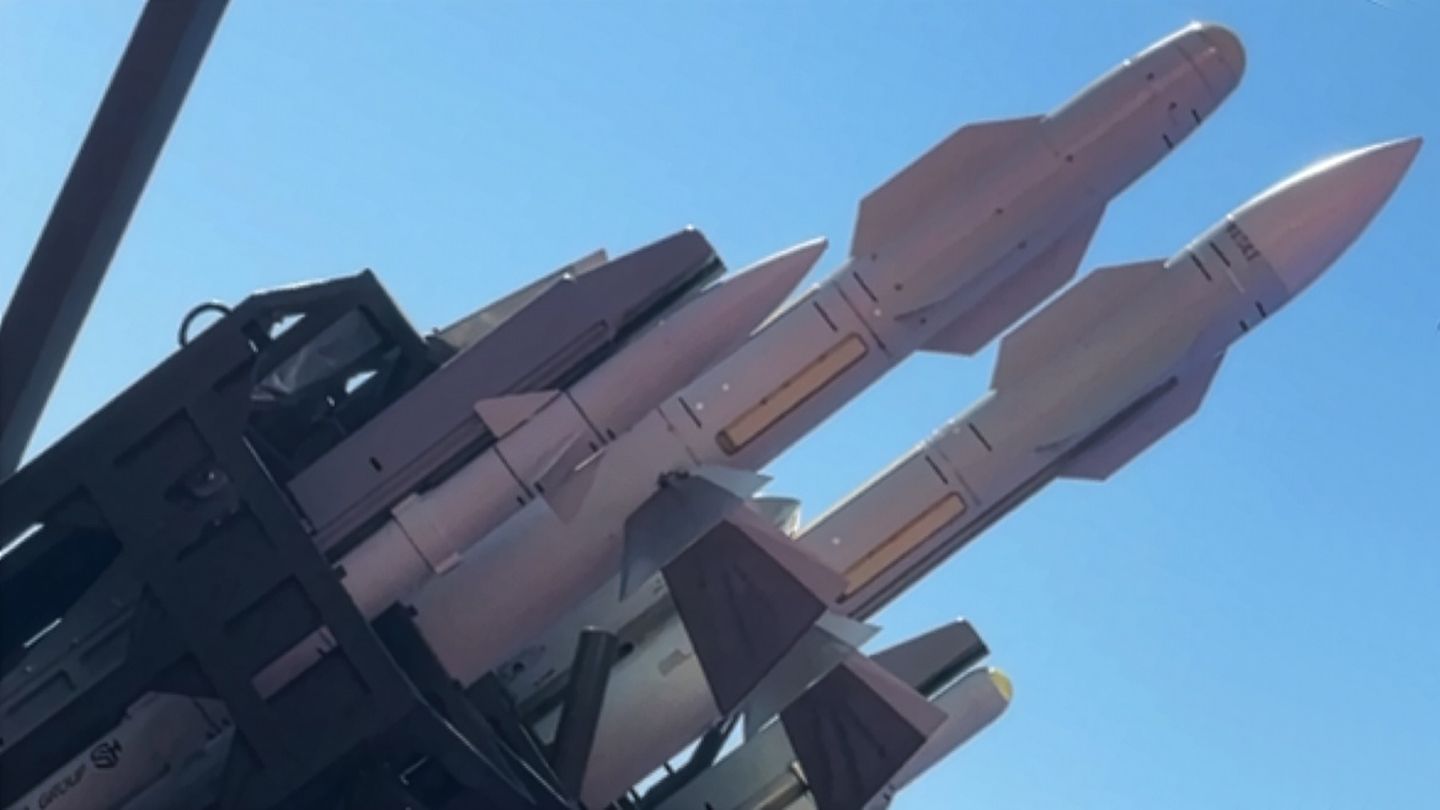
At MSPO 2026 in Kielce, Poland, in September 2026, the first operational components of Shershen were publicly shown. The displayed configuration consisted of a Perun combat-control vehicle, an Athena surveillance radar and four Borei launchers. The example was identified as the second operational prototype and was said to have completed initial test stages, including successful interceptions. Ukrainska Pravda reported that this prototype was close to the planned production configuration.
The September prototype also demonstrated the system with the Ukrainian R-120K missile. The R-120K uses a radar homing seeker and is intended for both air-to-air and surface-to-air employment. The missile remained under development, including work on its rocket motor, so its final performance and production status had not yet been established.
Design
Shershen is designed as a multi-caliber air-defense system rather than around a single dedicated interceptor. Its open architecture is intended to allow integration of missiles from different manufacturers and to support third-party surveillance and guidance radars.
Battery architecture
The configuration displayed in September 2026 consisted of one Perun combat-control vehicle, one Athena radar and four Borei launchers. The architecture separates detection, command-and-control and missile-launch functions while allowing external radar sources to be incorporated.
The Athena radar is reported to detect aerial targets at ranges of up to 85 km. When radar-guided interceptors are used, the engagement architecture is claimed to support guidance of as many as six launched missiles simultaneously.
Launchers and interceptors
The system is designed to employ adapted air-to-air missiles with either semi-active radar or infrared homing seekers. Missile compatibility reported for the September 2026 prototype included the R-27, R-73, AIM-9 Sidewinder and AIM-132 ASRAAM. Integration of the R-60 was also being explored.
An earlier Shershen test launcher was shown with radar-homing and infrared-guided R-27 missiles. The later prototype used a cage-type container launcher. Because the system is intended to accept different interceptors, its effective engagement range and altitude depend on the missile installed.
The R-120K represents a prospective Ukrainian interceptor for the system. It is equipped with a radar seeker and is intended to operate from both aircraft and ground-based air-defense systems. As of September 2026, development work was continuing and the missile had not reached a confirmed production configuration.
Program status
As of September 2026, Shershen remained in development. The second operational prototype had reportedly completed initial testing and had successfully intercepted targets at a test range, while its configuration was described as close to production form.
The advertised engagement figures had not been independently verified. They also cannot be treated as fixed performance limits for every Shershen configuration because the system is intended to use interceptors with different propulsion, seeker and aerodynamic characteristics.
Variants
- Early Shershen configuration - Project configuration presented at the World Defense Show 2026, including a removable ground-deployable launcher concept and support for several missile types.
- Second operational prototype - Configuration displayed at MSPO 2026 with the Perun combat-control vehicle, Athena radar and four Borei launchers. It had reportedly completed initial testing and was described as close to the planned production configuration.
Specifications (Shershen second operational prototype)
General characteristics
- Type: Short-range surface-to-air missile system
- Battery composition: Perun combat-control vehicle, Athena surveillance radar and four Borei launchers
- Compatible interceptors: R-27, R-73, AIM-9 Sidewinder and AIM-132 ASRAAM
- Additional missile integration: R-60 under consideration; Ukrainian R-120K under development
- Supported seeker types: Semi-active radar and infrared homing
Performance
- Radar detection range: Up to 85 km, claimed
- Maximum engagement range: Up to 25 km, claimed and dependent on interceptor type
- Maximum engagement altitude: Up to 10,000 m, claimed and dependent on interceptor type
- Simultaneous missile guidance: Up to six launched missiles when using radar-guided interceptors, claimed
- Target types: Aircraft, cruise missiles and drones
 Argentina
 Armenia
 Australia
 Austria
 Austria-Hungary
 Belgium
 Brazil
 United Kingdom
 United States
 Brunei
 Bulgaria
 Canada
 Chile
Chile China
China Colonial America
 Colombia
 Confederate States
 Croatia
 Czech
Czech Denmark
 Egypt
Egypt Finland
 France
 Georgia
 Germany
 German Imperial
 Greece
 Holland
 Hungary
 India
India Indonesia
 Iran
Iran Iraq
Iraq Ireland
 Israel
 Italy
Italy Japan
Japan Japan (1940)
 Jordan
 Kingdom of Italy
 Malaysia
 Mexico
 Myanmar
 Nazi Germany
 Netherlands
 New Zealand
 North Korea
 Norway
 Pakistan
 Peru
Peru Philippines
 Poland
 Portugal
 Prussia
 Romania
 Russia
 Saudi Arabia
 Serbia
 Singapore
 Slovakia
 Slovenia
 South Africa
 South Korea
 Soviet Union
 Spain
Spain Sweden
 Switzerland
 Syria
Syria Taiwan
 Thailand
 Turkey
 UAE
UAE Vietnam
 Yugoslavia