
History
The TYTAN TI-03 Hyperion is a rocket-boosted counter-drone interceptor developed by Germany-based TYTAN Technologies for military protection against unmanned aerial threats. The manufacturer describes it as an interceptor for NATO Class I and Class II unmanned aircraft.
Hyperion combines a rocket-assisted launch with an electrically powered interceptor. The booster rapidly carries the vehicle toward the required altitude before separating, after which the interceptor continues the engagement under electric power and autonomous guidance.
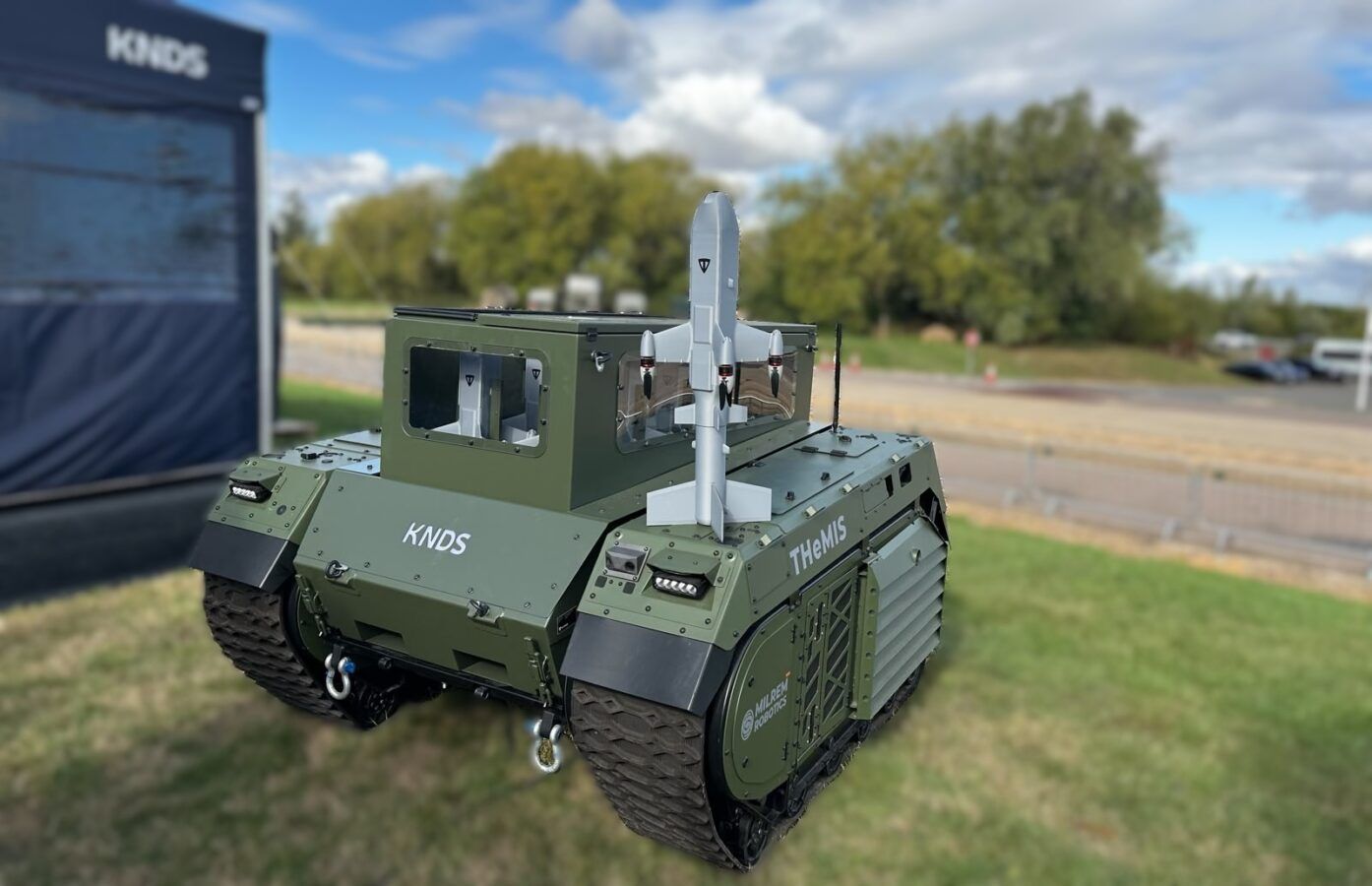
The TI-03 was publicly presented at DVD 2026 in the United Kingdom in an integration with the THeMIS unmanned ground vehicle and a KNDS mission module. TYTAN stated that the system progressed from concept to first flight in less than one year and that serial production in Germany was planned for the end of 2026.
Development
According to information provided by TYTAN Technologies, Hyperion emerged from work associated with a Bundeswehr contract awarded in October 2025 for development of a system intended to protect military installations. The work produced two parallel interceptor concepts. EOS was developed for dual-use and civilian applications against small drones through kinetic impact, while Hyperion was derived from EOS for military use and equipped with a warhead.
The military design was intended to provide greater range, faster reaction and longer endurance than the smaller interceptor. TYTAN stated that Hyperion completed the transition from concept to first flight in less than one year.
At DVD 2026 in Millbrook, TYTAN displayed Hyperion integrated with a tracked THeMIS unmanned ground vehicle through a KNDS mission module. The displayed configuration carried ten interceptors. The integration demonstrated a distributed counter-UAS concept in which the launcher can move separately from radar and command elements.
TYTAN stated in September 2026 that it intended to begin serial production in Germany by the end of 2026 after extensive testing, including trials described by the company as having taken place in active combat areas. The available material does not establish that the TI-03 had entered operational service at that time.
Design
Airframe and propulsion
The TI-03 uses a two-stage propulsion concept rather than relying on electric propulsion for the entire interception. A rocket booster provides the initial acceleration and rapidly carries the interceptor toward the target area or required altitude. Once the boost phase is complete, the interceptor separates from the rocket stage and transitions to electric flight.
One description of the system states that the separated booster descends by parachute. The interceptor itself uses four electrically powered rotors during the post-boost phase. This arrangement is intended to combine rapid initial climb with the manoeuvrability and controllability of an electrically powered terminal interceptor.
Guidance and engagement sequence
The engagement begins when an external surveillance sensor detects an aerial target. TYTAN has described radar, electro-optical systems and acoustic sensors as possible sources of detection data. The counter-drone system calculates an interception course and recommends an engagement to the operator.
The operator remains responsible for authorizing the use of the interceptor. After launch, the rocket booster accelerates Hyperion toward the required altitude. Following booster separation, external radar data guides the interceptor toward the target until its onboard sensor can acquire the threat.
The interceptor is then controlled autonomously through the final approach. A movable day-and-night sensor is mounted in the nose. Another description of the system identifies an AI-assisted thermal camera as part of the terminal tracking system. TYTAN also describes adaptive guidance for high-G manoeuvres, while the navigation architecture is intended to function in environments where GNSS signals are unavailable or disrupted.
Warhead
Unlike the kinetic EOS interceptor, Hyperion is designed to destroy its target with an integrated explosive fragmentation warhead. The military configuration has also been described as using a proximity fuze. Published specifications list a 0.9 kg payload, although the available information does not explicitly identify this value as the mass of the warhead alone.
Mobile launcher integration
The DVD 2026 configuration installed several TI-03 interceptors on the Milrem Robotics THeMIS tracked unmanned ground vehicle using a KNDS mission module. THeMIS has two tracked side modules with a central payload bay, allowing different mission packages to be installed.
The KNDS modular architecture supports interchangeable payloads for reconnaissance, logistics, casualty evacuation, route clearance, electronic warfare, counter-UAS missions and effector integration. Mission modules can weigh up to 650 kg and can be exchanged using a crane or forklift, with electrical and electronic connections provided through the vehicle interface.
For the Hyperion configuration, the unmanned vehicle acts primarily as a mobile interceptor carrier rather than as a complete independent air-defence system. Detection sensors, command elements and launchers can be physically separated and connected through the wider counter-UAS network. This allows interceptor magazines to be dispersed, repositioned with manoeuvre units and placed in exposed locations without stationing a crew directly on the launcher.
Program status
As presented in September 2026, the TI-03 Hyperion remained a developing counter-UAS interceptor. TYTAN had demonstrated a flying system and displayed an integrated mobile launcher at DVD 2026, while serial production was planned for the end of the year.
The THeMIS installation illustrated a concept for supporting moving ground formations with distributed counter-drone effectors. Multiple unmanned launch vehicles could in principle receive targeting data from common detection and command networks, allowing interceptor coverage to move with armoured, logistics or other deployed units. The effectiveness of such an arrangement would depend on the supporting sensors, command-and-control links, available interceptor inventory and communications resilience in a contested electromagnetic environment.
Specifications (TI-03 Hyperion)
General characteristics
- Type: Rocket-boosted counter-drone interceptor
- Total weight: 7.5 kg
- Payload: 0.9 kg
- Propulsion: Rocket booster for initial acceleration, followed by electrically powered flight
- Terminal propulsion: Four electrically powered rotors
- Warhead: Explosive fragmentation warhead
- Fuzing: Proximity fuze
Performance
- Maximum speed: More than 500 km/h
- Maximum range: 30 km
- Maximum ceiling: 5,000 m
Guidance
- Initial targeting: External sensor and ground-based targeting data
- Mid-course guidance: Radar-supported guidance toward the target area
- Terminal guidance: Autonomous onboard optical or thermal target acquisition and tracking
- Navigation: Designed for operation in GNSS-denied conditions
- Human control: Operator authorizes the engagement before launch
Target set
- Manufacturer-stated targets: NATO Class I and Class II unmanned aircraft
- Displayed THeMIS configuration: Described as intended particularly for NATO Class II drone threats
Related equipment
- TYTAN EOS: A related electrically powered interceptor developed for kinetic engagement of smaller drones and used as the technological basis for the military Hyperion development.
- Milrem Robotics THeMIS: Tracked unmanned ground vehicle used as the carrier for the KNDS mission module that displayed TI-03 Hyperion interceptors at DVD 2026.
 Argentina
 Armenia
 Australia
 Austria
 Austria-Hungary
 Belgium
 Brazil
 United Kingdom
 United States
 Brunei
 Bulgaria
 Canada
 Chile
Chile China
China Colonial America
 Colombia
 Confederate States
 Croatia
 Czech
Czech Denmark
 Egypt
Egypt Finland
 France
 Georgia
 German Imperial
 Greece
 Holland
 Hungary
 India
India Indonesia
 Iran
Iran Iraq
Iraq Ireland
 Israel
 Italy
Italy Japan
Japan Japan (1940)
 Jordan
 Kingdom of Italy
 Malaysia
 Mexico
 Myanmar
 Nazi Germany
 Netherlands
 New Zealand
 North Korea
 Norway
 Pakistan
 Peru
Peru Philippines
 Poland
 Portugal
 Prussia
 Romania
 Russia
 Saudi Arabia
 Serbia
 Singapore
 Slovakia
 Slovenia
 South Africa
 South Korea
 Soviet Union
 Spain
Spain Sweden
 Switzerland
 Syria
Syria Taiwan
 Thailand
 Turkey
 UAE
UAE Ukraine
 Vietnam
 Yugoslavia