
History
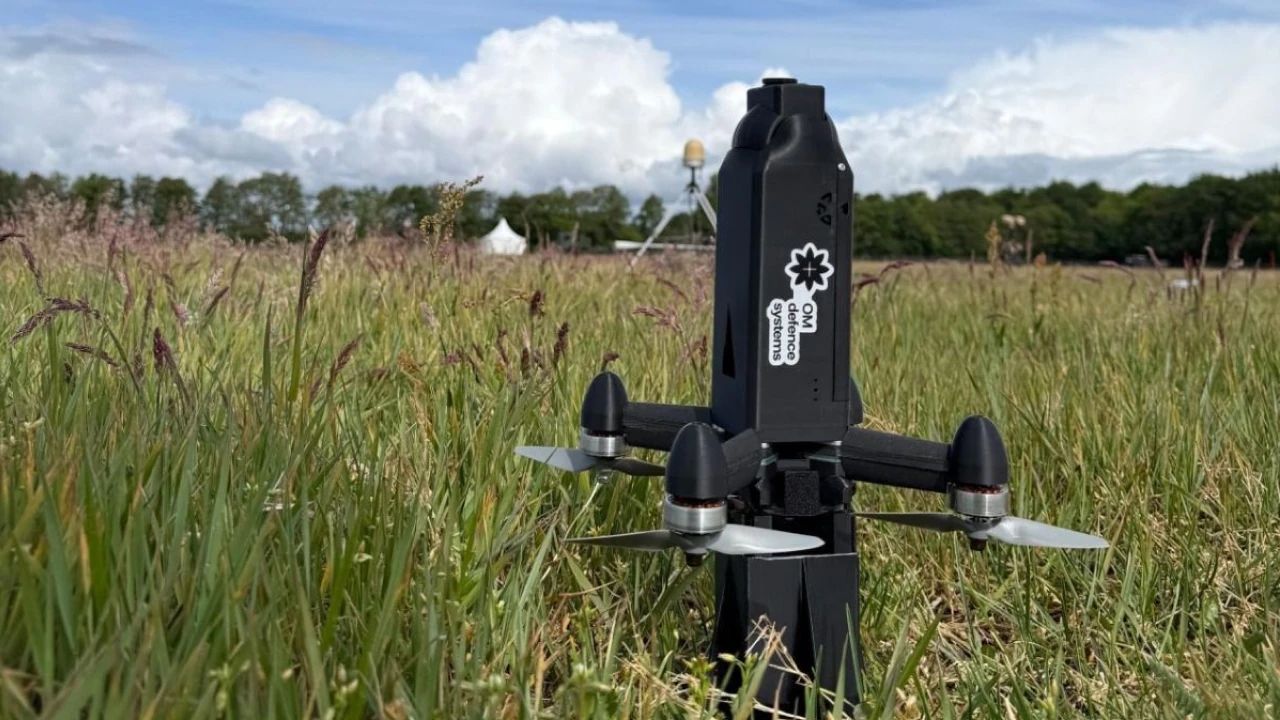
The OM Defence Systems X7 is a British counter-drone interceptor developed to engage hostile unmanned aircraft, including FPV drones. The system is intended to shift the interception task away from manually flown FPV interceptors toward operator-supervised autonomous engagements.
OM Defence Systems demonstrated the X7 during a series of military trials in 2026 for NATO and British users. These events were used both to test the system under operational conditions and to collect requirements from potential military customers.
The X7 reached technology readiness level 5 during development testing. OM Defence Systems stated that the system operated in full autonomous mode during field demonstrations with the British Army in March 2026, while the company was targeting technology readiness level 6 in early 2027.
Development and testing
The development concept centers on removing the requirement for a dedicated FPV pilot during an interception. Instead, an operator uses the OM Defence Systems ground control station and proprietary software to authorize and supervise the engagement. The planned architecture can therefore retain human involvement while automating the flight and interception process.
During 2026, OM Defence Systems conducted multiple live demonstrations of the X7. The company presented the system to NATO and British military users while refining requirements gathered from the organizations evaluating it. The X7 was designed and engineered in the United Kingdom and has been tested in Europe and Ukraine.
According to the available development information from Defence Blog, no contracts had been awarded at the time of reporting. OM Defence Systems nevertheless continued demonstrations while working toward a higher technology readiness level.
Design
The X7 system consists of three principal elements: the interceptor aircraft, a networked launch pad, and a ground control station. The interceptor is described as a one-way autonomous aircraft intended to engage Group 1, Group 2, and Group 3 unmanned aircraft.
Command and sensor integration
The ground control station is designed to receive targeting information from external radar systems rather than requiring a dedicated radar supplied specifically with the interceptor. Sensor information is ingested using the SAPIENT communications standard, allowing the engagement architecture to work with different radar feeds and external sensor networks.
The intended operating concept supports human-in-the-loop or human-on-the-loop control. An operator can authorize an engagement through the ground control station while the system performs functions that would otherwise require manual FPV piloting.
Interceptor
Company material describes the X7 as a one-way autonomous interceptor capable of speeds above 400 km/h (250 mph). The available information does not specify the propulsion system, guidance hardware, airframe dimensions, launch mechanism, endurance, range, or interceptor payload.
Program status
The X7 remained a development and demonstration system during 2026. It was assessed at technology readiness level 5, and OM Defence Systems targeted technology readiness level 6 for early 2027. The available information does not identify an awarded production contract or an operational military operator.
Demonstrations with NATO and British military users were being used to evaluate the system and gather customer requirements. These trials should not be interpreted as evidence that the X7 had entered operational service.
Specifications (X7)
General characteristics
- Type: One-way autonomous counter-drone interceptor
- System elements: Interceptor aircraft, networked launch pad, and ground control station
- Target classes: Group 1, Group 2, and Group 3 unmanned aircraft
- Control concept: Operator-supervised autonomous engagement through a ground control station
- Sensor integration: External radar and sensor feeds using the SAPIENT communications standard
Performance
- Maximum stated speed: Above 400 km/h (250 mph)
 Argentina
 Armenia
 Australia
 Austria
 Austria-Hungary
 Belgium
 Brazil
 United States
 Brunei
 Bulgaria
 Canada
 Chile
Chile China
China Colonial America
 Colombia
 Confederate States
 Croatia
 Czech
Czech Denmark
 Egypt
Egypt Finland
 France
 Georgia
 Germany
 German Imperial
 Greece
 Holland
 Hungary
 India
India Indonesia
 Iran
Iran Iraq
Iraq Ireland
 Israel
 Italy
Italy Japan
Japan Japan (1940)
 Jordan
 Kingdom of Italy
 Malaysia
 Mexico
 Myanmar
 Nazi Germany
 Netherlands
 New Zealand
 North Korea
 Norway
 Pakistan
 Peru
Peru Philippines
 Poland
 Portugal
 Prussia
 Romania
 Russia
 Saudi Arabia
 Serbia
 Singapore
 Slovakia
 Slovenia
 South Africa
 South Korea
 Soviet Union
 Spain
Spain Sweden
 Switzerland
 Syria
Syria Taiwan
 Thailand
 Turkey
 UAE
UAE Ukraine
 Vietnam
 Yugoslavia