
History
Hetz Dorban, marketed internationally as Iron Fist, is an Israeli hard-kill active protection system for armored vehicles. It was originally developed by Israel Military Industries, later IMI Systems, which became part of Elbit Systems in 2018. The system is intended to detect approaching anti-armor threats and launch an interceptor before they reach the protected vehicle.
Iron Fist combines radar-based detection with infrared sensing in configurations that use both sensor types. A computerized control system calculates an interception point and commands a small explosive interceptor. The interceptor is designed to detonate close to the incoming threat and defeat or destabilize it through blast and shock-wave effects rather than by projecting a large fragmentation pattern.
The program was publicly presented in 2006, and prototype testing began in 2007. Development subsequently expanded into several configurations and integration programs for Israeli, American, European and Australian armored vehicles. By August 2026, an Israel Defense Forces Eitan armored vehicle equipped with Hetz Dorban had been photographed during a training exercise.
Development
IMI presented the concept of a new active protection system to the Israeli Ministry of Defense in 2006. Testing of a prototype began in mid-2007. According to a detailed program history published by MILMAG, trials included rocket-propelled grenades, anti-tank guided missiles, high-explosive anti-tank ammunition and kinetic-energy armor-piercing projectiles.
In June 2009, the Israeli Ministry of Defense approved procurement and introduction of Iron Fist, with early systems tested on Namer heavy armored personnel carriers. In November 2010, however, the ministry ended its financing of Iron Fist development while proceeding with limited procurement of the competing Trophy active protection system.
Iron Fist continued testing outside Israel. During trials in the United States in May 2011, the system was reported to have intercepted anti-tank guided missiles, rocket-propelled grenades and kinetic-energy tank projectiles in stationary and moving scenarios.
In 2012, the Israeli Ministry of Defense considered combining elements of Iron Fist and Trophy. The proposed arrangement would have used the Iron Fist interceptor with Trophy command, control and communications elements and an ELTA radar. IMI did not accept an arrangement under which Rafael would act as the main integrator. Comparative testing of Iron Fist and Trophy followed in 2013. The ministry ultimately continued work on both systems for different platforms rather than selecting only one.
Cooperation was discussed again in December 2014 after the operational use of Trophy during the 2014 conflict in Gaza. Contemporary accounts described a proposed next-generation system combining technologies from Rafael, Israel Aerospace Industries and IMI. A broader chronological overview of the program is also available in the Iron Fist overview.
International integration and procurement
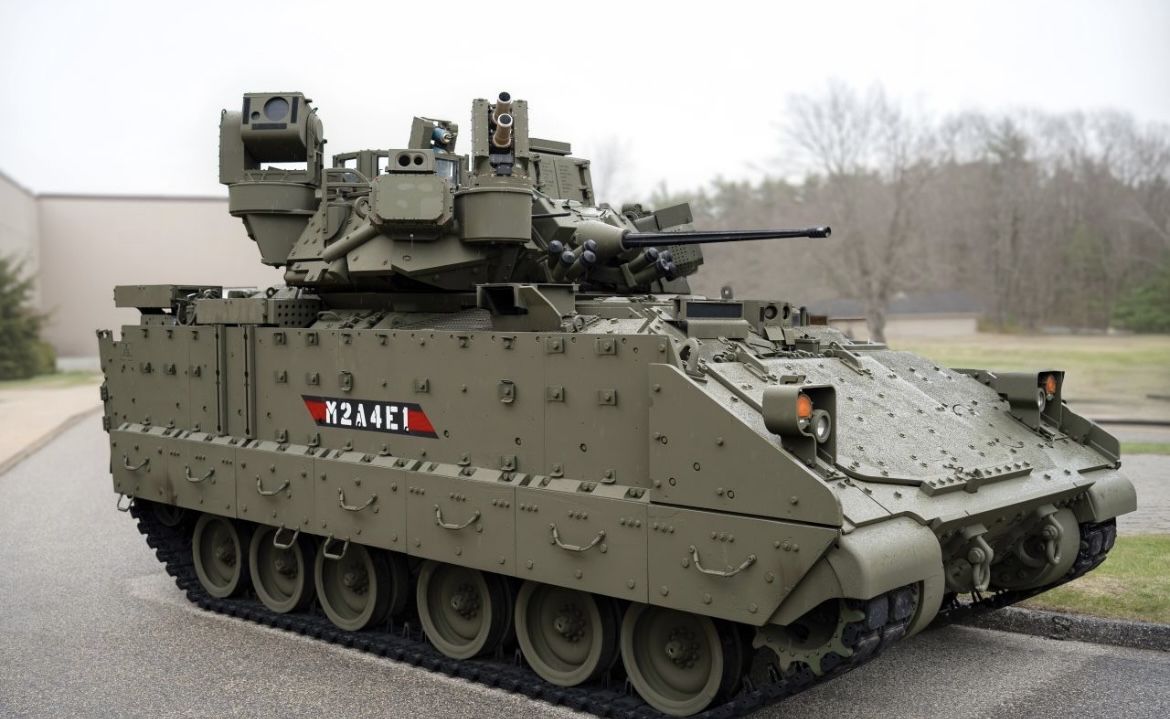
In June 2016, the U.S. Army selected the lighter Iron Fist Light configuration for testing under its Modular Active Protection System program. Trials on M2 Bradley infantry fighting vehicles led to further modifications and the designation Iron Fist Light Decoupled, or IF-LD.
In December 2016, IMI was selected by BAE Systems Hägglunds to provide a hard-kill active protection system for trials on Dutch CV9035NL infantry fighting vehicles. The Netherlands decided to procure Iron Fist Light systems in January 2021. The first serial CV9035NL in the updated configuration was handed over in September 2022.
Following the acquisition of IMI Systems by Elbit Systems, the Israeli Ministry of Defense selected Iron Fist Light Decoupled in August 2019 for integration with the Eitan 8×8 armored vehicle, turreted Namer infantry fighting vehicles and Caterpillar D9 armored bulldozers.
Elbit Systems and Spain's Escribano Mechanical & Engineering announced an agreement in November 2021 concerning integration of Iron Fist with the Guardian 30 unmanned turret intended for the Spanish VCR Dragon 8×8 program. This represented an integration agreement rather than confirmation that Spain had fielded the system.
In December 2022, BAE Systems Hägglunds announced a government-to-government agreement between Sweden and Slovakia for 152 CV9035 infantry fighting vehicles equipped with Iron Fist. In September 2023, Elbit Systems signed a USD 109 million contract to supply Iron Fist systems to BAE Systems Hägglunds for CV90 vehicles.
Australia selected the system for the AS21 Redback infantry fighting vehicle. A December 2023 Australian contract covered 129 Redback vehicles for the Land 400 Phase 3 program, with Iron Fist included as part of the vehicle configuration.
In March 2024, the U.S. Army awarded General Dynamics Ordnance and Tactical Systems and Elbit Systems an eight-year indefinite-delivery, indefinite-quantity contract for Iron Fist upgrades to Bradley infantry fighting vehicles. Iron Fist was also selected by both competing teams in the U.S. Army XM30 program. In August 2024, Elbit Systems announced another USD 130 million contract to supply Iron Fist for CV90 infantry fighting vehicles for an unnamed European country.
Images published by the Israel Defense Forces in August 2026 showed an Eitan wheeled armored vehicle fitted with Hetz Dorban during training. The appearance provides evidence of an Israeli Eitan carrying the system in a training environment, but does not by itself establish the scale of fleet-wide deployment.
Design
Iron Fist is a vehicle-mounted hard-kill active protection system. It is designed as an add-on system that can be adapted to different armored vehicles, ranging from lighter platforms to medium and heavy armored fighting vehicles. General Dynamics, which cooperates with Elbit Systems on U.S. integration, describes the current system as a modular configuration intended to minimize the space, weight and power burden on the host vehicle. Its technical description is available from General Dynamics Ordnance and Tactical Systems.
Sensors and fire control
The system uses radio-frequency radar sensing and infrared sensing. In the standard configuration described by MILMAG, the sensor suite can include as many as four Doppler radars with active electronically scanned phased-array antennas and as many as four infrared sensors. The sensors provide coverage around the protected vehicle and supply data to the computerized control unit.
The control system receives and classifies sensor information, predicts the trajectory of an approaching object and calculates an interception point. General Dynamics describes Iron Fist as providing 360-degree protection coverage and using independent radar and infrared sensing techniques to improve detection and tracking. The sensor suite can also contribute to situational awareness and hostile-fire detection.
Interceptors
Launchers are installed on the vehicle and carry ready-to-fire interceptors. The standard arrangement described by MILMAG places launchers on opposite sides of the turret or hull, with two ready launcher barrels on each unit. The computerized control unit commands the appropriate launcher when an incoming threat meets the engagement criteria.
The interceptor carries a small explosive warhead. It is initiated close to the approaching threat at a calculated distance from the protected vehicle. General Dynamics describes the defeat mechanism as a shock-wave effect intended to destroy, deflect or destabilize the threat. The interceptor is designed to limit fragmentation compared with conventional fragmentation-based projectiles.
Integration and safety
Different Iron Fist configurations have been adapted to vehicles with substantially different size, weight and electrical-power limits. General Dynamics describes its configuration as a bolt-on installation that does not require penetration of the basic vehicle structure and is designed for low power consumption and a low external profile.
Safety measures described for the system include a small-blast interceptor, insensitive-munition explosives, hardware and software intended to prevent false firing, redundant fuzing and fail-safe initiation. These descriptions apply to the configuration presented by General Dynamics and should not be assumed to describe every earlier Iron Fist installation without modification.
Published system weights vary between configurations. MILMAG gives approximately 450 kg for the complete standard Iron Fist system. General Dynamics gives approximately 250 kg for the overall platform installation of its configuration, including about 100 kg per side. The difference reflects the fact that the published figures refer to different system arrangements rather than a single universal installation.
Program status
Iron Fist has progressed through prototype testing, vehicle demonstrations, procurement programs and serial vehicle integration. It has been selected for Israeli Eitan, turreted Namer and armored D9 platforms, Dutch and other CV90-family vehicles, U.S. Bradley vehicles and Australian AS21 Redbacks. Some programs involve vehicles already delivered in an Iron Fist-equipped configuration, while others remain integration or procurement programs.
The August 2026 appearance of an Eitan equipped with Hetz Dorban during Israel Defense Forces training confirms that the system had been integrated on at least one Eitan used in a military training environment. The available source does not establish how many Israeli Eitan vehicles were equipped with the system at that time.
Variants
- Iron Fist: Original and standard family designation for the hard-kill active protection system developed by IMI and subsequently marketed by Elbit Systems.
- Iron Fist Light: Lighter configuration selected by the U.S. Army for testing under the Modular Active Protection System program in 2016.
- Iron Fist Light Decoupled: Modified configuration developed following U.S. Bradley testing. It has also been selected for Israeli vehicle programs including Eitan, turreted Namer and armored D9 platforms.
Operators
- Israel: Iron Fist Light Decoupled was selected for Eitan armored vehicles, turreted Namer infantry fighting vehicles and armored Caterpillar D9 bulldozers. An Eitan fitted with Hetz Dorban was photographed during training in August 2026.
- Netherlands: Iron Fist Light was ordered for the Dutch CV9035NL modernization program. The first serial vehicle in the updated configuration was delivered in September 2022.
- Slovakia: The system is specified for 152 CV9035 infantry fighting vehicles covered by the Sweden-Slovakia government-to-government agreement announced in December 2022.
- Australia: Iron Fist is included on 129 AS21 Redback infantry fighting vehicles ordered under the Australian Land 400 Phase 3 program.
- United States: Iron Fist Light Decoupled has been developed and contracted for M2 Bradley integration. In March 2024, the U.S. Army awarded an eight-year contract covering Iron Fist upgrades for Bradley infantry fighting vehicles.
Specifications (Iron Fist standard configuration)
General characteristics
- Type: Vehicle-mounted hard-kill active protection system
- System weight: Approximately 450 kg for the standard configuration described by MILMAG
- Coverage: 360 degrees
- Radar sensors: Up to four Doppler radars with active electronically scanned phased-array antennas
- Infrared sensors: Up to four infrared sensors
- Launcher arrangement: Launchers on opposite sides of the turret or hull, each with two ready interceptor barrels
- Control equipment: Computerized control unit, control panel, launcher control units and vehicle integration equipment
Engagement system
- Countermeasure: Small-warhead explosive interceptor
- Defeat mechanism: Interceptor detonation close to the incoming threat, using blast and shock-wave effects to destroy, deflect or destabilize it
- Threat classes demonstrated in testing: Rocket-propelled grenades, anti-tank guided missiles, high-explosive anti-tank ammunition and kinetic-energy armor-piercing projectiles
Related equipment
Rafael's Trophy is another Israeli hard-kill active protection system and was repeatedly evaluated alongside Iron Fist. Israeli defense authorities considered both competitive selection and combinations of technologies from the two systems during the 2010s. The programs ultimately continued on different vehicle platforms rather than being replaced by a single common system.
 Argentina
 Armenia
 Australia
 Austria
 Austria-Hungary
 Belgium
 Brazil
 United Kingdom
 United States
 Brunei
 Bulgaria
 Canada
 Chile
Chile China
China Colonial America
 Colombia
 Confederate States
 Croatia
 Czech
Czech Denmark
 Egypt
Egypt Finland
 France
 Georgia
 Germany
 German Imperial
 Greece
 Holland
 Hungary
 India
India Indonesia
 Iran
Iran Iraq
Iraq Ireland
 Italy
Italy Japan
Japan Japan (1940)
 Jordan
 Kingdom of Italy
 Malaysia
 Mexico
 Myanmar
 Nazi Germany
 Netherlands
 New Zealand
 North Korea
 Norway
 Pakistan
 Peru
Peru Philippines
 Poland
 Portugal
 Prussia
 Romania
 Russia
 Saudi Arabia
 Serbia
 Singapore
 Slovakia
 Slovenia
 South Africa
 South Korea
 Soviet Union
 Spain
Spain Sweden
 Switzerland
 Syria
Syria Taiwan
 Thailand
 Turkey
 UAE
UAE Ukraine
 Vietnam
 Yugoslavia