

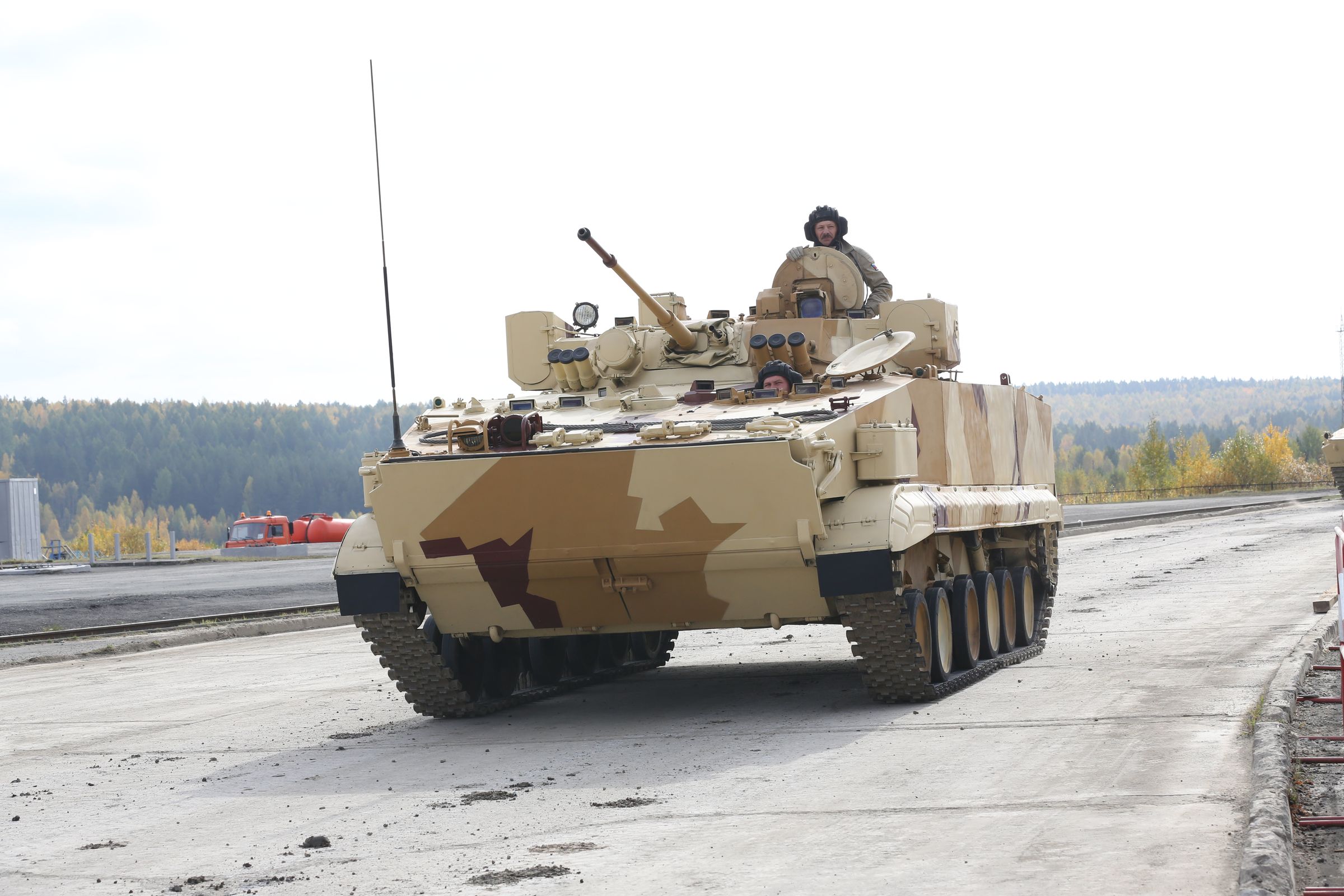
History
The BRM-3K Rys is a Russian tracked combat reconnaissance vehicle developed from the BMP-3 infantry fighting vehicle chassis. It was created for battlefield and artillery reconnaissance, combining long-range observation equipment, navigation and communications systems with a stabilized 30 mm automatic cannon.
The vehicle was developed in the early 1990s as a successor or supplement to the BRM-1K. A reconnaissance version of the BMP-3 was publicly identified in 1993 under the provisional designation Model 501, while the BRM designation and the name Rys, meaning lynx, were disclosed by early 1995.
The design retains the BMP-3 powertrain, tracked running gear and amphibious capability but replaces the standard BMP-3 armament arrangement with reconnaissance equipment and a turret centered on the 30 mm 2A72 cannon. Its six-person crew is organized to operate the vehicle, weapons, radar, navigation, communications and other surveillance systems.
Development
The BRM-3K was developed for reconnaissance by Russian ground forces and coastal-defense units. The chassis was associated with the Kurgan Machine Construction Plant, while the Rubtsovsk Machine-Building Plant acted as systems integrator and is also identified as the vehicle's developer and producer.
Its reconnaissance tasks include terrain surveillance, searching for fixed, moving and concealed ground targets, identifying targets and determining their coordinates. The vehicle is also intended to provide navigation data, maintain radio communications and engage land or aerial targets when required.
Published program information identifies production as beginning in 1993 and entry into service in 1995. Status descriptions are not fully consistent. One technical description lists the BRM-3K as being in limited service, while an older description characterized it as a prototype that might have entered low-rate production. No export operator is identified in the supplied material.
Design
Layout and crew
The BRM-3K uses the tracked chassis, engine, transmission and water-jet propulsion arrangement of the BMP-3. Externally it remains similar to the infantry fighting vehicle but has a different turret and reconnaissance-specific equipment. The BMP-3's 100 mm 2A70 gun and the two bow-mounted 7.62 mm PKT machine guns are omitted.
The crew consists of six personnel: a reconnaissance group commander, vehicle commander, gunner, driver-mechanic, navigator/computer operator and radio operator. The driver occupies the central front position. The commander and gunner are seated in the turret, while other crew members operate the navigation, communications and battlefield-surveillance equipment.
The vehicle has a combat weight of approximately 19.6 tonnes. It is 7.02 m long, 3.28 m wide and 2.57 m high, with a ground clearance of 0.45 m. The tracked suspension uses six road wheels per side and torsion bars.
Reconnaissance systems
A major element of the BRM-3K mission system is the mast-mounted 1RL-133-1 battlefield-surveillance radar. The radar can be retracted into the vehicle when not required. It can detect vehicles at approximately 8,000 to 10,000 m and personnel at about 4,000 m, although actual performance depends on terrain and operating conditions. The radar can be raised about 1 m and scanned independently of turret position over a wide sector.
Optical and electro-optical reconnaissance equipment includes the 1PN71 thermal observation device, the 1PN61 active-pulse night observation device and the 1D14 laser rangefinder. The 1PN71 has approximately 3.7x and 11.5x magnification and a stated target-identification range of up to 3,000 m. The 1PN61 provides approximately 7x magnification, with a stated range of 1,500 m in passive operation and 3,000 m in active mode.
The 1D14 periscopic laser rangefinder has approximately 7.3x and 18x magnification and a stated maximum ranging distance of 25,000 m. It is mounted so that the commander can use it for reconnaissance independently of the turret over a limited arc.
Navigation equipment includes the TNA-4-6 navigation system, 1T129 coordinate system and 1G50 gyrocompass. A 1V520 electronic computer supports the processing of reconnaissance and navigation information. The vehicle is intended to determine target coordinates within a full 360-degree area around the vehicle, with a stated coordinate accuracy of approximately 20 m under specified conditions.
Communications
The communications suite includes R-163-50U, R-163-50K and R-163-10U radio equipment. Stated radio-communication range is approximately 100 km while moving and up to 350 km when stationary under suitable conditions. Information gathered by the reconnaissance crew can be processed in the vehicle and transmitted through the command chain.
The BRM-3K can also support a detached observation post. A post may be established up to about 500 m from the vehicle using wire communications or up to approximately 6 km away when using a portable UHF radio.
A 4 kW auxiliary generator is installed to supply the reconnaissance and communications equipment without requiring continuous operation of the main engine.
Armament
The primary weapon is the dual-feed 30 mm 2A72 automatic cannon. The weapon is stabilized in two axes and can engage targets while the vehicle is stationary or moving. Technical data lists a cyclic rate of approximately 300 rounds per minute and an ammunition load of 600 rounds.
The 2A72 can use armor-piercing incendiary, high-explosive incendiary and high-explosive tracer ammunition. A stated engagement range of approximately 1,500 to 2,000 m is given for armored ground targets, while helicopters can be engaged at distances of up to about 4,000 m under suitable conditions. Weapon elevation is approximately -5 to +60 degrees in one description and -5 to +64 degrees in another, with full 360-degree powered turret traverse.
A 7.62 mm PKT machine gun is mounted coaxially with the cannon. The listed ammunition load is 2,000 rounds. The vehicle also has two groups of three Type 902 Tucha smoke-grenade launchers on the turret.
Weapons carried for dismounted use can include six assault rifles and 15 hand grenades. Provision is also described for carrying an anti-tank guided weapon system for dismounted employment.
Fire control
The BRM-3K fire-control equipment includes the BPK2-42 combined day and night sight, PPB-2 periscopic monocular sight, 2E52-1 armament stabilizer and BETs-088 control system. Because the BMP-3's 100 mm 2A70 gun is deleted, the reconnaissance vehicle does not require the missile laser-guidance equipment associated with that weapon.
Mobility
Power is provided by a UTD-29T four-stroke liquid-cooled diesel engine producing approximately 500 hp. It is connected to a four-speed hydromechanical transmission. With a combat weight of 19.6 tonnes, the stated power-to-weight ratio is about 25.5 hp per tonne.
Maximum road speed is approximately 70 km/h, while off-road speed is listed at about 45 to 50 km/h. Published road-range figures differ, with values of approximately 600 km and 700 km both appearing in technical descriptions.
The BRM-3K is fully amphibious. Two water jets at the rear propel it through water at approximately 8 to 10 km/h. Before entering the water, the crew raises the trim vane and activates the bilge pumps.
Protection
Technical descriptions differ in their characterization of the armor construction. One describes an aluminum hull and turret reinforced by steel plate over the frontal arc, while another describes an armored-steel hull and turret. Both characterize the protection as intended primarily against small-arms fire and shell fragments.
The vehicle is equipped with an NBC protection system and a fire-detection and suppression system. Its relatively low combat mass and amphibious configuration reflect the mobility requirements inherited from the BMP-3 chassis.
Operational history
The BRM-3K is identified as a Russian reconnaissance vehicle, with Russia listed as its notable user. One technical reference records entry into service in 1995 and describes its status as limited service. The supplied material does not provide detailed information about unit assignments, combat deployments or confirmed export deliveries.
Variants
- BRM-3K Rys: Standard reconnaissance vehicle based on the BMP-3 chassis and armed with the 30 mm 2A72 cannon.
- 57 mm turret proposal: A later configuration was displayed or proposed using the BRM-3K chassis with an AU-220M Baikal remote-controlled weapon station and BM-57 57 mm automatic cannon. The supplied information does not establish this configuration as a production or operational BRM-3K variant.
Operators
- Russia: Identified as the principal user. The supplied technical information describes the BRM-3K as having entered service in 1995 and remaining in limited service.
Specifications (BRM-3K Rys)
General characteristics
- Crew: 6
- Combat weight: 19.6 t
- Length: 7.02 m
- Width: 3.28 m
- Height: 2.57 m
- Ground clearance: 0.45 m
- Suspension: Torsion bar
- Engine: UTD-29T four-stroke liquid-cooled diesel
- Engine power: 500 hp
- Transmission: Four-speed hydromechanical
- Power-to-weight ratio: 25.5 hp/t
Performance
- Maximum road speed: 70 km/h
- Maximum off-road speed: 45-50 km/h
- Maximum water speed: 8-10 km/h
- Road range: Approximately 600-700 km; published figures differ
- Amphibious capability: Fully amphibious using two rear water jets
Armament
- Main weapon: 30 mm 2A72 automatic cannon
- Main-gun ammunition: 600 rounds
- Rate of fire: Approximately 300 rounds/min
- Turret traverse: 360 degrees
- Weapon elevation: Approximately -5 to +60/+64 degrees; published figures differ
- Secondary weapon: 7.62 mm PKT coaxial machine gun
- Machine-gun ammunition: 2,000 rounds
- Smoke grenade launchers: Two groups of three Type 902 Tucha launchers
Reconnaissance equipment
- Battlefield-surveillance radar: 1RL-133-1
- Thermal observation: 1PN71
- Night observation: 1PN61
- Laser rangefinder: 1D14
- Navigation: TNA-4-6 navigation system, 1T129 coordinate equipment and 1G50 gyrocompass
- Computer: 1V520 electronic computer
- Auxiliary electrical power: 4 kW generator
Related equipment
- BMP-3: Infantry fighting vehicle whose chassis, engine, transmission and amphibious propulsion arrangement form the basis of the BRM-3K.
- BRM-1K: Earlier reconnaissance vehicle that the BRM-3K was intended to supplement and replace.
 Argentina
 Armenia
 Australia
 Austria
 Austria-Hungary
 Belgium
 Brazil
 United Kingdom
 United States
 Brunei
 Bulgaria
 Canada
 Chile
Chile China
China Colonial America
 Colombia
 Confederate States
 Croatia
 Czech
Czech Denmark
 Egypt
Egypt Finland
 France
 Georgia
 Germany
 German Imperial
 Greece
 Holland
 Hungary
 India
India Indonesia
 Iran
Iran Iraq
Iraq Ireland
 Israel
 Italy
Italy Japan
Japan Japan (1940)
 Jordan
 Kingdom of Italy
 Malaysia
 Mexico
 Myanmar
 Nazi Germany
 Netherlands
 New Zealand
 North Korea
 Norway
 Pakistan
 Peru
Peru Philippines
 Poland
 Portugal
 Prussia
 Romania
 Saudi Arabia
 Serbia
 Singapore
 Slovakia
 Slovenia
 South Africa
 South Korea
 Soviet Union
 Spain
Spain Sweden
 Switzerland
 Syria
Syria Taiwan
 Thailand
 Turkey
 UAE
UAE Ukraine
 Vietnam
 Yugoslavia