
History
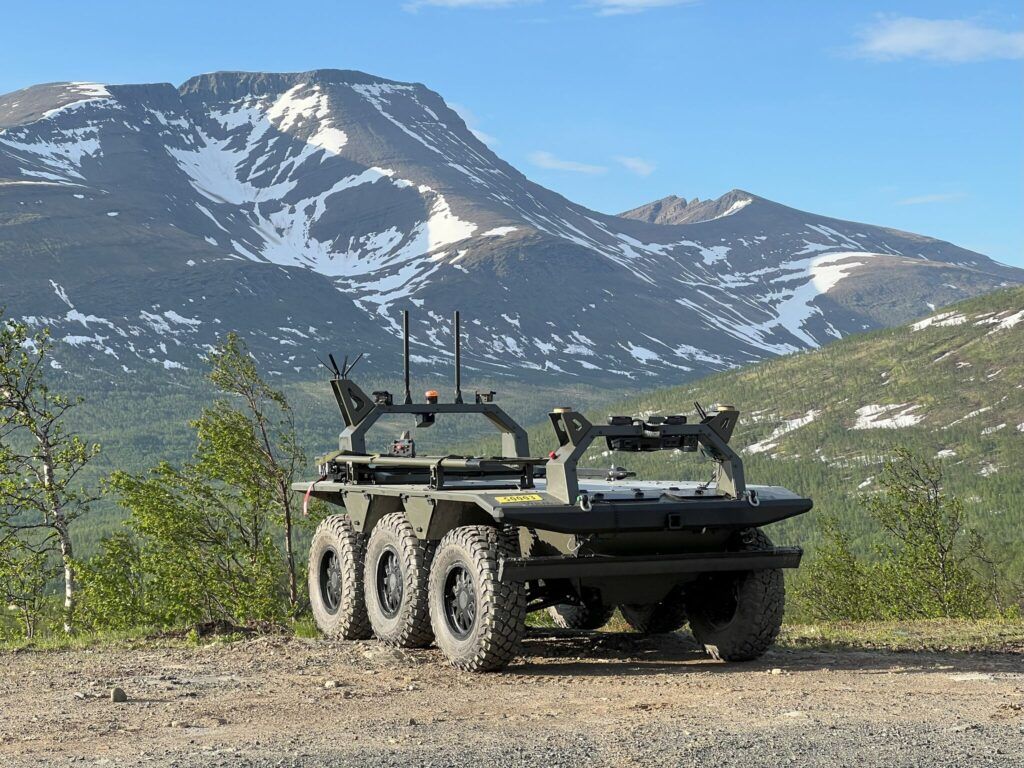
The IDV VIKING is a British-developed 6×6 uncrewed ground vehicle designed as a modular platform for autonomous and remotely controlled military missions. Its configurable payload area, hybrid-electric propulsion and onboard autonomy systems allow the same basic vehicle to support logistics, reconnaissance, electronic warfare, counter-UAS, casualty evacuation and combat-support tasks.
The platform originated with Horiba Mira and evolved through several generations before Horiba Mira became part of IDV in 2023. IDV continued development of VIKING in Britain, with the vehicle produced at its facility at MIRA Technology Park in Nuneaton and supported by a British supply chain.
By 2026, the latest VIKING 2.4 represented the fifth iteration of the platform. It introduced a production-oriented series-hybrid drivetrain, longer electric range, greater computing capacity and improved systems integration while retaining the compact 6×6 layout and 750 kg payload capacity of the vehicle family.
Development
Earlier VIKING versions used parallel-hybrid propulsion. VIKING 2.3 introduced a series-hybrid arrangement as a technology demonstrator but did not become a production product. VIKING 2.4 became the first product version based on the series-hybrid architecture.
The 2.4 configuration was publicly displayed at Eurosatory 2026. The electric motor became the sole propulsion motor, while a compact diesel generator recharged the battery. This arrangement improved very-low-speed control and extended electric-only range from approximately 20 km on earlier versions to as much as 30 km. Battery energy capacity was increased by approximately 50 percent compared with preceding versions.
The electronics architecture was also redesigned to simplify upgrades. Computing capacity was stated to be approximately five times greater than on the previous generation, supporting higher-resolution cameras, machine-vision functions and more demanding autonomy software. IDV also replaced the earlier transformer-oil cooling arrangement with a water-glycol system intended to simplify field maintenance.
In May 2026, the Italian Army signed a contract for an initial batch of eight VIKING 2.4 vehicles. The first batch was intended primarily to support doctrine development and frontline logistics experimentation rather than to enter service immediately in a weaponized configuration.
2026 mission demonstrations
At Eurosatory 2026, two VIKING 2.4 vehicles demonstrated different mission concepts. One carried a Leonardo Hitrole counter-UAS remote weapon station with a mast-mounted Janus-D electro-optical sensor. A second vehicle carried a concept modular missile launcher developed with MBDA. The launcher shown at the event used three canisters, while configurations with five or six canisters were also described. The missile-launcher installation remained a concept rather than a confirmed operational configuration.
At DVD 2026 in Britain, IDV presented VIKING in two further configurations. One vehicle demonstrated precision-effects integration, while another carried Leonardo Guardian Vantage electronic-warfare and signals-intelligence equipment together with a portable Guardian Shield unit. The electronic-warfare payload could operate from battery power while the diesel generator was shut down, allowing passive sensing with reduced acoustic and thermal output.
U.S. Army autonomous breaching trials
On 15 September 2026, IDV announced that IDV USA had been selected to participate in the U.S. Army Engineer Autonomous Breaching Capability initiative. VIKING was proposed as the mobility platform for an autonomous system intended to breach minefields and complex battlefield obstacles while reducing soldiers' exposure to direct observation and fire.
IDV USA was one of four companies selected for the competitive effort, alongside Caterpillar, Forterra and Overland AI. The Army requirement emphasized robotic systems capable of beyond-line-of-sight autonomous control rather than simple local teleoperation.
The precise breaching payload for the VIKING-based proposal had not been publicly identified. Selection for the program therefore represented entry into competitive evaluation rather than a decision to field VIKING as a standard U.S. Army breaching system. Demonstrations and assessments were planned to lead toward a Transformation in Contact unit assessment in early 2027, with soldier feedback intended to inform a later production decision.
Design
Layout and mobility
VIKING is a compact six-wheel-drive platform with independent suspension, differential locks and a low, open payload deck. The latest VIKING 2.4 retains an overall length of approximately 3.0 m and a width of 1.8 m. The load bed is approximately 0.9 m high and provides a payload area measuring about 2.2 by 1.8 m.
The vehicle has a kerb mass of approximately 1,300 kg, a gross vehicle mass of 2,000 kg and a payload capacity of 750 kg. Its compact dimensions and relatively large payload area are intended to support rapid reconfiguration between mission packages.
Maximum road speed is approximately 45 km/h. The vehicle has approximately 300 mm of ground clearance, can climb a 350 mm step, ford water up to 600 mm deep and negotiate a stated 60 percent gradient. Two-wheel and four-wheel steering provide a stated minimum turning circle of approximately 7 m.
Powerplant
VIKING 2.4 uses a series-hybrid drivetrain. The battery pack is positioned at the front, the electric traction motor is located centrally and the diesel generator is installed at the rear to distribute mass across the chassis. The electric motor drives the axles through three differentials equipped with locking capability.
The traction motor is rated at approximately 100 kW, corresponding to a stated power-to-mass ratio of about 50 kW per tonne at the vehicle's 2-tonne gross mass. The diesel generator recharges the battery but does not mechanically drive the wheels.
Electric-only range is up to approximately 30 km. Fuel carried for the diesel generator permits repeated battery recharging and provides a stated combined hybrid range exceeding 300 km. The platform can also remain in silent-watch operation for more than 24 hours under specified conditions, allowing onboard systems to operate while the diesel engine is shut down.
Autonomy and control
VIKING incorporates IDV Robotics' MACE system for remote control, teleoperation and autonomous functions. The system combines passive and active sensors with AI-enabled processing for navigation, mission planning and obstacle avoidance.
Supported autonomous behaviors include route following, Follow Me operation, reconnaissance and survey functions. IDV has also developed navigation technology intended to support operation where satellite navigation is degraded or unavailable. This capability is relevant to missions in environments affected by electronic warfare.
The communications architecture is designed to accept different customer-provided systems rather than depend on a single radio type. Tactical radios and satellite communications can be integrated, while fibre-optic control has also been described as a backup option for heavily jammed environments.
Payload integration
The 750 kg payload area incorporates standardized power and data interfaces for mission equipment. VIKING can therefore be reconfigured for logistics resupply, casualty evacuation, ISTAR, CBRNE missions, improvised explosive device detection, counter-UAS operations, remote weapon stations, anti-armour tasks and other combat-support roles.
The vehicle's electrical architecture allows demanding sensors and electronic-warfare systems to draw power from the onboard battery. Payloads can therefore continue operating with the diesel generator shut down when reduced acoustic and thermal emissions are required.
Deployment
The latest-generation VIKING can be transported internally by a Chinook helicopter or carried as an underslung load. It can also deploy under its own power or be towed.
Program status
VIKING has undergone more than a decade of trials with armed forces in Britain, continental Europe and the United States. Earlier iterations are described as being in service with several countries, while initial orders for the current platform have been placed by allied armies.
VIKING 2.4 was in industrialisation during 2026 and was described as a readily available product. The Italian Army ordered eight vehicles in May 2026. IDV also had continuing VIKING-related development programs in Sweden and Norway.
In the United States, the VIKING-based Engineer Autonomous Breaching Capability proposal remained under competitive evaluation in September 2026. No U.S. Army production order or operational fielding decision had been announced.
Variants
- Earlier VIKING generations: Initial versions of the 6×6 UGV using parallel-hybrid propulsion and progressively developed through military trials.
- VIKING 2.3: Series-hybrid technology demonstrator that introduced the powertrain concept later adopted for the production-oriented 2.4 version.
- VIKING 2.4: Fifth iteration and first product version with series-hybrid propulsion, increased battery capacity, up to 30 km electric-only range and a substantially upgraded electronics architecture.
- Counter-UAS demonstration configuration: VIKING 2.4 fitted with a Leonardo Hitrole remote weapon station and mast-mounted Janus-D electro-optical sensor for demonstration purposes.
- Missile-launcher concept: VIKING 2.4 displayed with a modular MBDA missile-launcher concept capable of accepting different missile types. This configuration remained a development concept in 2026.
- Electronic-warfare demonstration configuration: VIKING fitted with Leonardo Guardian Vantage electronic-warfare and signals-intelligence equipment and associated Guardian Shield equipment.
- EABC proposal: VIKING-based configuration proposed by IDV USA for the U.S. Army Engineer Autonomous Breaching Capability initiative. Its final breaching payload had not been publicly disclosed as of September 2026.
Operators
- Italian Army: Contracted for an initial batch of eight VIKING 2.4 vehicles in May 2026 for experimentation, doctrine development and initial frontline logistics use.
Specifications (VIKING 2.4)
General characteristics
- Configuration: 6×6 uncrewed ground vehicle
- Length: 3.0 m
- Width: 1.8 m
- Load-bed height: 0.9 m
- Payload-area dimensions: 2.2 × 1.8 m
- Kerb mass: approximately 1,300 kg
- Gross vehicle mass: approximately 2,000 kg
- Payload: 750 kg
- Powertrain: series hybrid with diesel generator, high-voltage battery and electric traction motor
- Electric motor output: approximately 100 kW
- Power-to-mass ratio: approximately 50 kW/t at gross mass
- Suspension: independent
- Drive: six-wheel drive with differential locks
Performance
- Maximum speed: approximately 45 km/h
- Electric-only range: up to 30 km
- Combined hybrid range: more than 300 km
- Silent-watch endurance: more than 24 hours under specified conditions
- Ground clearance: approximately 300 mm
- Step capability: approximately 350 mm
- Fording depth: approximately 600 mm
- Gradient: 60 percent
- Minimum turning circle: approximately 7 m
Mission systems
- Control: remote control, teleoperation and autonomous operation through the MACE architecture
- Autonomous functions: route following, Follow Me, navigation, mission planning, reconnaissance, survey and obstacle avoidance
- Payload interfaces: standardized power and data connections for modular mission equipment
- Communications: configurable customer-provided radio architecture, with support for tactical networks, satellite communications and fibre-optic control where required
 Argentina
 Armenia
 Australia
 Austria
 Austria-Hungary
 Belgium
 Brazil
 United States
 Brunei
 Bulgaria
 Canada
 Chile
Chile China
China Colonial America
 Colombia
 Confederate States
 Croatia
 Czech
Czech Denmark
 Egypt
Egypt Finland
 France
 Georgia
 Germany
 German Imperial
 Greece
 Holland
 Hungary
 India
India Indonesia
 Iran
Iran Iraq
Iraq Ireland
 Israel
 Italy
Italy Japan
Japan Japan (1940)
 Jordan
 Kingdom of Italy
 Malaysia
 Mexico
 Myanmar
 Nazi Germany
 Netherlands
 New Zealand
 North Korea
 Norway
 Pakistan
 Peru
Peru Philippines
 Poland
 Portugal
 Prussia
 Romania
 Russia
 Saudi Arabia
 Serbia
 Singapore
 Slovakia
 Slovenia
 South Africa
 South Korea
 Soviet Union
 Spain
Spain Sweden
 Switzerland
 Syria
Syria Taiwan
 Thailand
 Turkey
 UAE
UAE Ukraine
 Vietnam
 Yugoslavia