
History
The HDT Hunter WOLF, whose name expands to Wheeled Offload Logistics Follower, is a six-wheel unmanned ground vehicle developed in the United States for military logistics and modular field missions. HDT Global created the platform to reduce the equipment load carried by dismounted soldiers while retaining mobility on narrow trails and difficult terrain.
The vehicle combines a diesel-electric series-hybrid drivetrain, a configurable cargo deck, and an open electronic architecture. Its roles can include load carriage, casualty evacuation, communications relay, intelligence and surveillance, engineering support, and operation as a mobile electrical-power source.
The Hunter WOLF product is now associated with BLADE, formerly HDT. The platform has continued through U.S. Army training and evaluation programs rather than entering the record as a single fixed production configuration.
Development
Development began in 2012 in response to the U.S. Army's Squad Multipurpose Equipment Transport requirements. The program sought an unmanned vehicle able to carry equipment for a squad during a standard 72-hour mission and to follow soldiers through terrain that was unsuitable for larger conventional vehicles.
HDT unveiled Hunter WOLF at the Association of the United States Army exhibition in October 2017. Prototypes subsequently underwent evaluations involving the U.S. Army, Marine Corps, and Special Operations Command. Army Test and Evaluation Command granted safety releases for different prototype activities.
Army evaluation
In 2026, Hunter WOLF vehicles were delivered to the U.S. Army's 3rd Brigade, 10th Mountain Division at Fort Polk, Louisiana, for Ground Optionally Autonomous Transport training. The program included operator instruction, maintenance training, autonomy kits, casualty-evacuation configurations, and several modular mission payloads.
A further evaluation with the 82nd Airborne Division was scheduled at Fort Polk for 20 August 2026 as part of a Transformation in Contact exercise. This activity was intended to place the system with soldiers under realistic field conditions; it did not by itself constitute an announced procurement or operational fielding decision.
The current manufacturer's Hunter WOLF product description emphasizes the vehicle's payload, hybrid power system, and open architecture. A technical overview published by Army Technology documents the earlier SMET-oriented configuration and development history.
Design
Mobility and structure
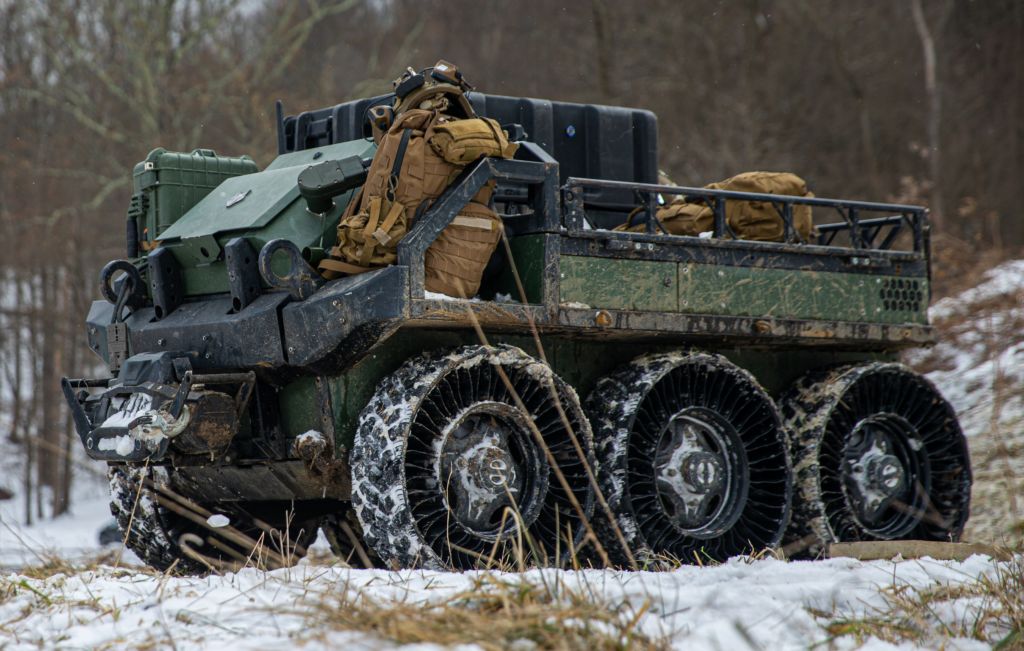
Hunter WOLF uses a compact 6×6 layout with the power unit at the front and a flat cargo platform extending through the centre and rear. Six Michelin non-pneumatic Tweel wheels avoid conventional pneumatic tyre failures. The steering and drive system provide pivot-turn behaviour resembling a tracked vehicle while retaining the maintenance advantages of wheels.
The platform was designed to move on narrow trails, steep slopes, and in dense vegetation while accompanying dismounted troops. The earlier published configuration measured approximately 2.3 m long, 1.4 m wide, and 1.17 m high, with a curb weight of about 1,100 kg. Later manufacturer material claims a payload exceeding 2,200 lb, indicating that published figures may describe different development configurations.
Hybrid power system
A series-hybrid electric drivetrain provides propulsion and a low-signature operating mode. Internal fuel can support more than 300 km of travel, while the manufacturer describes more than 200 miles of off-road travel for a fully loaded vehicle. Optional additional fuel can extend range substantially, but range varies with payload, terrain, and configuration.
The electrical system also allows Hunter WOLF to operate as a mobile generator. Manufacturer material describes approximately 15 kW of available generation for modular payloads and field equipment. The hybrid arrangement can recharge the electrical system while moving rather than requiring the vehicle to stop solely for charging.
Control and autonomy
The vehicle uses a modular open-systems architecture and a non-proprietary interface compatible with the Robot Operating System. This permits different autonomy kits and mission payloads to be installed without redesigning the base vehicle. Demonstrated functions include operator control, follow-me operation, and operation with kits intended for environments where reliable satellite navigation is unavailable.
Mission payloads
The flat cargo area and attachment points support equipment transport and modular payloads. Demonstrated or proposed kits include dual stretchers for casualty evacuation, communications relay equipment, intelligence and surveillance sensors, route-clearance tools, a mine roller, a lightweight bridge, and a backhoe or loader.
Remote weapon stations carrying machine guns have also been presented as optional payloads. A weapon station is not inherent to the base logistics vehicle, and installation would depend on the customer, mission configuration, and applicable control arrangements.
Program status
Hunter WOLF remains an actively evaluated multi-mission robotic platform. Its use in Army training and Transformation in Contact events provides operational feedback on mobility, sustainment, payload integration, and soldier workload. The available sources do not establish a large U.S. Army production order or a general service-entry date.
Variants and configurations
- SMET-oriented Hunter WOLF — the earlier logistics configuration developed for the Squad Multipurpose Equipment Transport requirement and publicly unveiled in 2017.
- Hunter WOLF 4.0 — a later configuration used in 2026 Army training and Ground Optionally Autonomous Transport activities.
- Modular mission configurations — payload-specific arrangements for logistics, casualty evacuation, communications, surveillance, engineering support, autonomy testing, or a remote weapon station.
Specifications (Hunter WOLF)
General characteristics
- Type: modular unmanned ground vehicle
- Manufacturer: HDT Global; subsequently BLADE
- Drive configuration: 6×6 wheeled
- Length: approximately 2.3 m for the published earlier configuration
- Width: approximately 1.4 m for the published earlier configuration
- Height: approximately 1.17 m for the published earlier configuration
- Curb weight: approximately 1,100 kg for the published earlier configuration
- Payload: more than 1,000 kg claimed for the current product; earlier published data listed up to 450 kg
- Powerplant: diesel-electric series-hybrid drivetrain
- Wheels: six non-pneumatic Michelin Tweels
Performance and power
- Internal-fuel range: more than 300 km; manufacturer material also claims more than 200 miles off road
- Endurance: up to approximately 120 hours with internal fuel, depending on mission
- Exportable power: up to approximately 15 kW according to manufacturer material
 Argentina
 Armenia
 Australia
 Austria
 Austria-Hungary
 Belgium
 Brazil
 United Kingdom
 Brunei
 Bulgaria
 Canada
 Chile
Chile China
China Colonial America
 Colombia
 Confederate States
 Croatia
 Czech
Czech Denmark
 Egypt
Egypt Finland
 France
 Georgia
 Germany
 German Imperial
 Greece
 Holland
 Hungary
 India
India Indonesia
 Iran
Iran Iraq
Iraq Ireland
 Israel
 Italy
Italy Japan
Japan Japan (1940)
 Jordan
 Kingdom of Italy
 Malaysia
 Mexico
 Myanmar
 Nazi Germany
 Netherlands
 New Zealand
 North Korea
 Norway
 Pakistan
 Peru
Peru Philippines
 Poland
 Portugal
 Prussia
 Romania
 Russia
 Saudi Arabia
 Serbia
 Singapore
 Slovakia
 Slovenia
 South Africa
 South Korea
 Soviet Union
 Spain
Spain Sweden
 Switzerland
 Syria
Syria Taiwan
 Thailand
 Turkey
 UAE
UAE Ukraine
 Vietnam
 Yugoslavia