
History
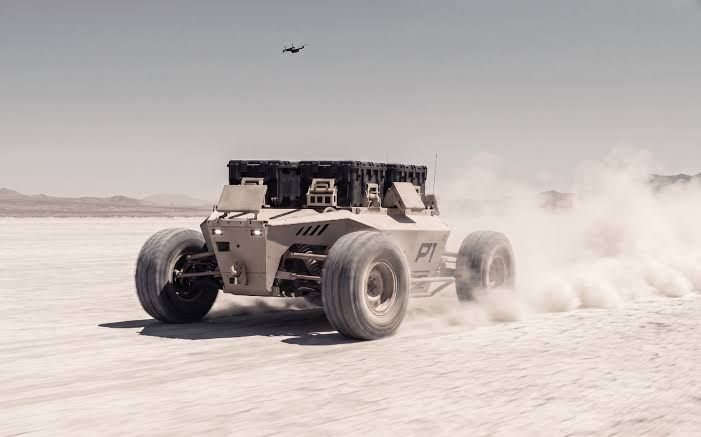
The Hypercraft Razorback is a medium-class unmanned ground vehicle developed in the United States as a software-defined tactical platform for autonomous mobility, logistics, electrical power export, communications, and mission-payload integration. Hypercraft describes the vehicle as a mobile operations and energy node rather than a conventional crewed truck.
Its diesel hybrid-electric drivetrain combines long road range with battery-only movement, while the platform can export up to 38 kW of electrical power for equipment such as radar, drone and vehicle chargers, command posts, electronic-warfare systems, and other mission payloads. The vehicle is designed around an open software and electrical architecture intended to allow different autonomy systems, sensors, and effectors to be integrated without redesigning the basic chassis.
Hypercraft publicly demonstrated a physical Razorback at South Valley Regional Airport in West Jordan, Utah, on 7 August 2026. This public demonstration confirms that a completed Razorback test vehicle existed in 2026.
Development and public rollout
Hypercraft announced Razorback as a next-generation autonomous UGV before the August 2026 demonstration. In its launch announcement, the company presented the platform as a flexible unmanned vehicle for high-consequence environments, built around a diesel hybrid-electric powertrain and a software-defined architecture.
At the 7 August 2026 briefing, Hypercraft showed an operational vehicle together with a bare frame and drivetrain. The live vehicle demonstration included battery-only running, operation with the diesel range extender engaged, rapid acceleration, immediate braking, and crab-walking. The TechBuzz briefing report described the event as the company's most public step in its move toward a dedicated defense-platform business.
A subsequent Defence Blog report characterized Razorback as a potential unmanned replacement for some military truck functions. The available sources do not establish a production contract, service-entry date, fielded military operator, or quantity ordered.
Design
Vehicle layout and mobility
Razorback uses a low, unmanned four-wheel chassis with four-wheel hydraulic steering. Hypercraft lists overall dimensions of approximately 4.06 m (160 in) long, 2.32 m (91.5 in) wide, and 1.17 m (46 in) high, with a vehicle weight of about 2,041 kg (4,500 lb). The cargo deck measures about 1.52 by 3.05 m (60 by 120 in), and the vehicle uses 0.89 m (35 in) tires.
The drivetrain has four electric traction motors with torque vectoring and a combined rating of 300 hp. A diesel auxiliary power unit acts as a range extender, with Hypercraft listing 50 kW at 2,500 rpm and 95 kW peak output. Energy storage is a 400 V, 42 kWh battery. The hybrid arrangement allows battery-only movement for reduced acoustic signature and uses the diesel system to extend endurance.
Hypercraft gives a limited top speed of 97 km/h (60 mph), a range of about 450 km (280 mi) with payload, and a payload capacity of about 1,089 kg (2,400 lb). The four-wheel steering system also permits lateral crab movement, which was demonstrated publicly in August 2026.
Software and autonomy architecture
The vehicle is built around Hypercraft's Carbon software architecture. The company describes Carbon as a common operating layer based on open standards and defense-oriented interfaces, intended to separate vehicle hardware from autonomy software, sensors, and mission applications. Its central-zonal electrical architecture uses centralized high-performance computing and a vehicle operating system that can receive software upgrades and additional applications.
Hypercraft also describes the platform as using a Modular Open Systems Approach, with interfaces intended to support customer maintenance, development, and the integration of third-party software. Steering, braking, and throttle are controlled through an autonomy-ready drive-by-wire system with associated safety functions. The TechBuzz report described the demonstrated configuration as SAE Level 4 autonomous, while Hypercraft's own Razorback product page emphasizes that the drive-by-wire and software layers are designed to accept different autonomy platforms.
Electrical power and tactical microgrid
A central feature of Razorback is its ability to export up to 38 kW of electrical power. Hypercraft proposes using this capacity to support forward command posts, intelligence and surveillance equipment, electronic-warfare nodes, drone and vehicle charging, directed-energy systems, and other electrically demanding payloads. The company also describes a tactical microgrid concept in which multiple Razorback vehicles can interconnect as distributed power nodes.
The manufacturer's listed export interfaces include a NATO-M connection, a STANAG 4074 500 A interface, 28 V screw terminals rated for 300 to 500 A, a two-pin 150 A MIL-DTL-5015 connector, three-phase outputs, USB and Ethernet connections in DTL-38999 form, a CAN breakout, and high- and low-voltage disconnects. The specification also lists a generator emergency stop and protected three-phase circuits.
Mission payloads
Hypercraft presents Razorback as a common carrier for several mission sets rather than as a single fixed-role vehicle. These include contested logistics, mobile export power, counter-UAS work, communications relay, electronic warfare, intelligence and surveillance, and terrain-denial tasks. The open deck and software architecture are intended to accept different sensors and effectors, but the available sources do not show that every proposed payload has completed qualification.
For counter-UAS work, Hypercraft has shown integration with Fortem Technologies. The described configuration combines vehicle-supplied electrical power with radar and an interceptor payload to create a mobile counter-drone node. The August 2026 briefing also presented Fortem's FireThorn interceptor as a Razorback-compatible payload, but FireThorn is a separate weapon system and is not part of the basic vehicle specification.
Program status
As of August 2026, Razorback had reached the stage of a publicly demonstrated physical vehicle. Hypercraft was promoting it for defense applications and for integration with partner autonomy and mission systems. The available evidence supports prototype or demonstrator status, but does not confirm serial production, military acceptance, operational deployment, or an established operator fleet.
Specifications (Hypercraft Razorback)
General characteristics
- Type: Software-defined unmanned ground vehicle
- Length: approximately 4.06 m (160 in)
- Width: approximately 2.32 m (91.5 in)
- Height: approximately 1.17 m (46 in)
- Weight: approximately 2,041 kg (4,500 lb)
- Payload: approximately 1,089 kg (2,400 lb)
- Deck mounting area: approximately 1.52 by 3.05 m (60 by 120 in)
- Tire size: approximately 0.89 m (35 in)
Powertrain and electrical system
- Powertrain: Diesel hybrid-electric
- Traction: Four electric motors with torque vectoring
- Drive-system output: 300 hp
- Auxiliary power unit: 50 kW at 2,500 rpm, 95 kW peak
- Battery: 400 V, 42 kWh
- Exportable electrical power: 38 kW
- Steering: Four-wheel hydraulic steering
- Brakes: SAHR and hydraulic service brakes
Performance
- Maximum speed: limited to approximately 97 km/h (60 mph)
- Range with payload: approximately 450 km (280 mi)
 Argentina
 Armenia
 Australia
 Austria
 Austria-Hungary
 Belgium
 Brazil
 United Kingdom
 Brunei
 Bulgaria
 Canada
 Chile
Chile China
China Colonial America
 Colombia
 Confederate States
 Croatia
 Czech
Czech Denmark
 Egypt
Egypt Finland
 France
 Georgia
 Germany
 German Imperial
 Greece
 Holland
 Hungary
 India
India Indonesia
 Iran
Iran Iraq
Iraq Ireland
 Israel
 Italy
Italy Japan
Japan Japan (1940)
 Jordan
 Kingdom of Italy
 Malaysia
 Mexico
 Myanmar
 Nazi Germany
 Netherlands
 New Zealand
 North Korea
 Norway
 Pakistan
 Peru
Peru Philippines
 Poland
 Portugal
 Prussia
 Romania
 Russia
 Saudi Arabia
 Serbia
 Singapore
 Slovakia
 Slovenia
 South Africa
 South Korea
 Soviet Union
 Spain
Spain Sweden
 Switzerland
 Syria
Syria Taiwan
 Thailand
 Turkey
 UAE
UAE Ukraine
 Vietnam
 Yugoslavia